Kiki’s Delivery Service

Studio Ghibli films are a very special kind of magical, and Kiki’s Delivery Service is no exception. One of Hayao Miyazaki’s early films, it is very much the embodiment of the magical realism genre that so many of his films incorporate. In the world of this film, magic and witches exist. They are rare enough to remark on but are still commonplace enough that everyone recognises one when they see one. Much like a good plumber, I suppose. The film follows the titular character’s journey as she leaves home for the first time.
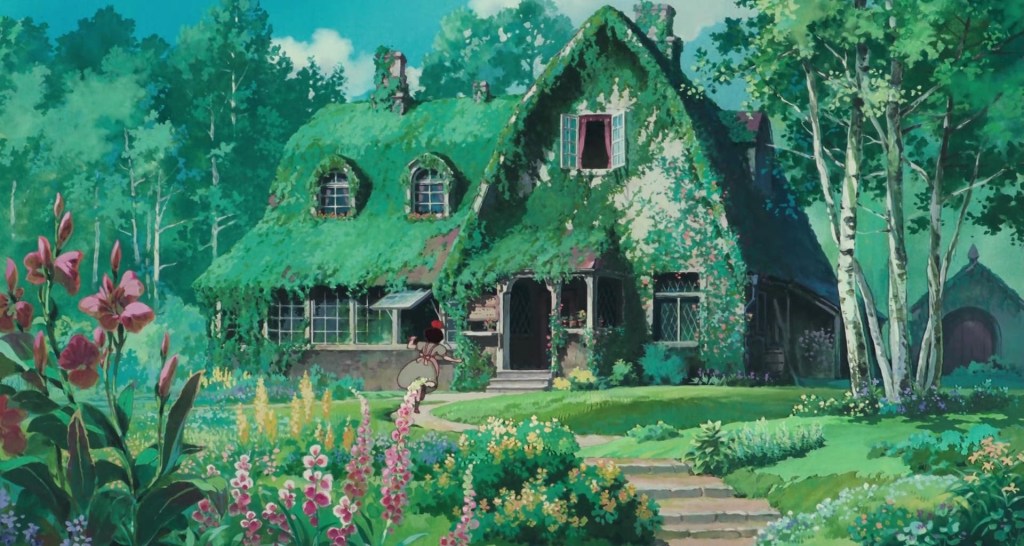
As with every single hand drawn Studio Ghibli film (no, I’m not exaggerating), the animation and the score are things of beauty. Many of Miyazaki’s films are based on real locations. For example, the town in Castle in the Sky, the first official Ghibli film, was largely inspired by the Welsh mining towns that Miyazaki visited in the eighties, during the miner’s strikes. He was inspired by towns in Sweden in this case, and the style of the town in the film is gorgeous. It is busy and bustling, very different from the quiet woodland house that Kiki comes from. Joe Hisaishi has scored just about every Ghibli film in existence and he’s at his very best here, with playful little numbers mixed in with the sweeping, soaring music that he’s most famous for.

These kinds of films are very much defined by the smaller moments within and the friends we meet along the way. This film is about discovering one’s own independence, and the struggles that come with that. Kiki is a young witch excited to find a new town and make her mark on the world, along with her talking cat, Jiji. Jiji also goes on his own little adventure independent from Kiki, getting to know and wooing a sweet little cat that lives near the bakery. Jiji acts as Kiki’s conscience at times during the film, and seeing him grow up is another reflection of Kiki’s own journey. While he is the active pursuer in his relationship, Kiki is very much the pursued by a boy from town seeking to be her friend, Tombo. She doesn’t want anything to do with him despite his efforts to befriend her and to take an interest in her, which is perhaps motivated by her desire to be independent. While she earns her keep at the bakery in return for a room, there is no transactional benefit to a friendship with Tombo.

Another key theme within the film is that of kindness. Like pretty much all of the films created by Studio Ghibli, there is a pervasive and constant theme of kindness, sincerity and support. Kiki is surrounded by kind people who want to help her, not for any personal gain, not to use her powers for themselves, but simply out of the goodness of their hearts. From the bakers, Osono and Fukuo, who take in Kiki like their own child; to Ursula, a student who struggles with artist’s block at times and treats Kiki like a younger sister, Kiki is surrounded by kindness. It’s important, then, that we see Kiki struggle with independence, with finding her place in the world. This is a journey that she was so keen to undertake, she’s found friends and people who love and she loves back, but despite that support system she still struggles. It’s a natural part of life, something that Kiki is able to overcome with her own strength as well as the support of others.

Speaking of kindness, I’m not sure there’s a character that boils my blood more than that ungrateful child who gets annoyed at her grandma baking her a pie. Kiki goes to so much effort to help cooking it, as she does with all her ventures so far in the story. She flies down to return the pacifier to the baby of a bakery customer, she spends hours ensuring that her delivery of the small toy cat goes well, and yet here she’s rewarded with a door slammed in her face. It’s her journey in the rain that gives her a cold too, causing her to miss the party that Tombo had invited her to. This is her first true taste of adversity, and she really struggles with it, as any child would.
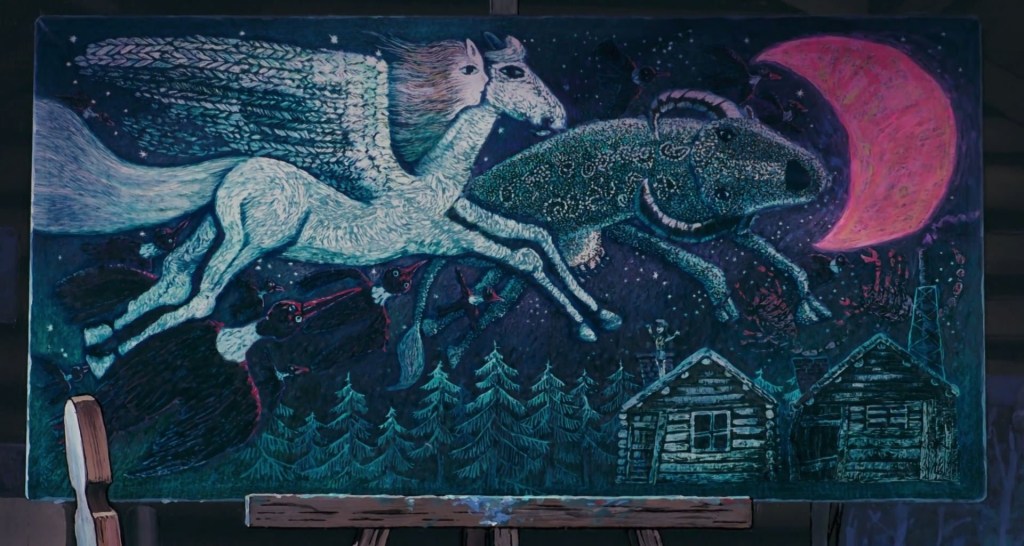
I adore Ursula’s painting almost as much as Kiki is transfixed by it. I’d quite like a replica on my wall, if such an item exists. Anyway, Ursula says that she’s thought of painting over it many times, until she saw Kiki again and wanted her to model for the girl’s face. She’s the one who first thinks that Kiki is suffering from a form of artist’s block. Of course, the crux of the film is about that. She says to Ursula “without even thinking about it, I used to be able to fly. Now, I can’t even begin to remember how I ever used to do it.” Sound familiar? Not the flying part, obviously, but the difficulty in doing something that used to come so naturally. There is nothing in particular that triggers it, it just happens one day. She can’t fly, she can’t understand Jiji, she can’t motivate herself. Ursula says one of the things that helps her overcome it is just to stop forcing herself and take a break. She doesn’t give up, as shown by the fact that she doesn’t paint over her painting, but she takes breaks from it. She gives herself the time she needs, or waits for an opportunity – such as when Kiki came along. It is a similar type of opportunity that inspires Kiki to fly again.
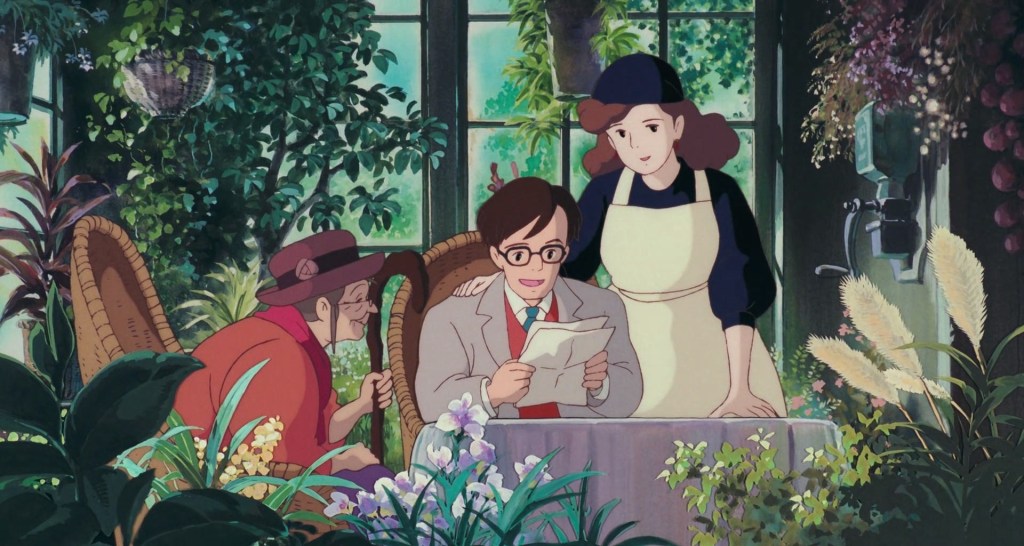
I love the way the film ends. I won’t go into detail for those that haven’t seen it, but over the closing credits (as Ghibli films so often end) we see Kiki’s family receive a letter from her, talking about her adventure and her life since leaving home. It’s a reflection on her roots and her beginnings. Despite seeing how far Kiki has come since leaving home, it also invokes a cyclical feeling. Kiki was so confident and eager to leave home in the beginning of the film, I think the fact that she’s found a new home is not lost on her either and she’s able to reflect on her journey so far. I’ve always loved that ability to quietly reflect on a film during the credits, I will usually stay until the end while at the cinema, but Studio Ghibli providing us with a kind of epilogue to watch during the credits works just as well.

It seems like I’ve got in the habit of writing slightly related ramblings at the end of my discussions. I wrote a little about the lack of cynicism in this film, so here’s some more thoughts on that topic. I feel like we’re in a very cynical age of media at the moment. America’s Obama-era optimism that was so prevalent in their productions throughout the 2010s has completely died now. So many of the most popular films cheap, artless cash grabs or struggle with the concept of hope and optimism. Even if you look at the cultural phenomenon that was Barbie, I think overall it highlights the struggles of simply living in this world. And no matter how many jokes you make about the capitalist hellscape in which we live, we’re not going to forget how much money the companies that made that film are worth.

Also, an extra, extra side note: I was looking through the top ten highest grossing films worldwide post-Obama – in 2018 and 2019, only one film out of the twenty total was not a sequel or part of an existing franchise – Bohemian Rhapsody. I don’t particularly want to think about that film more than I have to (it’s one of the worst I’ve seen in the cinema) but even that is based off someone’s life, you could make an argument for that not being original too. Following that, there are only two more films that are completely original – Tenet and Oppenheimer. Like him or not, Christopher Nolan has a way of capturing people.
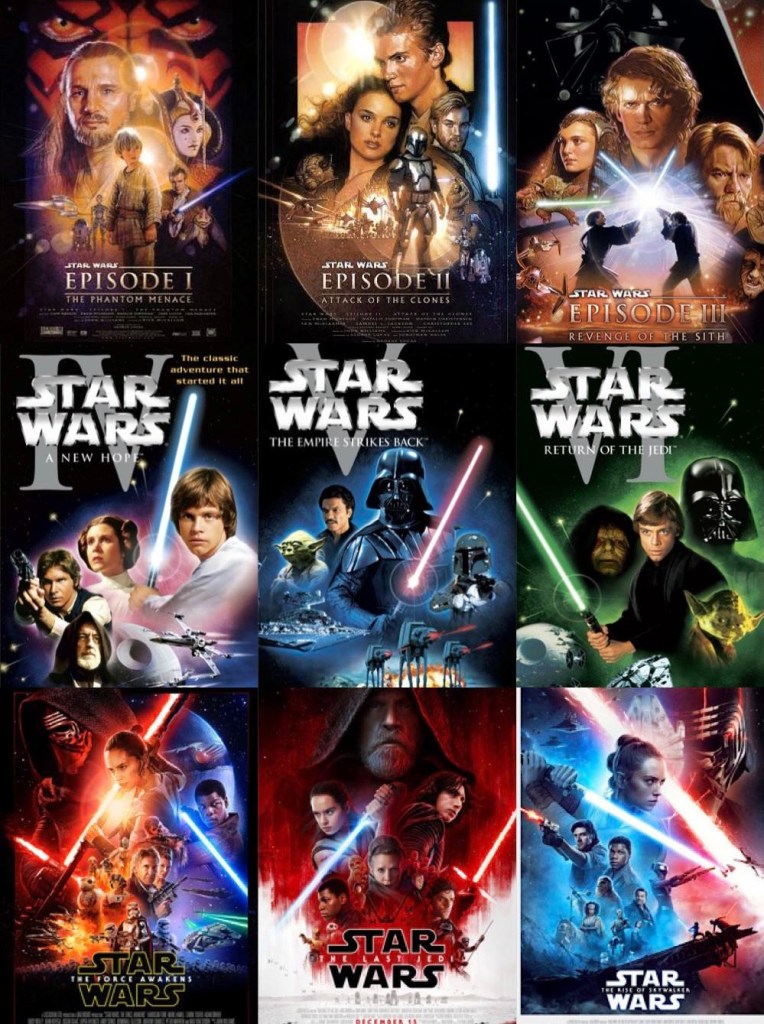
A Definitive Ranking of Every Star Wars Film

To celebrate Star Wars Day, here comes my ranking of every Star Wars film. The ones that matter anyway, all the live action ones. Funnily enough, the film version of The Clone Wars was actually the first film of the franchise that I ever watched. I was hardly off to a great start, was I? But we’re not thinking about that one today. Without further ado, let’s start with the worst of the bunch.

XI: The Rise of Skywalker

I’ve only seen this once, when it first came out at the cinema, and I’d quite like to keep it that way. Goodness gracious, what an absolute shambles. The plot lurches from point to point, from revelation to revelation, none of which are very interesting or surprising. Palpatine returned! Hux is the spy! Rey and Kylo are in love? Finn has something to say! Will he ever say it? No. Because this film was written by committee, by people with no love or creativity. Half of the creative decisions seem designed to bury The Last Jedi into the dirt due to the mixed fan reaction. Rose turns up for a moment just to say that she’d better sit this one out. She might as well have winked at the camera and help up a sign saying ‘I was a bad choice from the previous director, who is an idiot’. What a disgustingly cowardly end to a franchise that has inspired and thrilled so many millions of people. They even retconned the most interesting creative decision the sequel trilogy made, which was to make Rey a nobody who is unrelated to any other character. That’s what the Force is about, right? That all of us can feel it, not that you can only use it if you’re part of like three families in the universe.

X: Attack of the Clones

The battle for last place was a fierce one, but this ultimately just missed out. From the dreadful over-reliance on special effects and green screen that have aged like milk in the Sahara, to the shockingly bad dialogue delivered by people who clearly couldn’t care less, this film is a mess from start to finish. I know the story of Star Wars is hard to escape from the general consciousness, but the ‘plot’ to create a convenient clone army that will go on to destroy their masters seems incredibly obvious in retrospect. Anakin also should have gone to counselling or something, especially after using a Tusken Raider camp as his own personal rage room. I do like the parallel at the end of seeing the vast clone army whilst hearing the imperial march, though. Good choice.

IX: The Phantom Menace

I’ve seen lots of people praise the prequel trilogy by calling it a good story, but poorly told. I’m not sure that I could disagree more. The opening crawl is about a trade route dispute, for crying out loud. This trilogy was doomed from the start. Anakin never should have been shown as an annoying child. The Jedi should never have been portrayed as stupid and bureaucratic as they were. Everything in moderation, and all that. I maintain that starting the trilogy at the outbreak of the so called ‘Clone Wars’, watching Anakin fall deeper into the dark side as the tireless battle wears on and eventually having him manipulated into becoming the Emperor’s puppet would have been far more interesting as a concept. It’s not even too far from the actual story.

VIII: Rogue One

It’s just so bland. It looks gorgeous, the cast are great, the idea behind the story is kind of fun, but it all just falls flat. Some things are better left to the imagination, and while it was thrilling to watch the daring plot on Scarif play out the first time, it really doesn’t seem that great when rewatching. All of the characters are cardboard cutouts who look cool and say cool things, but they really don’t leave any kind of lasting impact. One day, somehow, I’ll understand what the point of Saw Gerrera was. This is another film in the franchise that clearly had a lot of work behind the scenes between filming and the final cut, and yet again it yields a kind of disappointing end result.

VI: Solo

I think this one is simply a matter of personal preference. It’s as unnecessary to the greater story as Rogue One, but I thought the internal events of the film were more fun to watch and I cared about the characters more. I also kind of appreciate the audacity in how they try to explain the origin of things from the original trilogy. Han ‘Solo’ because he’s travelling solo. The blaster that everyone knows and loves (?) was just given to him by someone. What’s a parsec? Who cares. Like all of the Disney era films though, the special (and practical) effects are absolutely fantastic. I thought Alden Ehrenreich was good too, in a rather thankless role.

VI: The Revenge of the Sith

Like the rest of the prequel trilogy, the story is a hot mess that leaps from point to point with no real development to be had. Anakin goes from someone who is a bit doubtful of the intentions of the Jedi order to mass-murdering children with no real trigger point. Watch it again, without the nostalgia goggles on, and tell me if any of his character development feels organic. Without referencing season 5, episode 753 of The Clone Wars TV series, too. It’s very dramatic though, and the dialogue is a definite improvement over the previous two films. The idea for Anakin’s fall was always a good one, but the execution was flawed from day one of this trilogy.

V: The Force Awakens

If the prequel trilogy was ‘good idea, badly executed’ then the best summary for the sequel trilogy (well, this and episode VIII) would be ‘kind of ok idea, brilliantly executed’. The parallels to A New Hope were clearly intentional and designed to remind us fondly of the original trilogy, though it does go way too far at times. I sound like a broken record, but the effects are fantastic too. A lot of love was poured into this film by the whole production team. The trailer was oh so good too, quite possibly the best film trailer ever made. I do feel like this film was one of the first to highlight the ever-dwindling level of media literacy in the general public. For the last time, Rey is not a Mary Sue for being able to defeat Kylo Ren at the end. He had just been shot with Chewbacca’s cross-bow weapon, which was shown about four times in the film to have devastatingly explosive power. We see him bleeding from the wound. We see him devastated at having killed his own father. The only reason the battle ended is because the planet was literally splitting in two, which separated him and Rey.

IV: The Return of the Jedi

The beginning and end make up for the really kind of rubbish middle act. We see a confident and self-assured Luke after his defeat by Vader’s hand at the end of the previous film, and in the end good triumphs over evil. The less said about the Ewoks in the middle, the better though. I read somewhere that they were originally supposed to be Wookies, which would have made far more sense in the film. While Star Wars has always been a franchise for kids first and foremost, this was just a little bit too silly. The last 15 minutes or so is arguably the best part of the entire franchise though, from Luke’s surrender at the second Death Star to Vader’s redemption and ultimate victory for the rebels.

III: A New Hope

Where it all began, and still endlessly watchable to this day. It’s a classic underdog story, but in space! With aliens! And loveable cowboys and scary robot men and princesses and farm boys! It’s incredibly charming and really such a good story. It’s hard to go wrong with the classics, and this is no exception. It’s hard to say much more about arguably the most famous film ever made.

II: The Last Jedi

This is probably my favourite in the franchise, though I will concede it’s not the best (was anyone really expecting anything else to be number one?). Having said that, this film is so much fun for how much it tries to experiment with the established Star Wars formula. Not everything really comes off, but my goodness it gets points for trying. I loved the development of Finn from someone who only really cares about Rey to someone who learns to be the hero he wants to be. ‘That’s how we’re gonna win. Not by fighting what we hate. But saving what we love’. Yes, the line is a little clunky, but isn’t this the central thesis of the franchise as a whole? It’s about the battle of good and evil, but also doing it for the right reasons. Not for personal glory, not for revenge, but to save the people you care about. Finn was never going to destroy the battering ram with that flimsy speeder, it was literally breaking into pieces in the approach, but he was trying his suicide missing for selfish reasons, to be seen as a hero. I’ll save my deeper analysis for the inevitable full-length post on the film, but I still think it’s great.

I: The Empire Strikes Back

Surprise, surprise. This is widely regarded as one of the best films ever made for good reason. It was a bold and daring follow up to something as famous as A New Hope, but it all works. Splitting up Luke from the rest of the gang, in hindsight, was such a risk as well. People loved this rag-tag group of rebels, but splitting them up allows them all to develop and grow throughout the film. Luke starts his journey to become a Jedi, to become a man, and his relationship with Yoda is so much fun to watch. Seeing all these different planets was great fun too, it feels like such an expansion to the universe after spending most of the previous film on either Tattooine or Yavin 4. It’s everything a sequel should be, and the culmination of the film with a battle between Luke and Darth Vader is probably the most thrilling light sabre battle in the entire franchise.

So there you have it, my ranking of the most famous film franchise in history. Let me know your thoughts, I’d love to hear them!

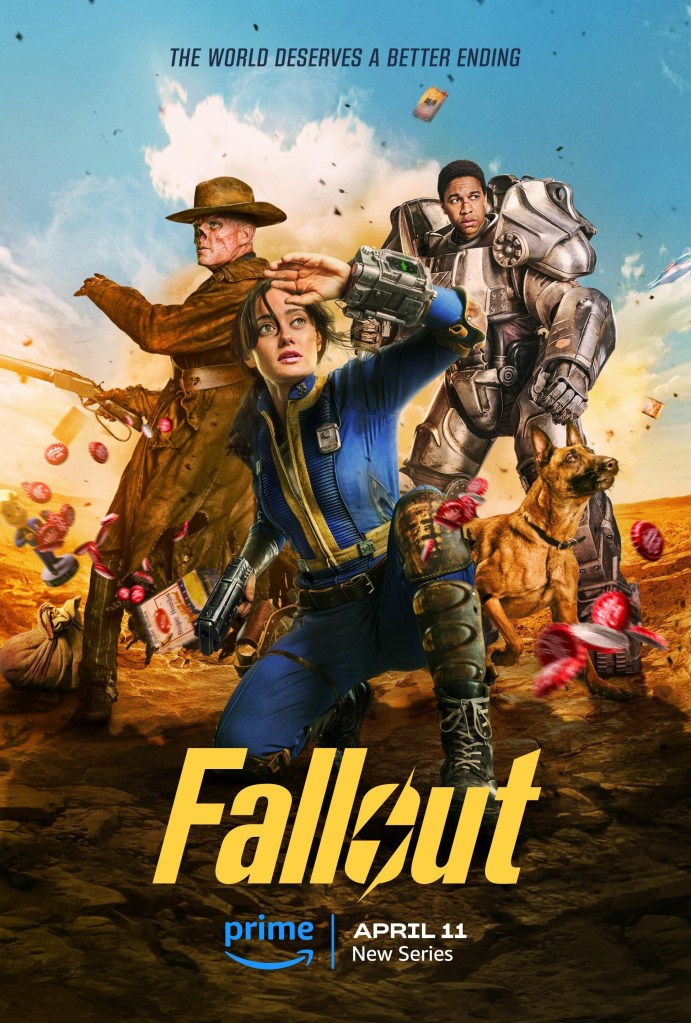
First Impressions – Fallout

Continuing my series of only looking at the first episode of a show, we move on now to Fallout, which came out just a few weeks ago. Based off the video game series of the same name (which I’ve never played), it’s very much a post-apocalyptic story that hearkens back to the old sci-fi traditions and stories of the mid-twentieth century. Starring Ella Purnell, Aaron Moten and the always delightful Walton Goggins, the show follows three people over two hundred years after nuclear war has ravaged the Earth.

It was a bold choice to launch into a dual narrative (three narratives, if the last five minutes of the episode are anything to go by) and I think this is probably the weakest part of the episode. The prologue is stunning and gripped me instantly. It launches us into this post-war but alternative world with a TV cowboy entertaining a birthday party under the looming threat of a nuclear holocaust. After that, we’re greeted with a huge jump in time to a bunker with kooky characters, weird outfits and a shade too many incest jokes, if truth be told (I watched the first half with my parents before they decided it probably wasn’t for them). It’s weird and fun in a way that drew me right in, setting up some really interesting characters and concepts. However, we’re abruptly launched into a scene that’s far less fun and colourful, in the outside world that’s been ravaged by the nuclear fallout. It feels like a completely different show within the first episode, and while players of the games may think this works well, I thought it was just a little too jarring. Personal preference perhaps, but I’d have preferred an entire episode focussing on Lucy MacLean before we start to learn about other characters. That’s not to say the other narrative doesn’t hold promise, but it certainly hasn’t left the same impression of that whirlwind first half an episode. However, the epilogue of the episode has certainly piqued my interest again.

Crucially for an adaptation like this, I didn’t feel particularly lost by any of the plot points or jargon. It’s a very tricky thing for a first episode to do when it’s based off an existing piece of media – how to entice people new to the franchise without dumbing it down too much for old hats. It doesn’t feel like a lot of adaptations, where a lot of the scenes are akin to an inside joke and you just end up sitting there not entirely sure whether you should be laughing or not. Everything feels very organic here, we get lots of nice establishing shots in the first part showing us around the underground bunker. Our self-narrated introduction to Lucy is a nicely done touch of exposition too, where she’s talking herself up to justify why she should be chosen for marriage. Not only do we get a glimpse into her world, we also get a glimpse into the world. It’s a really well delivered set up to the show.

As you’d hope for in a show based on what I believe to be a fairly open-world, or at least open-ended, video game, there’s no telling where we’ll end up going over the next few episodes, or indeed across the possible seasons to come. We get very neat introductions to who I’m sure will end up being the three main protagonists – Purnell’s Lucy, Moten’s Maximus and Goggins’s Cooper Howard. Of these three, and as I’ve already said, Lucy’s is the most well-rounded by far, and Cooper’s adds a nice dollop of mystery to the whole affair – how does a handsome cowboy end up still alive 219 years later, sans nose?

It feels like a crime that I’ve barely focussed on that prologue, but that’s because I could write another thousand words on it. I’ll try to restrain myself though. It’s a truly fantastic introduction to the show and hooks you in instantly. Line, sinker and everything else for that matter. It sets the scene for the rest of the action too, hearing and seeing the fears of a nuclear war and the reactions to the prospect. These range from lack of care, to wilful ignorance, to outright indignation at being forced to do your job with the end of the world nigh. You get to see the devastation and the desperation that permeates the rest of the episode, with one family disappearing down an underground bunker and another father being beaten for trying to follow. The image of Cooper throwing his daughter onto his horse and trying to outrun a mushroom cloud is somewhat haunting and helps to illustrate the sheer scale of what has happened. It’s an effective contrast of the development of humanity too, the overlap of the old world into the new.

On a final note, I really really really really HATE when all the episodes from a new series are released all at once. I fully and firmly believe that they completely destroy the majority of hype and interest that a new show can generate. Fallout first came out on the 10th April, and I can’t remember anyone really talking about it since about four days after that. Of course, here I am, but I’m sensible. Comparing the interest in any show to Attack on Titan (THE show which has launched anime back into the mainstream) is unfair, as that has perhaps been the most anticipated and talked about show in the last decade, but can you imagine if the final season had all come out in one go? You’d have a very clear divide in the binge watchers and the people who want to take their time, and various subsections within that. No one on this planet, other than the initial binge watchers, will be on the same wavelength. What’s Eren up to? Couldn’t tell you, mate, I watched it all three months ago. Think he’s a giant bone man. Spoilers, sorry. Wasn’t it wild when *that* happened though? Oh, you haven’t seen that bit. Oops.

It’s my belief that a part of the enjoyment of any show, or piece of media really, is the shared experience. Yes, you could make a pledge to watch it at a certain time with a certain group in order to mimic that weekly release schedule that seems to be dying a painful death, but I just can’t see how that benefits anyone. The anticipation of waiting two months from the first episode to that last would still be building here if they followed the weekly release timetable, but alas. It seems that I’m going to have to carry on the tiresome routine of asking a friend if they’ve seen said show, to asking how far in they are, to one of us trying to recall when they watched the most recent episode that both of us have watched and what happened in it. I’m tired.

Lady Bird

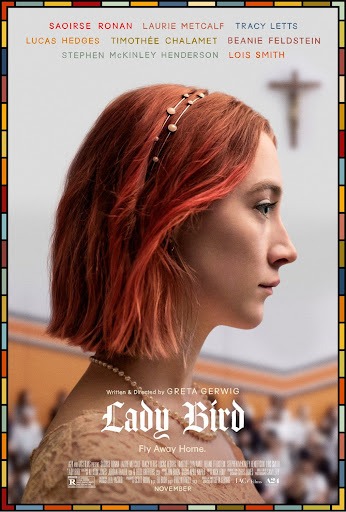
No pressure, to myself that is, but I think this is probably my favourite film, so I really hope I do it justice. I remember taking my sister to watch this at the cinema all the way back in 2018 and when we came out, we both knew it was a special film. I love coming of age, slice of life type films and Lady Bird fits into that template perfectly. Set during 2002 and 2003 in Sacramento, California (where director Greta Gerwig was born, more on that later), the film follows the titular Lady Bird (Christine) as she navigates her final year of high school.
Anyone who has even been near an English degree will have heard of Roland Barthes’s essay ‘The Death of the Author’. He argues that the biography and external context surrounding the author’s life and intention for writing something is ultimately irrelevant, it’s all about the reader’s interpretation and understanding. Barthes is wrong. I’ve simplified his argument so it’s easier to make my point (why doesn’t everyone do this?), but criticism is something multi-faceted and every-changing, so to reduce it down to ‘author irrelevant’ is ridiculously reductionist. No, we shouldn’t take the author’s word and intention as gospel, but when Gerwig was born and raised in Sacramento just a few years before the film was set, how can we ignore that? Lady Bird’s essay for her university applications is about Sacramento, and is even referred to as a love letter to the city. Lady Bird doesn’t intend it to be, but is told that it reads like love. While I don’t feel that the film is an autobiographical bildungsroman per se, it is clear to me that the film is a love letter to Sacramento, to the years of adolescence where we struggle more than ever to understand how we fit into the world. How better to illustrate that than a young woman who desperately wants to leave the place that she grew up, while also being deeply intwined with the people and roots of that place?
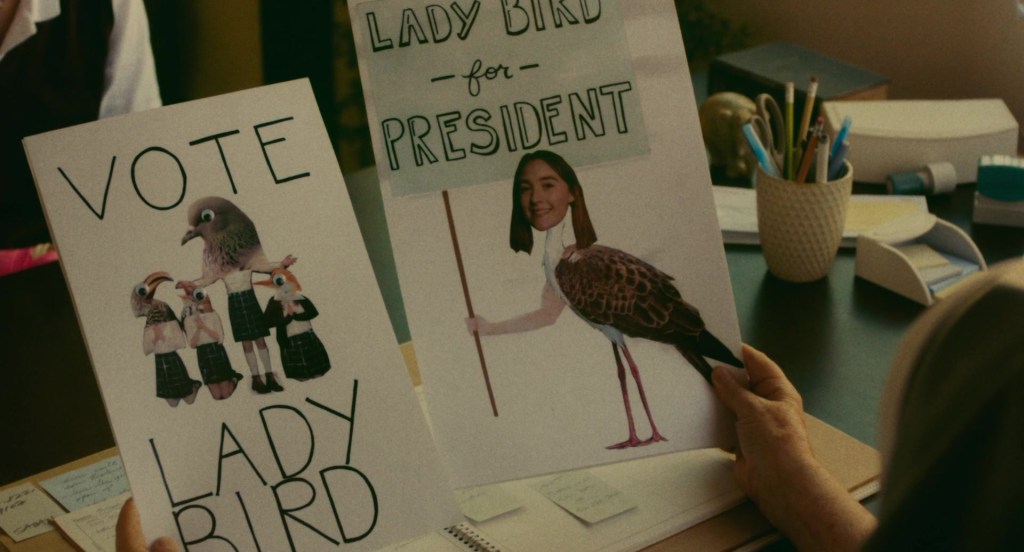
So much of the film is about Lady Bird’s identity, of her discovering how she fits into the world. Her name is chosen by herself, at least partly in defiance to a mother who criticises her at every turn. She experiments with different aspects of her personality throughout the film, from trying out the theatre to trying out being ‘cool’. The real Lady Bird, the real Christine, lies somewhere within this spectrum, something which she begins to discover at the end of the film. She realises that she wants to be with Julie instead of her new cool friends for Prom. She realises that moving to the other side of the continent brings a loneliness that she’s never had to confront before. She realises that despite everything, she appreciates what her mother, Marion, has done for her, even throughout their strained relationship on screen.


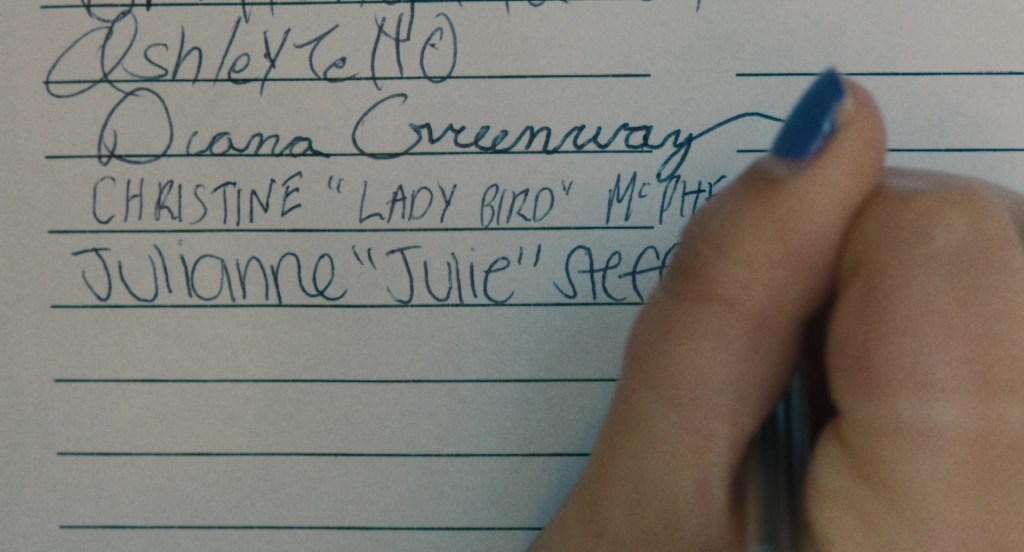
Unlike other commentators, I wouldn’t describe Lady Bird as selfish or self-absorbed, but she certainly behaves like it at time. At the beginning of the film, she signs her name as “Christine ‘Lady Bird’ McPherson for the school play, and then criticises her friend for putting “Julie” in quote marks as it it’s a shortened version of Julianne. It’s not the same, Lady Bird says, but why can’t it be? Lady Bird is not the only person who chooses to go by a different name from their birth certificate, but she wants to be. Throughout the film, she fluctuates between wanting to stand out and wanting to fit in. She wants to be seen and heard, to be admired in some ways, but she also wants to settle down with the cool kids and act like she doesn’t have a phone out of choice, not because her family can’t afford one. Yes, Kyle, I’m looking at you. You may have fooled everyone else when you called Lady Bird ‘good girl’ for not owning a government tracking device (mobile phone), but you haven’t fooled me. Timothée is as good as ever though; it took me several films he was in to see past the smug and edgy façade that he plays so well.
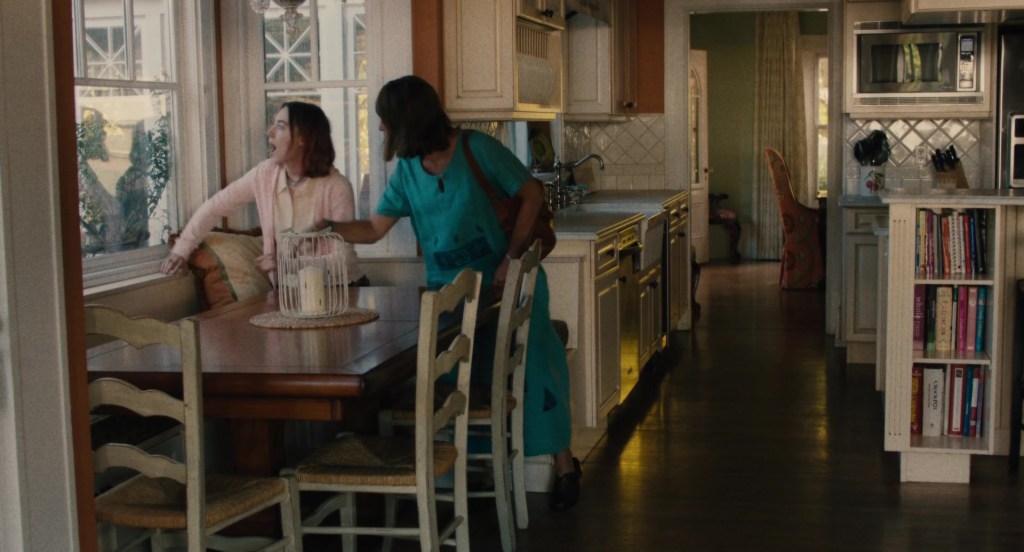
She talks about how she’s from ‘the wrong side of the tracks’ and she asks her dad to drop her off away from the school. She doesn’t do this maliciously, but she doesn’t think of how this will look and sound to the people she cares about. She takes her parents and her family for granted slightly, she knows that they have to be there and so does she, but she rarely thinks about how she can harm those closest to her. She’s not wrong at all in not being happy about the way her mother treats her, but we, the audience, can see deeper into why her mother treats her this way. I think Marion genuinely believes that criticising and pressuring her daughter at almost every turn will help build her character, will turn her into a stronger person. There is certainly some disappointment about how her own life has turned out and I imagine she thinks that by coming down hard on Lady Bird, she might turn out differently from herself. We also learn that her own mother was an abusive alcoholic – this is all we hear about that relationship, but it also sets us up to think about why she can be so harsh towards her daughter. I don’t feel like I’m being asked to condemn or condone what she does, simply to think about it. There’s a moment later in the film when her new friend realises that she’s lied about her house – Lady Bird wants to appear rich and sophisticated so lies about where she lives. Jenna doesn’t seem to even care about that, just about the fact that she’s lied. Don’t get me wrong, Jenna is never portrayed as a good friend to Lady Bird, but this just helps highlight that Lady Bird acting like someone that she’s not is not good for her.


I think it’s also important that three of the major supporting characters suffer somewhat with depression, to which Lady Bird is oblivious. One of my favourite scenes in the film is when they’re doing a drama warm up, playing to see who can be the first to make themselves cry, and within seconds Father Leviatch has broken down to tears. At first, it’s played for laughs, but this is one of the last times that we see him on screen. The next time we see him he’s talking to Lady Bird’s mother, who we know is a mental health nurse. This also puts into strong contrast the relationship that Marion has with her daughter compared to other people. So often throughout the film, we see her laughing and chatting amiably to other minor or unnamed characters, checking in on them and their lives. This ties in to the nature of her work, to care, but we also see her find this so hard to do with Lady Bird. Similarly, when Lady Bird goes to Julie’s for Prom she finds her friend crying, saying that nothing is really wrong, but some people aren’t built happy. Most importantly, Lady Bird’s father also suffers from depression. She doesn’t even realise that he’s struggling, she knows that he’s lost his job but he doesn’t want to concern her with his mental health struggle. Her mother uses it as a weapon to almost insult Lady Bird, to ask why she’s so self-centered that she didn’t even realise what her father is going through. This isn’t her fault though, because we also see her father try his best to support Lady Bird and to not let her see what he’s suffering through.
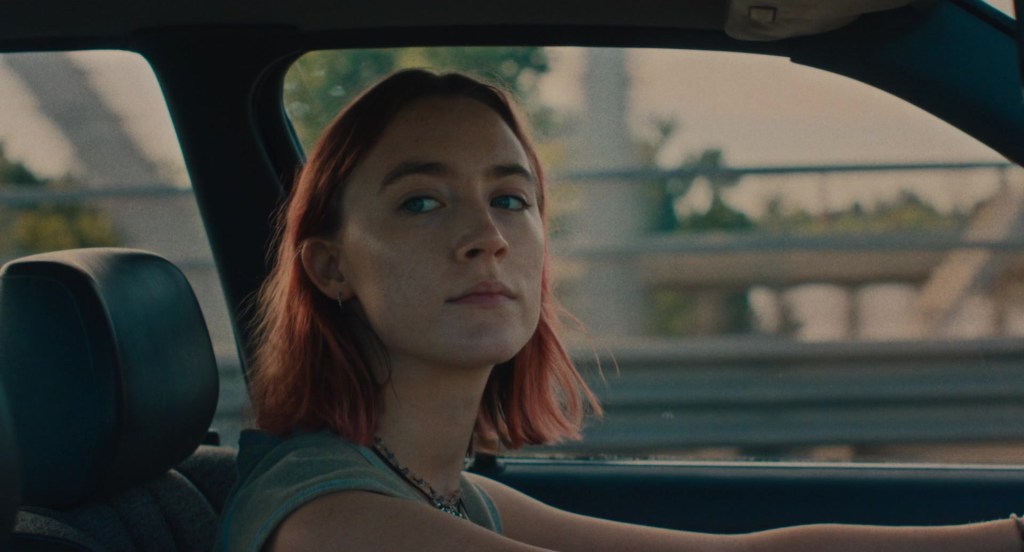
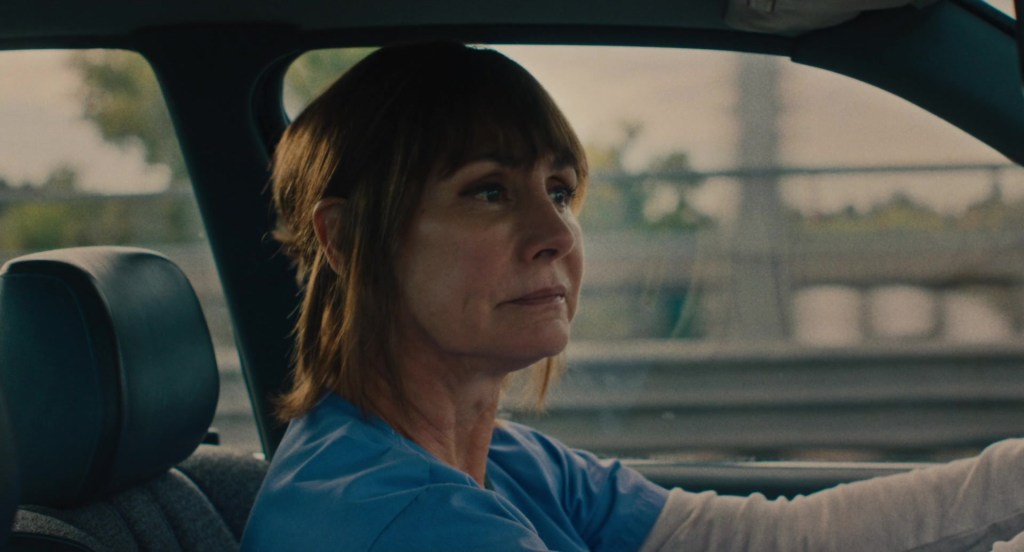
Laurie Metcalf does a spectacular job as Lady Bird’s mother. There’s a scene when they’re shopping together, picking out a dress for Prom, and they’re arguing before flipping a switch and immediately gushing together over a lovely dress they’ve both seen. I also love the scene after Lady Bird breaks up with Kyle. Her mother picks her up and immediately consoles her, then we see them partaking in one of their favourite activities together – dressing up and going to fancy house viewings. I think this highlights one of the most important things about Lady Bird’s mother – she is making a choice to be critical of Lady Bird, to talk down to her and to make her feel small. Marion, for whatever reason, seems to believe that this will help her daughter. However, Lady Bird is at her happiest when she is living for herself, and she reflects on this when she leaves the voicemail for her mum at the end of the film. I think Lady Bird understands the reasons for her mother’s behaviour more than the viewer ever could. That shared experience of driving around your home town, not for any particular purpose but just to take it in, is something that she realises brings them together. They have breathed the same air, driven on the same roads, lived under the same sky. It’s such an incredible relationship to watch play out on screen because so much goes unsaid and unspoken, and we leave them both at the beginning of the next chapter for both of them.


Marion is petty and vindictive however. When she finds out that Lady Bird is on the waitlist for a New York university, she chooses not to talk to her daughter for weeks, possibly months. Lady Bird begs her to talk, says all the terrible things about herself that her mother always told her, but she doesn’t yield. Perhaps this is one of the formative moments for her becoming a better mother. It’s one thing to tell your daughter that she’s not as good as she could be, but to have your daughter say it about herself… Marion’s stubbornness is the only thing that keeps her silent in my opinion, and it’s only when Lady Bird is finally out of reach that she breaks down and realises what she’s done, that the things she said are harmful to her daughter. It is only then that she wants to talk to her daughter, and from the letters that we glimpse at we know that she is starting to try to make amends. However, she still doesn’t give them to her daughter, it’s her husband that does this. It’s a step however, the first of very many you’d have thought, but Lady Bird isn’t the only one who can change. I love that we don’t get to see or hear all the details in these letters too. They are for Lady Bird, not for us.
I also love how many scenes in the film begin with dialogue between characters that aren’t on screen, only to cut into seeing said conversation. I’m sure there’s a name for this, there’s a name for everything, but it feels so warm and comforting. It’s a really wonderful visual story telling technique because Gerwig has made a clear choice about what we see on screen whilst we hear the dialogue. My favourite example of this is during Lady Bird’s, now Christine’s, voicemail to her mother. Voice messages in their very nature are meant to be heard later, they are very much not dialogue, but interspersing and cutting between shots of Christine and Marion driving along the same roads in Sacramento whilst we hear her contemplating her own experiences of the city is a really beautiful way to end the film.

Romeo + Juliet

I used to hate this film. Hate, hate, hate it. Looking back, I couldn’t really tell you why, other than that I was a snobby purist who believed that adaptations had to be as close to 100% accurate to the source material as possible. Look at that, seems like I can tell you exactly why. Anyway, I’ve grown up and reevaluated my elitist attitude, so here we are with an incredibly fun adaptation of a Shakespeare classic.

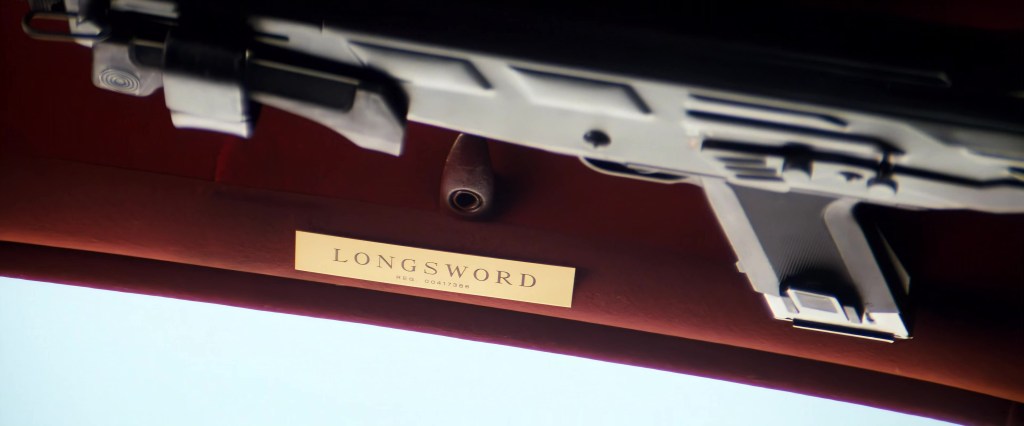
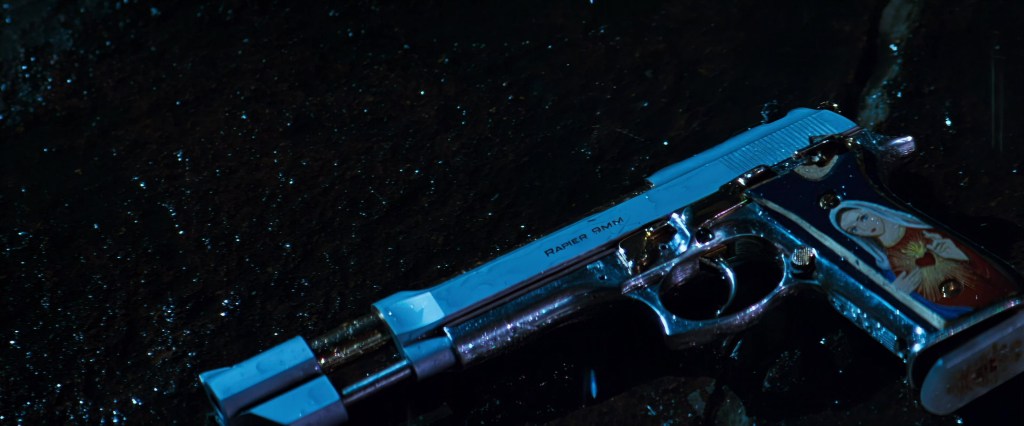
Almost all of the dialogue is lifted directly out of Shakespeare’s play which yields to certain logistical difficulties, all of which the film gets around simply by being earnestly and completely committed to itself. Instead of swords, the characters all carry guns which are branded with things like ‘Rapier’ and ‘Longsword’ (which is basically just a long gun, brilliant).

As silly as I used to think this was, it all works within the context of the film because once again, it is fully and sincerely committed to itself. There’s even a courier service called ‘Post Haste’. I feel like taking a very literal interpretation of how to adapt certain terms helps endear the film to the viewer. Some words and names are changed from the original – Friar Laurence becomes Father Laurence, Prince Escalus becomes Captain Prince for example, but these just help contextualise elements of the film for the modern viewer. If they had wielded guns and called them such, and if they had send the letter ‘quickly’ or ‘via UPS’, that takes us out of the hybrid world that Baz Luhrmann has created.

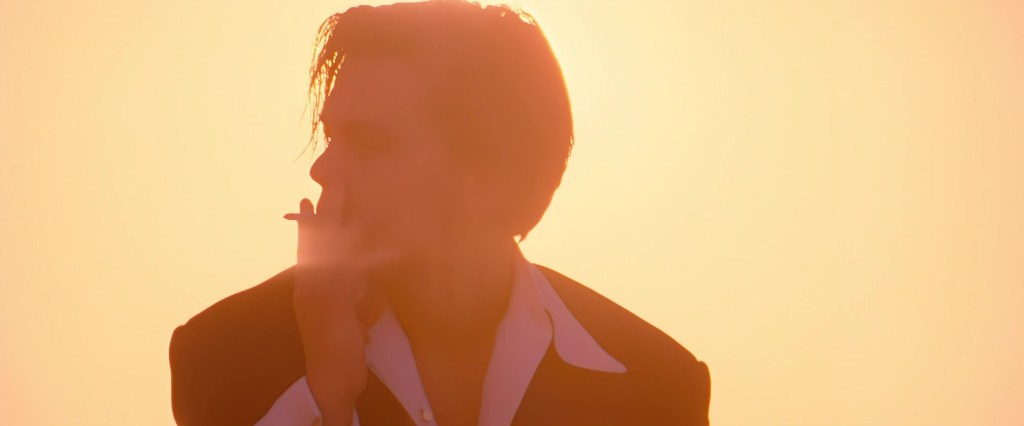
It also helps that it both looks and sounds gorgeous. The original play is full of moody and dramatic characters, and this film bathes them in a beachside sunset, neon filled tombs, a ruined stage. The opening shot of Romeo, smoking a cigarette on the beach whilst Radiohead’s ‘Talk Show Host’ plays is glorious.

Greeting us with this image of Romeo tells us just about everything you need to know about this character. Handsome, cool, rebellious, moody, youthful, whilst still being uncertain about his place in the world. At this point, he’s in love with Rosaline, in the helpless way that young people are. In this short scene, we are given so much of the introductory context in quite a subtle way, certainly in contrast to the rest of the film’s more in your face method of storytelling.

The repeated use of the piano from Des’ree’s ‘I’m Kissing You’ plays almost as Romeo and Juliet’s theme throughout the film. The song is used diegetically as a performance at the Capulet party, which is where the lead characters first meet and first fall in love. I get goosebumps every time I listen to that song and it fits perfectly within the film. I couldn’t go this whole review without at least mentioning it.

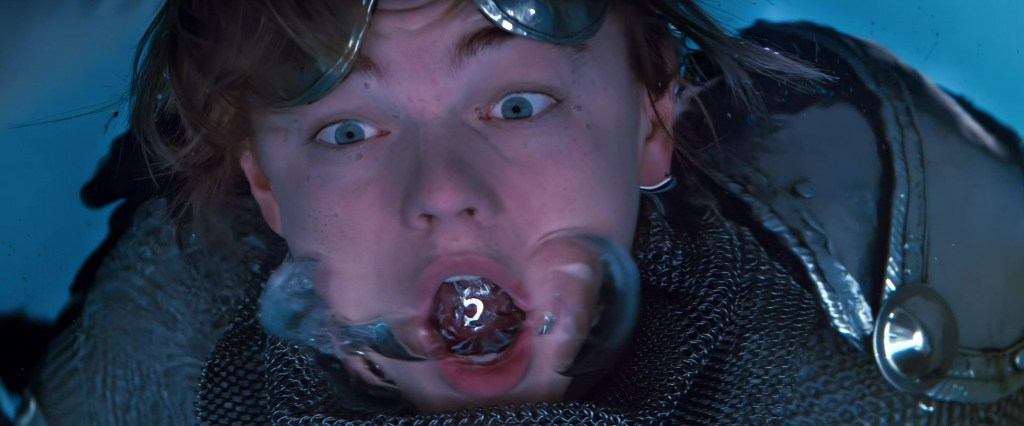
There’s a lovely recurring motif of looking through water, either the characters or we the viewer seeing things through the water.

In a stark contrast to Romeo being bathed in the evening sun, we first see Juliet through the water. She is clear an angelic, hair floating about her face. Unlike Romeo who is looking off to the side when we first see him, Juliet is instead looking directly at the camera. She is far less conflicted than Romeo, she has not known the woeful state of unrequited love (although Romeo is being entirely far too dramatic about that, which is kind of the point). She also cannot hear her mother’s calls through the water, being immune to her family and the baggage that it brings. However, it is her nurse’s calls that eventually get through to her. In this, we get an early sense of the importance of her and her nurse’s relationship as well as her defiance of her family. Both of the titular character introductions are perfect and beautiful and tells us so much without beating us around the head with exposition.

We also see Romeo in a similar position, although here he is distressed rather than at peace, trying to clear his head from the drugs that Mercutio has given him. He doesn’t know this, because he hasn’t watched the film, but he’s trying to gain the peace that Juliet feels at the beginning of the story. In the way that he is anguished and she is innocent, it is as if he is trying to rid himself of his unrequited love for Rosaline, as shown by him meeting Juliet very shortly after.

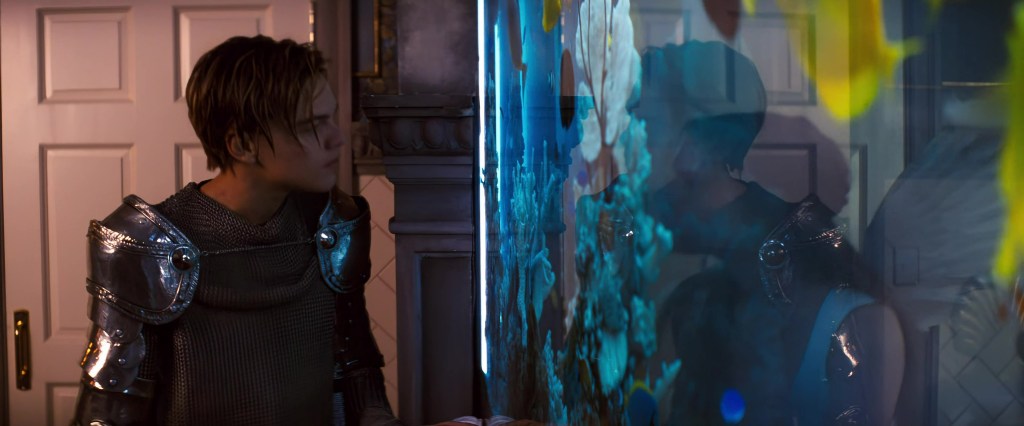
Once again, subtlety is not this film’s strong point, though it’s hardly trying to be. Their costumes are reflections of themselves, a medieval knight and an angel, and I think in this way they are reflected in each other through the fish tank. They are both innocent and they are both noble (and true and just and the rest of the things a knight is supposed to be). Of course, the glass and the water represent an invisible yet unbreachable barrier, owing to their family history, one that they don’t struggle to get around. Despite this barrier, they can see each other perfectly through it, and they do of course breach it and meet one another properly.

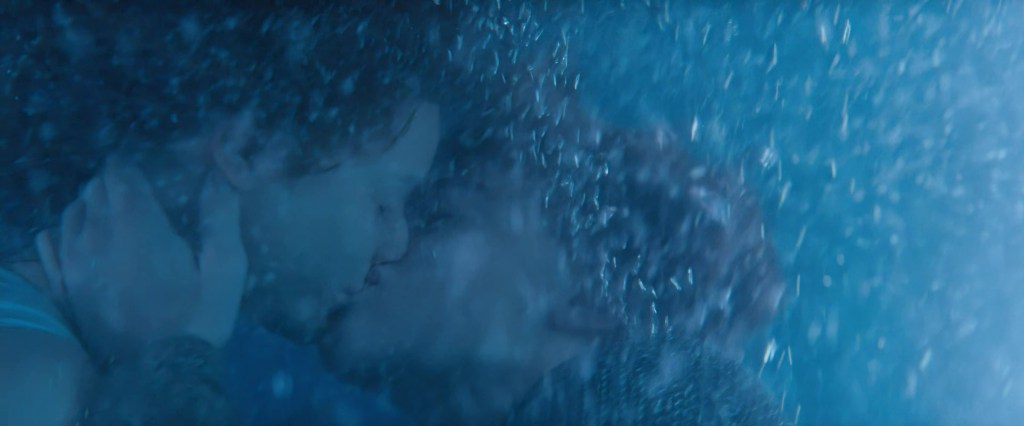
Water is so often a place of tranquillity in this film, a space free from the anxiety and stress of the outside world. It is through water that they both see each other for the first time, and a place that they share a final kiss before parting for the night, a night that will change their lives forever. Now I’m being dramatic, but it’s true. By inviting us into this peaceful place, the director is encouraging us to feel this calm, to share it with Romeo and Juliet. For all of its pomp and its grandeur, as Luhrmann pictures so typically are, this is contracted by the intimacy and tenderness of their relationship.

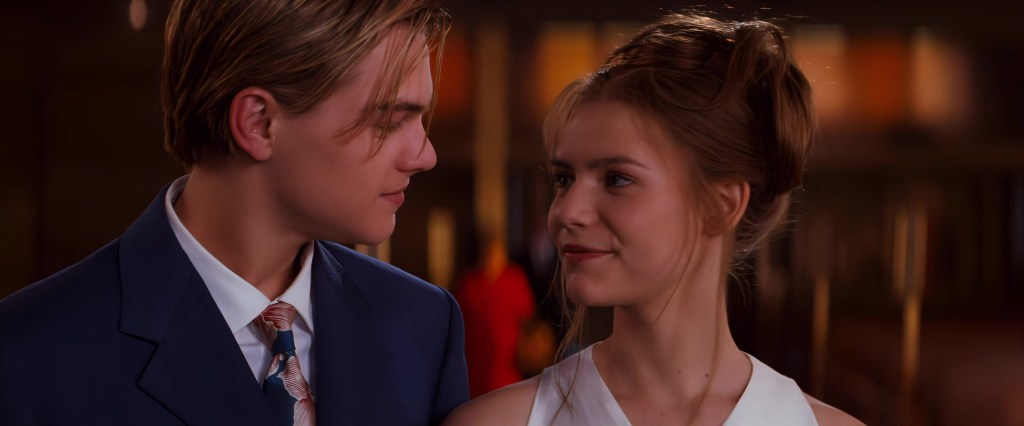
I’ve said before about the earnestness of the film, and that is represented and embodied by the performances of the two leads, Leonardo DiCaprio and Claire Danes.  While they both struggle at times with the Shakespearean dialogue, that is not for their lack of trying. Their portrayals of these two well known characters are pure and sweet, and ultimately are thoroughly convincing. They have wonderful chemistry as well in their time together on screen, especially during their wedding (you’d hope so, wouldn’t you?).

There are three absolute standout performers however: Miriam Margolyes and Pete Postlethwaite who are obviously completely at ease with the classical dialogue, and Harold Perrineau as Mercutio for his truly captivating take on the character. You can tell that the two classically trained actors are the ones most at ease with the dialogue and are able to grow beyond it, delivering memorable performances in small roles. Laurence has the gravitas of an experienced man of religion, and the unnamed nurse grows into her role as Juliet’s surrogate mother. She alone out of Juliet’s family and confidantes supports her fully and is seen with her throughout the film.

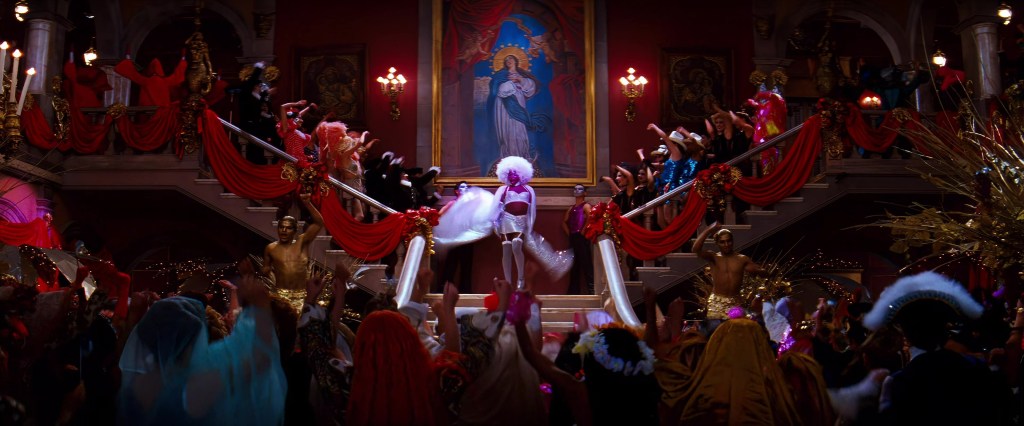
However, it is Perrineau’s Mercutio that steals the show. He has a wonderful physicality that dominates the screen every time that we see him, with the character always being larger than life in their various portrayals. His drag costume at the Capulet party is brilliant and he truly feels like the life and soul of the party, as was always his attention. He chews on the dialogue and Perrineau really enjoys the role, playing it with the sincerity of all the other actors in the film. His death feels theatrical as well as tragic in true Shakespearean fashion as well, literally set on the ruined stage on the beach. He clearly has so much fun playing the character, but his death does not feel like a loss from the story in a way, because this action sets in motion the tragedy of the climax. Indeed, Mercutio moves the plot along in a way that no other character does, whether it is his encouragement of Romeo to gatecrash the party where he meets Juliet, or his cursing of the two families and their feud as he lays dying.

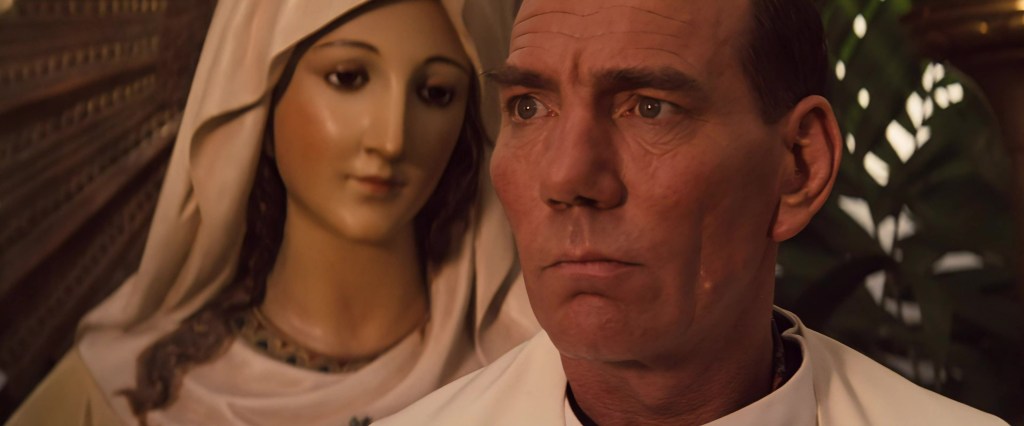
How could I go this long without discussing all of the lovely religious themes and iconography? Almost all of the guns have imagery on them that wouldn’t look out of place in a jazzy Catholic church. Isn’t that ironic, weapons of death with the Immaculate Heart of Mary adorned on them?

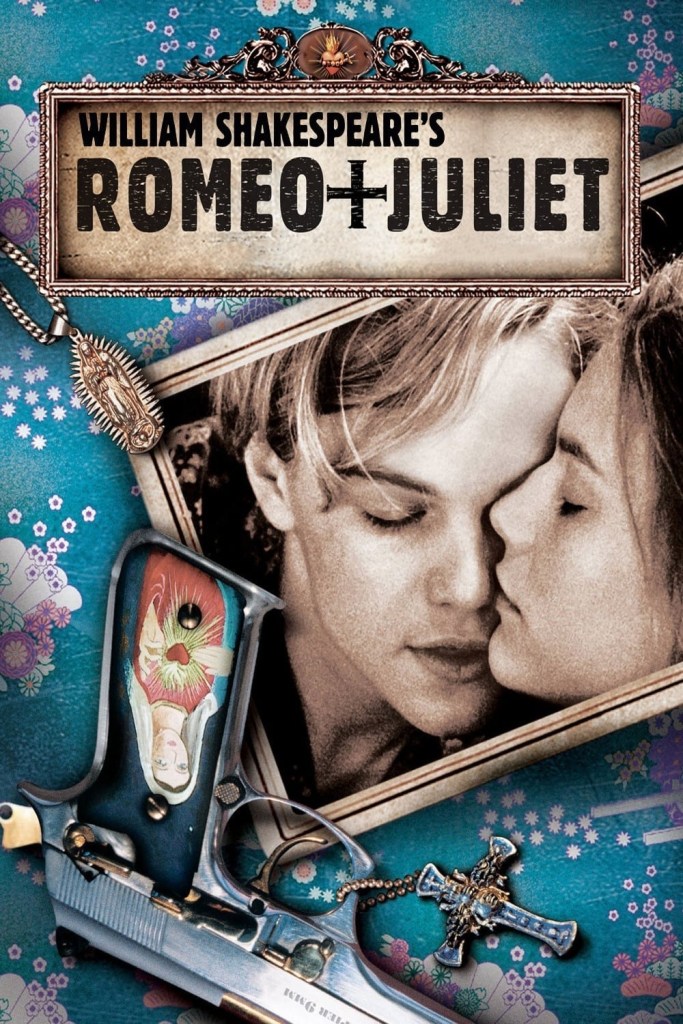
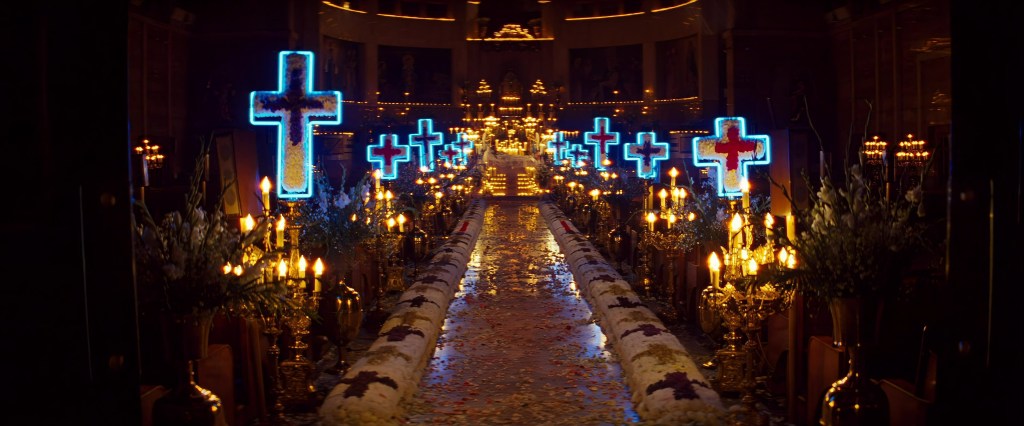
There are crosses absolutely everywhere as well. Tattooed on the back of Father Laurence, covering the tomb, even in the title. It is no coincidence that Luhrmann has opted to forgo an ‘and’ in the title and instead chosen a ‘+’. Star cross’d lovers, indeed.

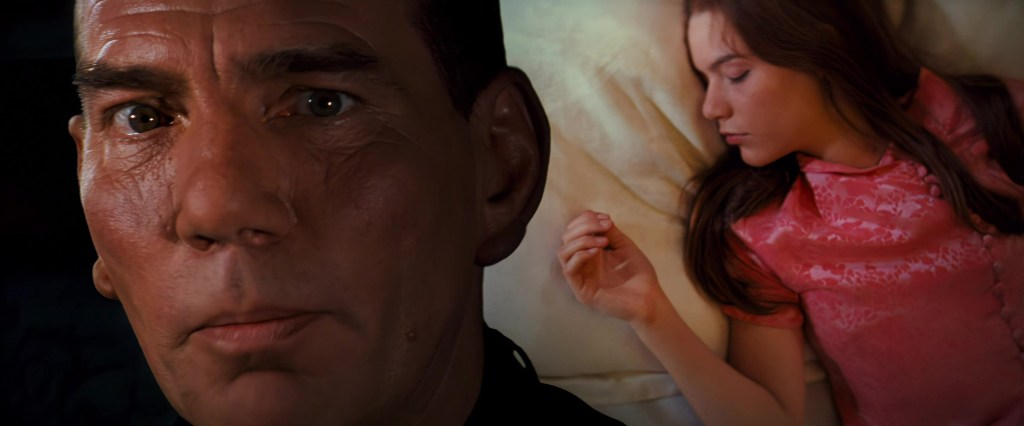
I love these reflected shots of Father Laurence as he considers the implications that his marriage of Romeo and Juliet could cause, and then his plan to render Juliet in a comatose state in order to allow her to escape her family in order to be with Romeo.

In each of these scenes, he has a vision of what the future could hold. He sees newspaper headlines announcing the conciliation between the Capulets and Montagues, and then of his plan to help Romeo and Juliet run away together. It also brings to mind the imagery of the angel and devil on each shoulder, representing the warring sides of good and evil. I had always thought that traditionally, the angel was always seen on a specific shoulder, but this isn’t the case. As such, the idea of the Virgin Mary whispering in his ear over his shoulder in the first image doesn’t necessarily represent the good, and the actions seen throughout the rest of the film as a result of him marrying the two lovers reflect this. Romeo and Juliet are two characters free from the burdens of good or evil, their love for each other defies this. It is the actions of the those around them that can be seen in this binary (though is there such thing as true good or evil? Certainly not in this film, but I digress). Juliet’s nurse and her love for her is good, Tybalt’s hatred and anger is evil. Things like that.

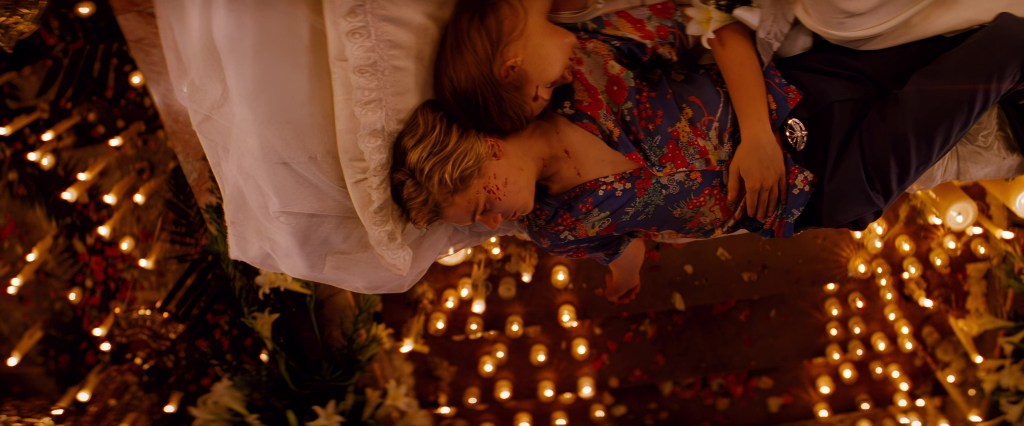
I really like the decision to have Juliet wake up just as Romeo has taken the poison. In the original play, he dies long before she awakens from her induced slumber and in other adaptations, she awakes to find him dead. Sometimes she kisses him in an attempt to take some poison lingering on his lips, in other she stabs herself. Here however, she awakes as Romeo finds her seemingly lifeless form, watching him take the poison before she can alert him that she is alive or realising what he has done. It is here then, after lamenting his death and the mere seconds that would have changed everything, that she shoots herself, her blood adorning his lifeless face as the true tragedy is allowed to sink in. They were ever the victims of small circumstances – the circumstances of their birth, the family feud, her engagement to Paris, Tybalt’s fury and Romeo’s vengeance. However, the choice to essentially close the film with a montage of Romeo and Juliet’s moments throughout the film as they lay dead in each other’s arms is inspired. These small circumstances also allowed them to find each other and be together, if only briefly. From their chance meeting at the party to their first night as husband and wife, we see how their flame burns brightly.

Romeo and Juliet is often called a cautionary tale about young love, but surely it’s a tale about finding moments of light in a life that can be extinguished far too quickly? In Romeo + Juliet, it is a story about the purity and earnestness of young love, of how small chances can lead to wonderful things, but how hatred and power are the barriers to such joy. We are never shown or given detail of what has caused these two families to hate each other so, and the purity and innocence of the titular characters is what should break this cycle, but only leads to their deaths. This is the true tragedy of Juliet and her Romeo.

First Impressions – 3 Body Problem

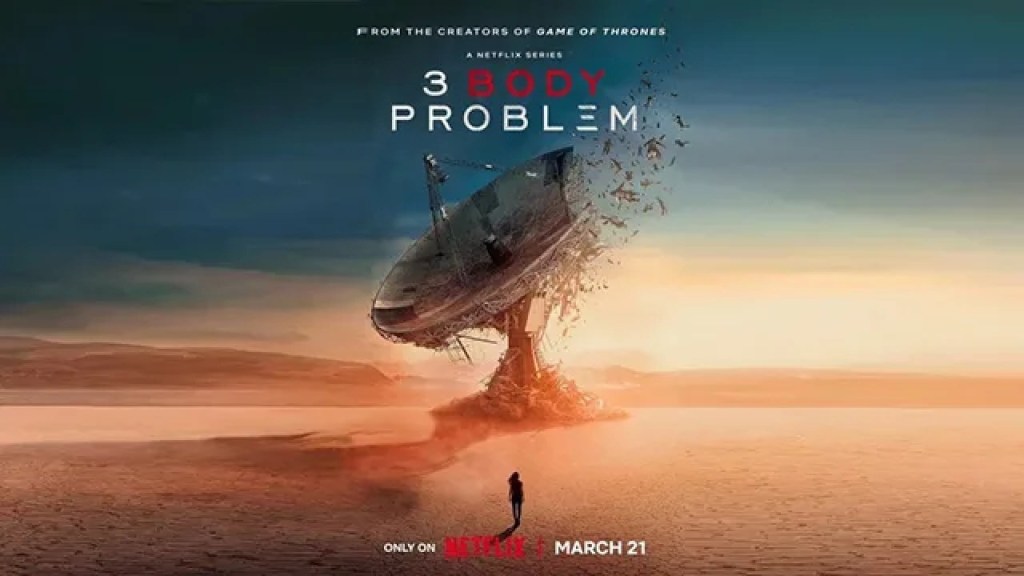
Third time’s the charm, or something like that. Anyway, I’m going to be trying something a little different today. This is the first instalment of a series I’m going to call ‘First Impressions’, where I will talk about the first episode of a given TV series. Only the first episode, mind you. Now the name makes sense. Hardly the wittiest, but being devoid of wit isn’t a crime.

Time to get stuck in. 3 Body Problem was recommended to me by a close friend, in the kind of enthusiastic way that you know it’s really worth a watch, not just the ‘oh yeah, this is kind of good’ way. They’re very different. I’m veering off course very early today, but I digress.

3 Body Problem is a sci-fi series which is based off a Chinese novel published in 2006. I knew next to nothing about this before starting the first episode, and as of writing this I’ve only seen the first two episodes, so no chance for spoilers here! It’s got a very strong cast, including Benedict Wong, Eliza Gonzalez and John Bradley, and was created in part by David Benioff and D. B. Weiss of Game of Thrones fame (infamy?). This may ring alarm bells for those with a short memory, but please remember how good the first few seasons of that show were. This is when they had the source material to work from, which is the same with this show. Also involved is Alexander Woo, who was a writer for True Blood and some other TV series over the last few years.

The opening scene is one of my favourite cliches of any kind of story-telling. A scene that is seemingly unrelated to the rest of the show based on our expectations, but will clearly have strong thematic or narrative significance later on. This seems specific, but the best example I can think of recently is The Last of Us, where the opening scene depicts an old television interview with a scientist who highlights the danger of a fungus that can infect the nervous system. We’re thrown into the middle of a Maoist struggle session, with no context as to what that is or what’s going on. We see academics beaten in front of a braying crowd by members of the military, academics who might question the established order. These struggle sessions formed part of China’s cultural revolution in the late sixties into the seventies, and were credited with helping Mao tighten his stranglehold on the hearts and minds of the Chinese people.

This, essentially, lays the foundation for the series, which revolves around the daughter of one of the murdered academics, as well as a group of academics who are brought together by the death of a friend and mentor. We are also introduced to Benedict Wong’s detective character, investigating unusual circumstances surrounding various deaths across England, and the world. The series splits its time between China following the death of Ye Wenjie’s father, and modern day England, primarily following the characters of Jin Cheng (who discovers an unusual helmet) and Auggie Salazar (whose vision is plagued with a visual countdown to zero). It’s always interesting seeing how a series reveals information to us across different narratives, and I’m intrigued to see how this develops to. You have to be so careful with what you hint at and what you show as not to ruin the surprise. This series so far is most akin to a detective story, where it establishes all of these mysteries that we will obviously delve into as each episode continues.

I really enjoyed this episode because it does such an effective job at hooking you in. This is perhaps the most essential role of an opening episode of a series, along with setting up the core narrative and characters that we will follow throughout. Intrigue is thrown at us in almost a breakneck pace, with each of the first few scenes demanding that we continue watching by giving us something to ponder, to think about, to query. I find it incredibly hard to get hooked in to TV series, to the point where I don’t think I’ve watched a new one this year even, but this has really grabbed me. I can’t wait to see where it goes.

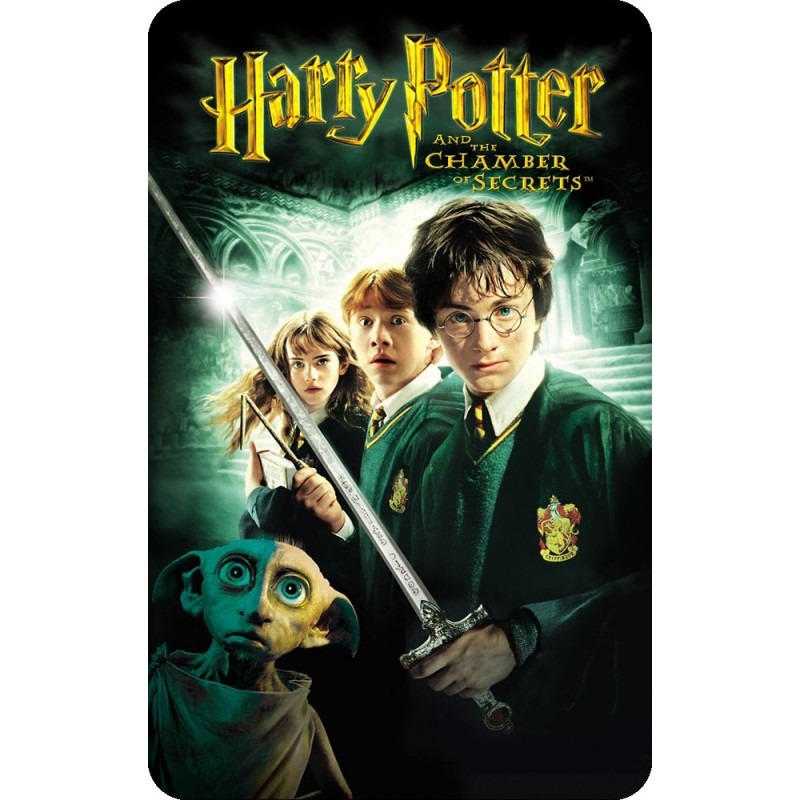
Harry Potter and the Chamber of Secrets

It was just over two years ago that I posted about the first Harry Potter film. Whoops. Lots has happened since then in the franchise – the critical and financial failure of the Fantastic Beasts films, leading to big question marks over their future and the announcement of a television remake of the books. There’s also been the open world video game, which had a lot of hype behind it but I haven’t really heard anything since. Maybe that’s on me. Anyway, we’re here to talk about the next film in the franchise, so let’s get to it.

Harry Potter and the Chamber of Secrets was released in 2002, following the hugely and globally successful first film, with Christopher Columbus still in the director’s chair. Visually, thematically, stylistically, it’s all very much a direct follow up to The Philosopher’s Stone. This is a good thing, right? Wrong. It’s really hard to talk about this film in its own right, because everything other than the plot is identical to the first one, and even the plot follows the same broad strokes – what’s going on, and what does it have to do with Voldemort? Honestly, the first two films in the series just feel like an extended two-part television episode. In a way, it’s why I appreciate the next three films in the series beyond their inherent quality level, because each of them brings in a new director with their own ideas and art direction.

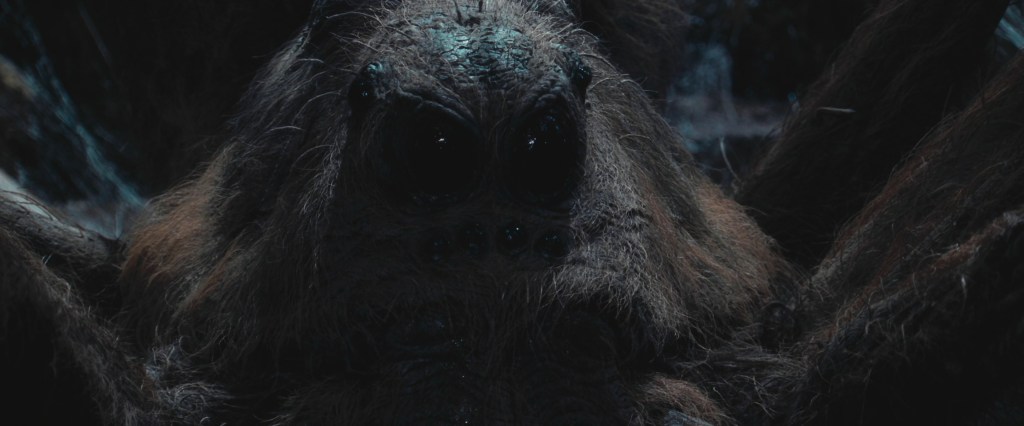
The practical effects are as strong as ever, especially for the giant spider, Aragog.

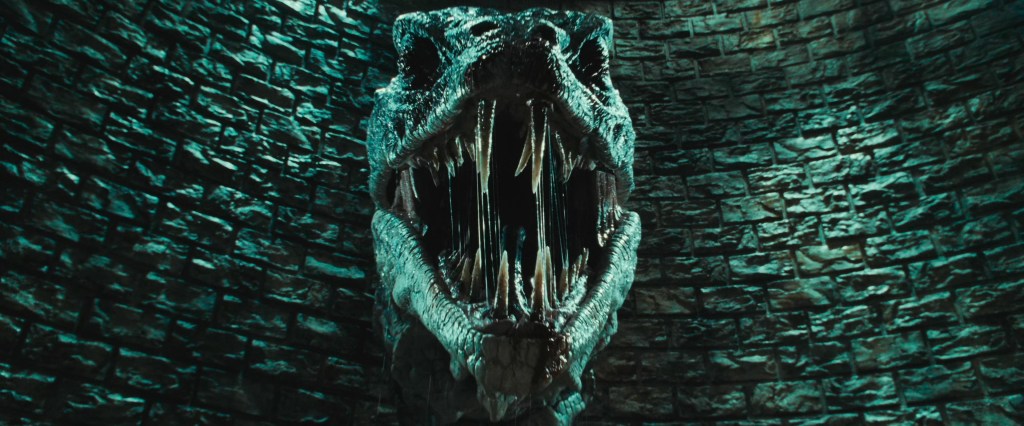
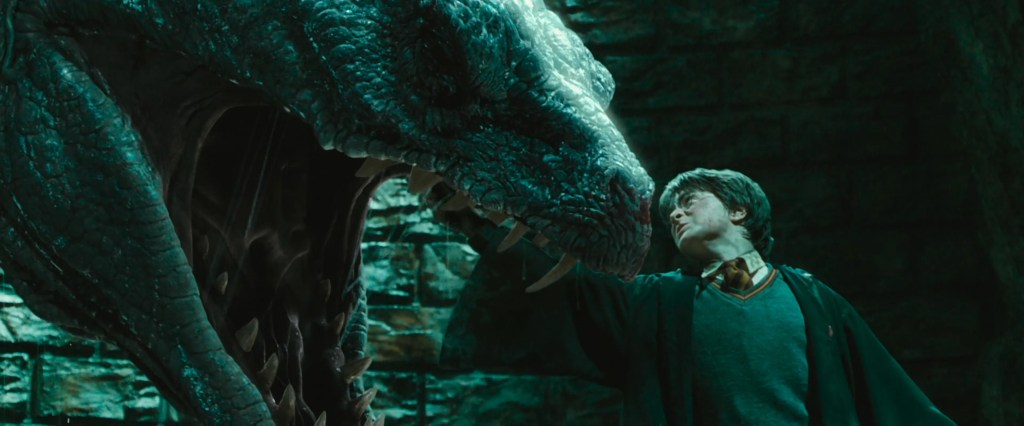
Isn’t he wonderful? I don’t even like spiders. The mandrakes are great too, it’s so much nicer when you can tell that the actors can physically see and feel what they’re reacting too, especially child actors. Look at how much better the basilisk looks when it’s a real, physical thing, as opposed to CGI. They’re different angles, annoyingly, but you get the picture (haha).

Watching the scene again, it just looks like Harry is slashing at air. I know that there was still a long way to go with visual effects, but why use a giant, moving model of a basilisk only some of the time? I can understand for the wide shots, but in all the close-ups with Harry using the sword, why don’t all of them feature the animatronic? Its mouth moves and everything! Don’t get me wrong, the visual effects are much stronger than the first film, but this particular scene just feels so inconsistent.

The casting is continuously strong, bringing in some of the most talented names that the British Isles have to offer, on top of an already loaded cast. Two of my very favourites are Kenneth Branagh as Gilderoy Lockhart and Christian Coulson as Voldemort, both for their extravagant and overblown portrayals of their characters. Lockhart looks very little like he was described in the book, but Branagh captures his delusional arrogance so well, the veiled cunning behind the gormless and vapid expressions. Speaking of arrogance, I’m still disappointed that this was Coulson’s only appearance in the franchise. If The Half-Blood Prince had any kind of spine at all, he would have been brought back for the flashback scenes of Tom Riddle as a young man, culminating in his final visit to Hogwarts before Tom Riddle officially disappeared and Voldemort was born. He was hammy and over the top in the very best way, chewing his words before spitting them out at Harry in that climactic scene in the chamber itself (spoilers).

As many times as I’ve seen this film, it’s quite telling that I’m finding it hard to really say anything of note. It’s all fine, but it’s never really anything more than that. It lacks ambition, which is frequently the fault of the studio’s handling of the franchise. The books are hardly great works of literature, and other than the core concept of ‘wizard school’, they never really go in a particularly interesting or surprising direction. The core concept of ‘something mysterious is going on that will not be solved until two weeks before the end of the school year in a climactic stand-off’ is essentially the plot of every single book. Of course, there’s a lot of interesting stuff going on beneath the surface and in side-plots, but very few of these were translated to the films. Maybe the series will do a better job of this, with the key advantage of having more time, but we’ll see.

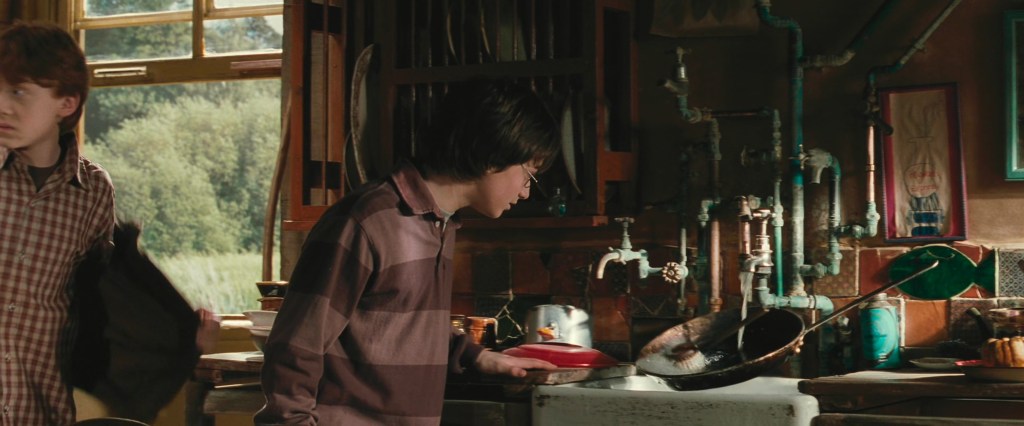
One thing that I do enjoy, that we so rarely see in a film about about magic and magicians, is everyday magic just happening. The introduction of the Weasley’s house is Harry’s first introduction to magical life outside of Hogwarts, and they do a great job of capturing his wonder. Of course, they have to spell it out with his cheesy little “I love magic” line, but Daniel Radcliffe’s earnestness really helps sell the line.

My main issue with this film is that there’s nothing more here, nothing particularly interesting that makes it stand out. The plot ambles along with no real interesting twists or turns along the way (maybe that’s because I’ve seen it so much though). It’s old and dusty, the charm of the original already wearing pretty thin. Thank goodness for the visual shake-up in the next film, not only does the style change but so do some of the sets, expanding the castle and the grounds to feel more sprawling and mysterious. It’s still very watchable, as are all of the films in this series, I’m just glad they started to take it in a different direction after this.

Oppenheimer

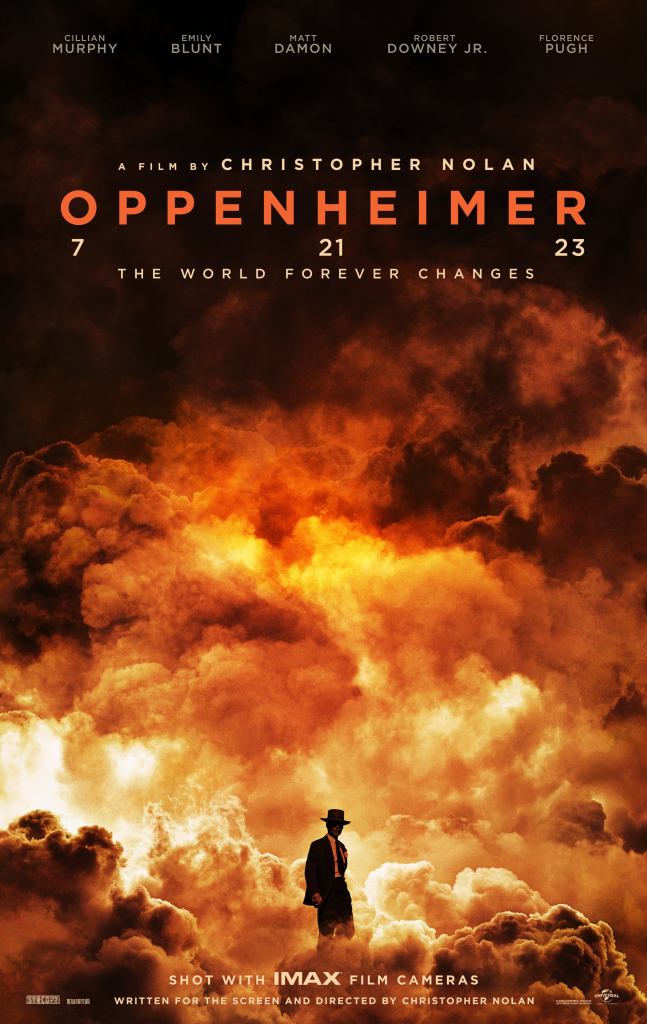
When looking up the book that Oppenheimer was based on (American Prometheus, by Kai Bird and Martin J. Sherwin), there is a review from Thomas Powers which says ‘it is Oppenheimer the man, not general ideas about the nuclear age, that dominates these pages’. I have seen some pockets of criticism online that comment on Nolan’s lack of coverage of the impact of the nuclear bombings on Hiroshima and Nagasaki, of the impact on Japan and the world even, but that is not what this film is about. It covers the issues of the morality of using such weapons in great depth, how could it not? Ultimately this film, as it is so aptly titled, covers the career of J. Robert Oppenheimer. From his beginnings as a student of physics to the so-called end of his career after his security clearance is revoked and his reputation tarnished, Oppenheimer is at the front and centre of this story. I also happen to think that this is one of Nolan’s best films, his most focussed and certainly his most striking. As is the case with many of his films, the whole narrative is building up to the ending, a crescendo that will leave the viewer thinking for many days afterwards.

The film, as much as it is about Oppenheimer, is about morality. The debate about the usage of atomic weapons in Japan still goes on today, and throughout the film we see a lot of different angles and opinions shown by a lot of different parties. From Oppenheimer himself, from government officials, from members of the military, to a variety of scientists at Los Alamos, we the viewer are invited to take part in this debate. We see many of the arguments that have raged throughout history. The bomb may kill more instantly, but will save lives if the USA were to attempt a land invasion. The Japanese never would have surrendered otherwise. If they don’t develop it and use it as a deterrent, the Russians or the Germans will get there first. Would the Japanese have surrendered without a complete and devastating military defeat from the USA? We’ll never know.

In fact, this brings me to a Japanese film I watched that was set during the second World War. In This Corner of the World follows a woman who attempts to help her family survive and live as normally as they can throughout the war, in spite of air raids and the deaths of friends and loved ones. After the atomic bombs are dropped, when she learns of Japan’s surrender, she breaks down. She asks how they could have surrendered, when she is still alive to fight, when her family could still fight. She cannot reconcile the deaths, the destruction, the misery that has been caused all for them to surrender. It’s interesting that from this perspective, the end of the war is a terrible thing, that losing has caused the fight to be in vain. Indeed, this is one of the perspectives that was used to justify the nuclear weapons – that Japan would never give up otherwise. Was that the reality? I’m not a historian, but how can the instant deaths of tens of thousands, and the gradual and painful death of many more, be justified?

However, that does not mean that we are pointed in one, clear direction: the fallout from the usage of the weapons was devastating. Oppenheimer is haunted by images of the bomb after its usage in war. His development is used against him just a few years after its usage by the same government that used the device. A podcast that I was listening to on the topic suggested that the bomb, once it was completed, had to be used partially for political reasons. If the public learned that the USA had a bomb that could have ended the war, but their sons or friends or neighbours had died during a land invasion of Japan, well they couldn’t have that could they? Every vote counts after all.

Maybe that’s simplifying things too much, nine years is a long time in politics and especially in technological advancements, but to be tarred and feathered for doing what he was ordered to do is surprising. Of course, his vague links to Communists is presented as the true reason for the enquiry, which is then later shown to be revenge from Lewis Strauss for allegedly publicly humiliating him. I think simplifying things too much would be to claim that there was only one motive, only one moving part, in the process of discrediting Oppenheimer.

Indeed, the most striking scene in the film, perhaps the most striking scene that Nolan has ever put to screen, is when Oppenheimer gives a brief speech after learning of the successful nuclear detonation over Hiroshima. Cillian Murphy plays this scene stunningly, as he does throughout the whole film, that goes without saying. We see his facial expression shift and change throughout, from trying to be the crowd-pleaser that he so often was throughout his career, whilst battling with the implication that he had done it. A weapon whose project he had led and developed had been used, killing tens of thousands of people instantly. He sees the blinding light, hears the screams, feels the burnt bodies of innocents on the floor. All throughout the film we see the way that he attempts to justify to himself the development of such a weapon, primarily that if they didn’t do it, the enemy would do it first and use it against them. Indeed, the two other sections of the film regarding the two different hearings, investigate his shifting position throughout the years. The use of his position to be an advocate of peace, the UN, of not developing even more destructive nuclear weapons, all of this is used against him. How can one justify the deaths of hundreds of thousands of people? We, as an audience, are asked just that ourselves. I believe it is impossible to find an answer.

I’ll bring in my one major criticism now, because in the grand scheme of things it’s really not that big of a deal. It’s an issue I have with just about all of Nolan’s filmography; the dialogue. I know what you’re thinking, how can the dialogue not be that big of an issue? Primarily, it’s because the issues with it run about as far as the first act. From the time that Oppenheimer arrives to lead the project at Los Alamos, from the time that the film becomes rooted in fact (as much as a biopic can be), these issues are washed away. Nolan has a habit of writing dialogue as if the characters are aware they’re in a film, a standout from early in the film is during a rainy train journey where Rabi tells Oppenheimer ‘there’s a man you need to meet’. Oppenheimer replies with ‘Heisenberg’. It feels like the ‘getting the gang together’ cliché from every heist movie. The first act of the film is frenetic, all building towards the building of Los Alamos, telling us why that location was chosen, why the major players were assembled there. It’s still enjoyable to watch, don’t get me wrong, but the dialogue sparkles far more throughout the rest of the film.

Unlike most biopics, or at least the ones that I’ve seen, much of this film is based on factual events, drawing from transcripts of the 1954 security clearance hearing and the 1959 confirmation hearing of Lewis Strauss. I’ve read some of the security clearing transcripts, they’re not thrilling reading and they’re certainly not brief, but it’s interesting how much of the dialogue is lifted out of them. It’s far too long to try to read all of, but I find myself glancing over familiar snippets. The questioning of Kitty was almost verbatim from the transcripts as well. I’ve been trying to find Robb’s examination of Oppenheimer regarding his objection to the development of a hydrogen bomb, when the room lights up as though by a nuclear light before fading, but I’ve been unable to. To be fair, there are twenty-nine volumes of the transcripts, many of which are over one hundred pages long. At any rate, what I’m trying to get at is that these conversations, these existing and recorded transcripts, provide some of the best moments of the film. For the confirmation hearing, it’s actually the imagined (at least, I can’t see how they aren’t) conversations between Strauss and Alden Ehrenreich’s unnamed character that pop the most. Robert Downey Jr. is fantastic as Strauss, portraying his arrogance and the way he completely loses it after David L. Hill takes to the stand to let the hearing know all of the betrayal and manipulation that Strauss has done to attempt to secure his place at Congress.

I’ve mentioned how the whole film builds up to its ending, this is partly due to the very strict three act structure that Nolan follows. You can almost see the staging being moved off camera as the story first covers Oppenheimer’s early life until he is recruited to lead the Manhattan Project, the events at Los Alamos and finally his life following the war. This is interspersed with scenes from the security clearance and the confirmation hearings, but they all serve to bring us into and provide context for Oppenheimer’s story. The conversation between Oppenheimer and Einstein by the pond, unheard until the end of the film, is the driving force for the events of Oppenheimer’s life following his work at Los Alamos. I won’t spoil what is said, that would be mean, but it is almost worth watching the whole film for that alone.

The score is also fantastic. Composed by Ludwig Göransson, it is impactful and tense, being a driving force behind several scenes in the film. I’ll use this opportunity to talk about the build up to the Trinity test, probably the best use of sound throughout the film. There’s a frenetic build up of violins to the detonation of the world’s first nuclear device, following the different groups of people waiting to watch the explosion. From the soldiers to the scientists, to Oppenheimer himself, we feel the tension in the air as they await the unknown. Obviously the detonation didn’t set off a chain reaction that burned the Earth’s atmosphere, but you almost feel like it could. I could feel the vibrations in the theatre as the bomb went off, was almost blinded by the pure, white light of destruction. I could feel the cheer at its success, and the realisation of what had been done, what they had created.

Immersion is the name of Nolan’s game, he has become THE director who must be watched in cinemas, and you can see why. You can’t help but be pulled into not only the events of the film, but the ethical debate surrounding such events. You, as the audience, are invited in to the discussion and the conversation, all the different sides of the story. It’s intimate in a way that I have rarely seen from Nolan, whose films I usually find cold and distant even as I find myself entertained and awed by them. This is probably his most focussed film, his most polished, simply because we are invited in. He has not left us on the sidelines to watch events play out, as I felt was the case in Dunkirk especially, but we feel as if we are sitting there in that little room, watching Oppenheimer get torn apart in a kangaroo court, lying down with a piece of welding glass in front of our eyes, seeing the visions of the destruction and terror wrought upon the world. I’ve always admired Nolan’s work, but this is the crowning jewel. I can’t wait to see where he’ll take us next.

Just as a nice little side note, considering my criticism of the ‘getting the band together’ dialogue and how he literally gets the band together when recruiting for Los Alamos, I loved how this film was a ‘who’s who’ of famous actors. They felt like cameos, but fun. Jack Quaid playing the bongos? Go on. I could write another few thousand words about Oppenheimer, but I’ll conclude here.

The Flash

Right then, back with a bang. I had the honour? Privilege? Punishment? Of being able to watch this before it was released, so some scenes may have been edited slightly for the final film. However, unless said final edits were to change the entire film to something completely different, I’m fairly confident that I can give my accurate take on the film.

What a mess. I don’t think I can remember when I last watched something that had such a clear lack of vision, such a mish-mash of ideas that either didn’t work or really didn’t work, in a long time. Scratch that, because that reminds me of DC’s own Justice League which came out just a few short years ago. At least that one had the excuse of being made by two completely polarised directors, although what we ended up with was one of the most generic, milquetoast blockbusters ever made, in a field that so often lends itself to crowd-pleasing mediocrity. But I digress, if I wanted to talk about Justice League, I would, but that about sums up everything I have to say anyway.

Back to the topic at hand, there are just so, so many baffling decisions. Too many fingers in the pie, methinks, but surely someone at some point was watching this all come together and said ‘come on, this is a mess’. First and foremost, how was Ezra Miller allowed to be in this film? From terrorising the people of Hawaii to the harassment and kidnapping allegations, why on earth didn’t the film makers do everything they could to distance themselves from this person? I won’t say anymore before I get too libellous, but I’m sure alternate arrangements could be made. This is just a drop in the ocean though.

                Time travel/multi-verse stories are a penny-a-pound now, and this film combines the worst aspects of all of them. It’s a tick box exercise for all the worst cliches across the genres. The hero goes to find an old friend only to find they’re someone different? Multiple versions of the hero? Hero goes to find someone but uh-oh they don’t exist anymore? Really minute change that has no impact on anything (more on that later)? The threat of a collapsing muti-verse? All ticks, all in there. If DC were looking for a greatest hits video as James Gunn’s saga is about to launch, they have failed miserably. For a film which could have been so exciting and so interesting, and a farewell to the messy and muddled existing DC cinematic universe, they have achieved nothing. My annoyance at this film has only grown in the months since watching it, and I found myself frequently rolling my eyes in the cinema at the time already.

Oh yes, as all time travel seem to be required by law to do, there’s an overly simplified, kind of boring explanation of how the internal mechanics of all of this time travel and universe mixing works, which in this case is explained by an old and tired Batman with a bowl of spaghetti. Bring back ‘wibbly wobbly, timey wimey’ from Doctor Who any day of the week, because time travel analogies within fiction are almost always unnecessary. It’s a superhero film with a man who can run faster than light, another man who can’t run fast anymore and old Batman, just go with it. Why are we still doing this?

On the topic of ‘how did this make it in’, what was with the constant ‘Eric Stoltz was almost Marty McFly’ jokes? It happened first reasonably early in the film, where there’s a reference to Back to the Future and everyone other than Barry says how great Eric Stoltz is in the role, the actor who was first cast as the lead. I get that any mainstream film that even mentions time travel has to reference Back to the Future at least once, it’s a rite of passage, but this was incessant and just weird by the end. Was it all a set up for the Nic Cage cameo near the end, another actor who almost played a character? God only knows, but it wasn’t funny the first time and it wasn’t funny the twentieth. More to the point, why was this and about three other things changed as a consequence of Barry changing the past? I feel like there are going to be a lot of rhetorical questions here, but they serve to sum up my incredulity at a vast number of creative decisions made during the process of this film. As far as I can remember, Barry going back in time a few years manages to: save his mum, recast Batman and recast Marty McFly. That’s it. How weird.

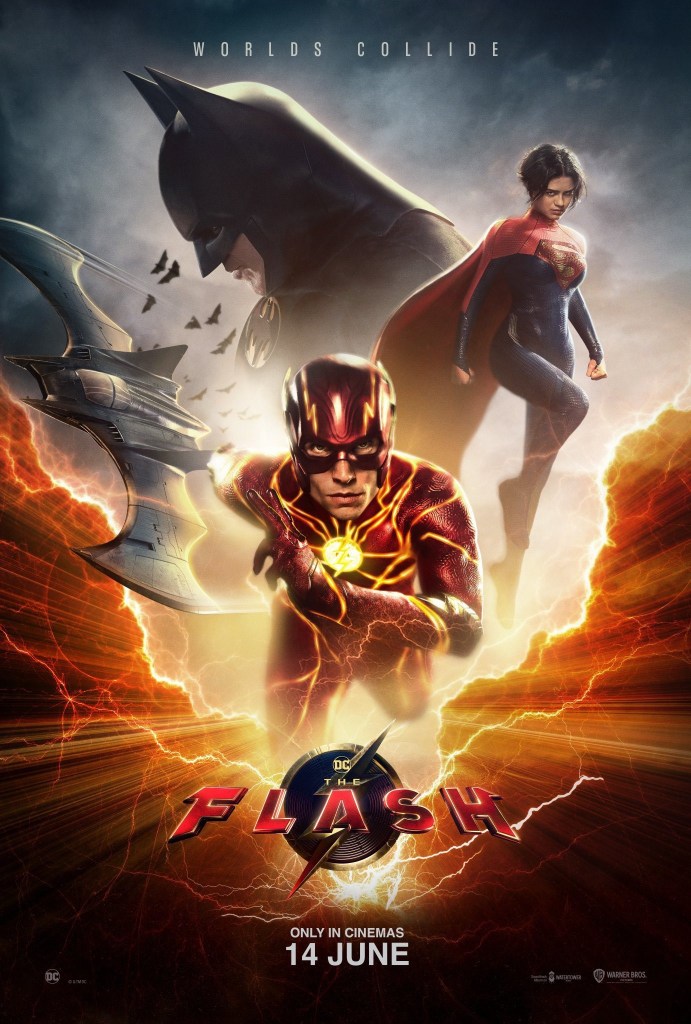
However, there is one bright spot in this film, and it’s Sasha Calle’s portrayal of Supergirl. I fondly remember the TV series starring Melissa Benoist, and as cheesy and rubbish as the show often was, it had real heart. While her brief screentime doesn’t give her the time to shine that she deserved, I though Calle had a really nice performance in this film. She had the hope, and often the rage, that to me defines the character of Supergirl – she fights for what she believes in, but her anger at the injustice and terror that others face highlights the basic strokes of her moral compass. Honestly, written down that all sounds really broad and obvious, but I don’t care. She was a fun character to watch on screen.

I could go on all day about my issues with this film, but I won’t. This negativity has gone on for just about long enough. Any interesting or emotional moments were undercut by the other nonsense going on. Ezra Miller wasn’t good at acting any role they had, and as they had three that’s impressive in its own right. Michael Keaton and Michael Shannon clearly had no clue why they were there, but I don’t blame them. A payday is a payday. There’s a glimmer of light in the future with James Gunn taking charge, as I’ve enjoyed most of his superhero films so far, but I’m just so bored of it all. At least Across the Spider-Verse was good.

First Impressions – Glee

I’m going to mix things up a little and try a series I’m going to dub First Impressions, giving you my thoughts on the first episode of a television series. Some will be things that I’ve watched before – like this one, Glee, and some will be brand new ones that I’ve never watched. Let’s see how this goes. (Side note to the reader, I wrote this before my post on 3 Body Problem, because I’m really organised).

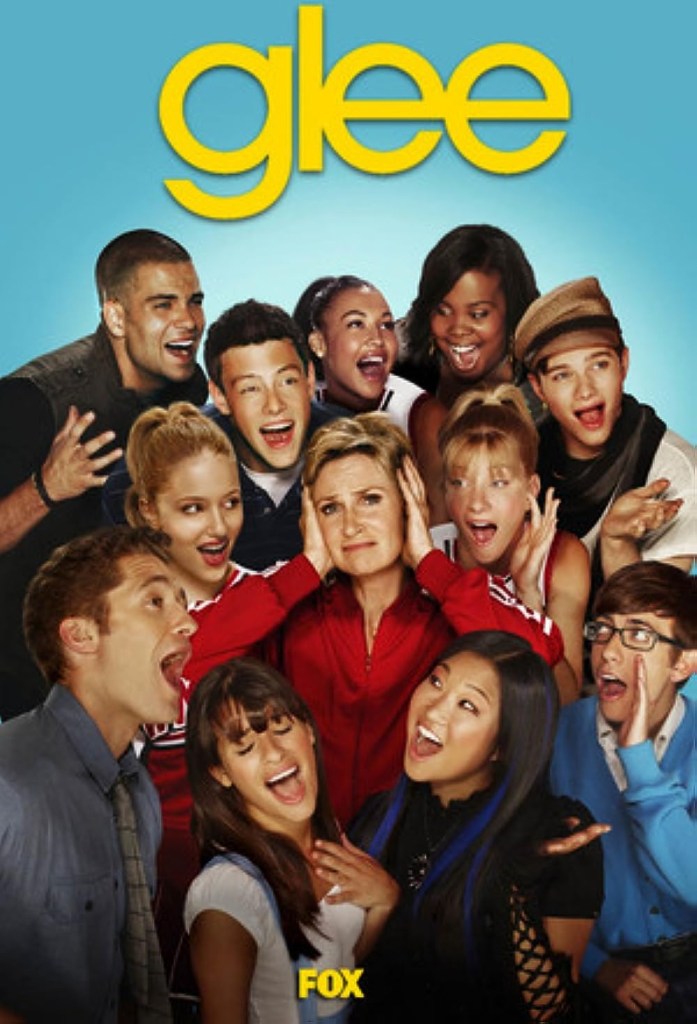
Glee was brilliant, at times. Like most series over a run of several years, there were ups and there were downs, but Glee at its height was one of the funniest, most enjoyable pieces of television that I’ve ever seen. I’m not exaggerating. For whatever this show might have become, I think that the whole first season was incredible, and that starts with the Pilot (as American shows often do, just spend five minutes thinking of a name for the episode, I beg of you).

So much of an American TV pilot’s runtime is dedicated to introducing as many characters as possible in as much detail possible in as little time as possible, which lends itself well to the quick cuts and snappy dialogue so often seen throughout the run of Glee. I used to hate the way the camera cut what felt like every half a second, but on rewatches I’ve found myself loving it. Anyway, Will is kind of useless, Emma has OCD, Sue is brilliant, Ken is sad and lonely, Rachel is a drama queen who will do anything to get her way, Finn is conflicted, I could go on. Through the auditions for the Glee club, we get a good sense of all the other major players that we’ll carry on seeing. Tina even writes her name with a stutter, which is something I’ve only just caught. Glee is so full of all these little visual jokes that work so well, and they’re very much ‘blink and you’ll miss it’ due to the speedy camera cuts.

Already in the first episode, Rachel and Sue are the absolute standout characters. While the rest of them fit varyingly within and without the caricatures that they are destined to parody, Rachel in particular is striking from the first moment she appears on screen. From her fake crying to get the old Glee coach fired to signing off her name with a gold star, she’s golden. No, I didn’t intend that. Yes, I’m leaving that in. She’s delusional about everything other than her incredible talent, and as annoying as her character is, she’s the star of the show. If she wasn’t she’d let you know about it.

Sue is too of course, but Jane Lynch was always destined to be brilliant. Her first line of ‘you think this is hard, try being water-boarded, that’s hard’ is so good, and you can see throughout the episode the different jokes they tried out for the opening scene. While her influence and power as a character wanes throughout the show, as she becomes more and more overused, she starts off incredibly and carries on for at least a couple more years. Jessalyn Gilsig is another standout as Will’s domineering, overbearing and slightly psychotic wife. ‘I’m on my feet four hours a day, three days a week here’ is essentially her opening line here too, and yeah, written down this stuff isn’t so funny, but trust me, it is.

What I think is the truest testament to the quality of this episode is that I’ve seen so few of the things that Glee parodies and pastiches. You’ve got the fourteen to sixteen-year-olds played exclusively by people aged twenty-five or older and the strict caste system of jocks and cheerleaders above everyone else. The only things I’ve seen which feature Glee clubs are this and Pitch Perfect, which both kind of make fun of the concept of a Glee club, which I’m pretty sure are an alien concept to anyone outside of the USA. Yet, despite that, I find myself getting the jokes. It’s true that as the show goes on, it seems to become what it’s parodying. This is a fatal flaw in pretty much every Ryan Murphy production, it’s like he forgets what he was doing in the first place and goes to playing everything way too straight. The first season of Glee is brilliant though, and the first episode starts things off brilliantly.

I haven’t even mentioned the music yet, and that’s where most of the show’s heart comes from. There’s a lot of telling each other how they feel through songs, which sounds cheesier and more insufferable than it is. I remember the first time this episode was on TV it featured a scene with Will singing ‘Leaving on a Jet Plane’ because he was leaving his job, and my dad walked in and said ‘I take it that guy is leaving to go somewhere’. I think that sums up how on the nose the music in this show can be, but in later episodes it gets so much more fun. Finn singing ‘(You’re) Having My Baby’ to Quinn without realising he’s outing her pregnancy to her parents is hilarious. I won’t mention Will’s white-man rapping though. ‘Gold Digger’ is something to be forgotten.

I’ll finish before I get too ahead of myself though. As a first episode, this is a triumph. If you like it, chances are you’ll enjoy the show before abandoning it somewhere in the fourth season and then picking it up several years later to see how it all ends. That’s based on a true story. If you don’t like it, well, you never will.