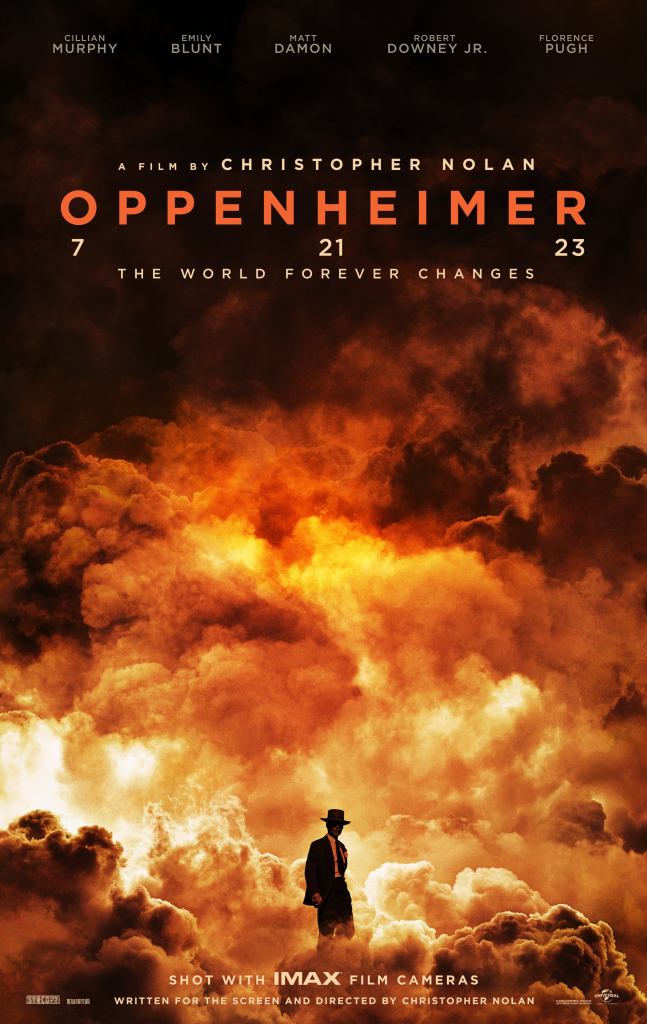
When looking up the book that Oppenheimer was based on (American Prometheus, by Kai Bird and Martin J. Sherwin), there is a review from Thomas Powers which says ‘it is Oppenheimer the man, not general ideas about the nuclear age, that dominates these pages’. I have seen some pockets of criticism online that comment on Nolan’s lack of coverage of the impact of the nuclear bombings on Hiroshima and Nagasaki, of the impact on Japan and the world even, but that is not what this film is about. It covers the issues of the morality of using such weapons in great depth, how could it not? Ultimately this film, as it is so aptly titled, covers the career of J. Robert Oppenheimer. From his beginnings as a student of physics to the so-called end of his career after his security clearance is revoked and his reputation tarnished, Oppenheimer is at the front and centre of this story. I also happen to think that this is one of Nolan’s best films, his most focussed and certainly his most striking. As is the case with many of his films, the whole narrative is building up to the ending, a crescendo that will leave the viewer thinking for many days afterwards.
The film, as much as it is about Oppenheimer, is about morality. The debate about the usage of atomic weapons in Japan still goes on today, and throughout the film we see a lot of different angles and opinions shown by a lot of different parties. From Oppenheimer himself, from government officials, from members of the military, to a variety of scientists at Los Alamos, we the viewer are invited to take part in this debate. We see many of the arguments that have raged throughout history. The bomb may kill more instantly, but will save lives if the USA were to attempt a land invasion. The Japanese never would have surrendered otherwise. If they don’t develop it and use it as a deterrent, the Russians or the Germans will get there first. Would the Japanese have surrendered without a complete and devastating military defeat from the USA? We’ll never know.
In fact, this brings me to a Japanese film I watched that was set during the second World War. In This Corner of the World follows a woman who attempts to help her family survive and live as normally as they can throughout the war, in spite of air raids and the deaths of friends and loved ones. After the atomic bombs are dropped, when she learns of Japan’s surrender, she breaks down. She asks how they could have surrendered, when she is still alive to fight, when her family could still fight. She cannot reconcile the deaths, the destruction, the misery that has been caused all for them to surrender. It’s interesting that from this perspective, the end of the war is a terrible thing, that losing has caused the fight to be in vain. Indeed, this is one of the perspectives that was used to justify the nuclear weapons – that Japan would never give up otherwise. Was that the reality? I’m not a historian, but how can the instant deaths of tens of thousands, and the gradual and painful death of many more, be justified?
However, that does not mean that we are pointed in one, clear direction: the fallout from the usage of the weapons was devastating. Oppenheimer is haunted by images of the bomb after its usage in war. His development is used against him just a few years after its usage by the same government that used the device. A podcast that I was listening to on the topic suggested that the bomb, once it was completed, had to be used partially for political reasons. If the public learned that the USA had a bomb that could have ended the war, but their sons or friends or neighbours had died during a land invasion of Japan, well they couldn’t have that could they? Every vote counts after all.
Maybe that’s simplifying things too much, nine years is a long time in politics and especially in technological advancements, but to be tarred and feathered for doing what he was ordered to do is surprising. Of course, his vague links to Communists is presented as the true reason for the enquiry, which is then later shown to be revenge from Lewis Strauss for allegedly publicly humiliating him. I think simplifying things too much would be to claim that there was only one motive, only one moving part, in the process of discrediting Oppenheimer.
Indeed, the most striking scene in the film, perhaps the most striking scene that Nolan has ever put to screen, is when Oppenheimer gives a brief speech after learning of the successful nuclear detonation over Hiroshima. Cillian Murphy plays this scene stunningly, as he does throughout the whole film, that goes without saying. We see his facial expression shift and change throughout, from trying to be the crowd-pleaser that he so often was throughout his career, whilst battling with the implication that he had done it. A weapon whose project he had led and developed had been used, killing tens of thousands of people instantly. He sees the blinding light, hears the screams, feels the burnt bodies of innocents on the floor. All throughout the film we see the way that he attempts to justify to himself the development of such a weapon, primarily that if they didn’t do it, the enemy would do it first and use it against them. Indeed, the two other sections of the film regarding the two different hearings, investigate his shifting position throughout the years. The use of his position to be an advocate of peace, the UN, of not developing even more destructive nuclear weapons, all of this is used against him. How can one justify the deaths of hundreds of thousands of people? We, as an audience, are asked just that ourselves. I believe it is impossible to find an answer.
I’ll bring in my one major criticism now, because in the grand scheme of things it’s really not that big of a deal. It’s an issue I have with just about all of Nolan’s filmography; the dialogue. I know what you’re thinking, how can the dialogue not be that big of an issue? Primarily, it’s because the issues with it run about as far as the first act. From the time that Oppenheimer arrives to lead the project at Los Alamos, from the time that the film becomes rooted in fact (as much as a biopic can be), these issues are washed away. Nolan has a habit of writing dialogue as if the characters are aware they’re in a film, a standout from early in the film is during a rainy train journey where Rabi tells Oppenheimer ‘there’s a man you need to meet’. Oppenheimer replies with ‘Heisenberg’. It feels like the ‘getting the gang together’ cliché from every heist movie. The first act of the film is frenetic, all building towards the building of Los Alamos, telling us why that location was chosen, why the major players were assembled there. It’s still enjoyable to watch, don’t get me wrong, but the dialogue sparkles far more throughout the rest of the film.
Unlike most biopics, or at least the ones that I’ve seen, much of this film is based on factual events, drawing from transcripts of the 1954 security clearance hearing and the 1959 confirmation hearing of Lewis Strauss. I’ve read some of the security clearing transcripts, they’re not thrilling reading and they’re certainly not brief, but it’s interesting how much of the dialogue is lifted out of them. It’s far too long to try to read all of, but I find myself glancing over familiar snippets. The questioning of Kitty was almost verbatim from the transcripts as well. I’ve been trying to find Robb’s examination of Oppenheimer regarding his objection to the development of a hydrogen bomb, when the room lights up as though by a nuclear light before fading, but I’ve been unable to. To be fair, there are twenty-nine volumes of the transcripts, many of which are over one hundred pages long. At any rate, what I’m trying to get at is that these conversations, these existing and recorded transcripts, provide some of the best moments of the film. For the confirmation hearing, it’s actually the imagined (at least, I can’t see how they aren’t) conversations between Strauss and Alden Ehrenreich’s unnamed character that pop the most. Robert Downey Jr. is fantastic as Strauss, portraying his arrogance and the way he completely loses it after David L. Hill takes to the stand to let the hearing know all of the betrayal and manipulation that Strauss has done to attempt to secure his place at Congress.
I’ve mentioned how the whole film builds up to its ending, this is partly due to the very strict three act structure that Nolan follows. You can almost see the staging being moved off camera as the story first covers Oppenheimer’s early life until he is recruited to lead the Manhattan Project, the events at Los Alamos and finally his life following the war. This is interspersed with scenes from the security clearance and the confirmation hearings, but they all serve to bring us into and provide context for Oppenheimer’s story. The conversation between Oppenheimer and Einstein by the pond, unheard until the end of the film, is the driving force for the events of Oppenheimer’s life following his work at Los Alamos. I won’t spoil what is said, that would be mean, but it is almost worth watching the whole film for that alone.
The score is also fantastic. Composed by Ludwig Göransson, it is impactful and tense, being a driving force behind several scenes in the film. I’ll use this opportunity to talk about the build up to the Trinity test, probably the best use of sound throughout the film. There’s a frenetic build up of violins to the detonation of the world’s first nuclear device, following the different groups of people waiting to watch the explosion. From the soldiers to the scientists, to Oppenheimer himself, we feel the tension in the air as they await the unknown. Obviously the detonation didn’t set off a chain reaction that burned the Earth’s atmosphere, but you almost feel like it could. I could feel the vibrations in the theatre as the bomb went off, was almost blinded by the pure, white light of destruction. I could feel the cheer at its success, and the realisation of what had been done, what they had created.
Immersion is the name of Nolan’s game, he has become THE director who must be watched in cinemas, and you can see why. You can’t help but be pulled into not only the events of the film, but the ethical debate surrounding such events. You, as the audience, are invited in to the discussion and the conversation, all the different sides of the story. It’s intimate in a way that I have rarely seen from Nolan, whose films I usually find cold and distant even as I find myself entertained and awed by them. This is probably his most focussed film, his most polished, simply because we are invited in. He has not left us on the sidelines to watch events play out, as I felt was the case in Dunkirk especially, but we feel as if we are sitting there in that little room, watching Oppenheimer get torn apart in a kangaroo court, lying down with a piece of welding glass in front of our eyes, seeing the visions of the destruction and terror wrought upon the world. I’ve always admired Nolan’s work, but this is the crowning jewel. I can’t wait to see where he’ll take us next.
Just as a nice little side note, considering my criticism of the ‘getting the band together’ dialogue and how he literally gets the band together when recruiting for Los Alamos, I loved how this film was a ‘who’s who’ of famous actors. They felt like cameos, but fun. Jack Quaid playing the bongos? Go on. I could write another few thousand words about Oppenheimer, but I’ll conclude here.

 The Herbshank Blogdemption