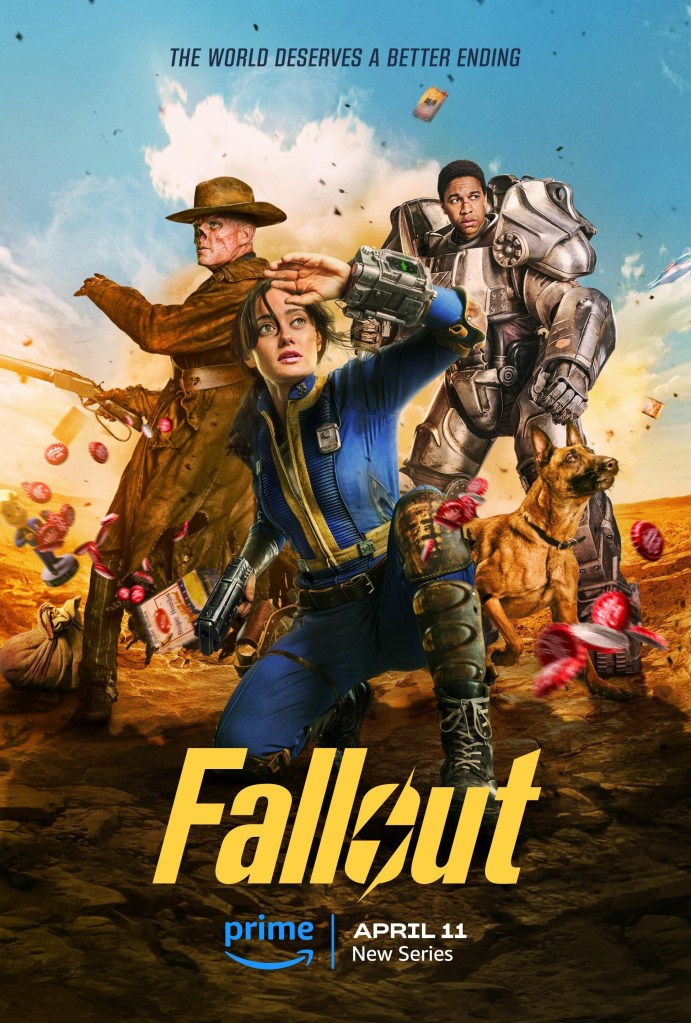
Continuing my series of only looking at the first episode of a show, we move on now to Fallout, which came out just a few weeks ago. Based off the video game series of the same name (which I’ve never played), it’s very much a post-apocalyptic story that hearkens back to the old sci-fi traditions and stories of the mid-twentieth century. Starring Ella Purnell, Aaron Moten and the always delightful Walton Goggins, the show follows three people over two hundred years after nuclear war has ravaged the Earth.
It was a bold choice to launch into a dual narrative (three narratives, if the last five minutes of the episode are anything to go by) and I think this is probably the weakest part of the episode. The prologue is stunning and gripped me instantly. It launches us into this post-war but alternative world with a TV cowboy entertaining a birthday party under the looming threat of a nuclear holocaust. After that, we’re greeted with a huge jump in time to a bunker with kooky characters, weird outfits and a shade too many incest jokes, if truth be told (I watched the first half with my parents before they decided it probably wasn’t for them). It’s weird and fun in a way that drew me right in, setting up some really interesting characters and concepts. However, we’re abruptly launched into a scene that’s far less fun and colourful, in the outside world that’s been ravaged by the nuclear fallout. It feels like a completely different show within the first episode, and while players of the games may think this works well, I thought it was just a little too jarring. Personal preference perhaps, but I’d have preferred an entire episode focussing on Lucy MacLean before we start to learn about other characters. That’s not to say the other narrative doesn’t hold promise, but it certainly hasn’t left the same impression of that whirlwind first half an episode. However, the epilogue of the episode has certainly piqued my interest again.
Crucially for an adaptation like this, I didn’t feel particularly lost by any of the plot points or jargon. It’s a very tricky thing for a first episode to do when it’s based off an existing piece of media – how to entice people new to the franchise without dumbing it down too much for old hats. It doesn’t feel like a lot of adaptations, where a lot of the scenes are akin to an inside joke and you just end up sitting there not entirely sure whether you should be laughing or not. Everything feels very organic here, we get lots of nice establishing shots in the first part showing us around the underground bunker. Our self-narrated introduction to Lucy is a nicely done touch of exposition too, where she’s talking herself up to justify why she should be chosen for marriage. Not only do we get a glimpse into her world, we also get a glimpse into the world. It’s a really well delivered set up to the show.
As you’d hope for in a show based on what I believe to be a fairly open-world, or at least open-ended, video game, there’s no telling where we’ll end up going over the next few episodes, or indeed across the possible seasons to come. We get very neat introductions to who I’m sure will end up being the three main protagonists – Purnell’s Lucy, Moten’s Maximus and Goggins’s Cooper Howard. Of these three, and as I’ve already said, Lucy’s is the most well-rounded by far, and Cooper’s adds a nice dollop of mystery to the whole affair – how does a handsome cowboy end up still alive 219 years later, sans nose?
It feels like a crime that I’ve barely focussed on that prologue, but that’s because I could write another thousand words on it. I’ll try to restrain myself though. It’s a truly fantastic introduction to the show and hooks you in instantly. Line, sinker and everything else for that matter. It sets the scene for the rest of the action too, hearing and seeing the fears of a nuclear war and the reactions to the prospect. These range from lack of care, to wilful ignorance, to outright indignation at being forced to do your job with the end of the world nigh. You get to see the devastation and the desperation that permeates the rest of the episode, with one family disappearing down an underground bunker and another father being beaten for trying to follow. The image of Cooper throwing his daughter onto his horse and trying to outrun a mushroom cloud is somewhat haunting and helps to illustrate the sheer scale of what has happened. It’s an effective contrast of the development of humanity too, the overlap of the old world into the new.
On a final note, I really really really really HATE when all the episodes from a new series are released all at once. I fully and firmly believe that they completely destroy the majority of hype and interest that a new show can generate. Fallout first came out on the 10th April, and I can’t remember anyone really talking about it since about four days after that. Of course, here I am, but I’m sensible. Comparing the interest in any show to Attack on Titan (THE show which has launched anime back into the mainstream) is unfair, as that has perhaps been the most anticipated and talked about show in the last decade, but can you imagine if the final season had all come out in one go? You’d have a very clear divide in the binge watchers and the people who want to take their time, and various subsections within that. No one on this planet, other than the initial binge watchers, will be on the same wavelength. What’s Eren up to? Couldn’t tell you, mate, I watched it all three months ago. Think he’s a giant bone man. Spoilers, sorry. Wasn’t it wild when *that* happened though? Oh, you haven’t seen that bit. Oops.
It’s my belief that a part of the enjoyment of any show, or piece of media really, is the shared experience. Yes, you could make a pledge to watch it at a certain time with a certain group in order to mimic that weekly release schedule that seems to be dying a painful death, but I just can’t see how that benefits anyone. The anticipation of waiting two months from the first episode to that last would still be building here if they followed the weekly release timetable, but alas. It seems that I’m going to have to carry on the tiresome routine of asking a friend if they’ve seen said show, to asking how far in they are, to one of us trying to recall when they watched the most recent episode that both of us have watched and what happened in it. I’m tired.
 The Herbshank Blogdemption