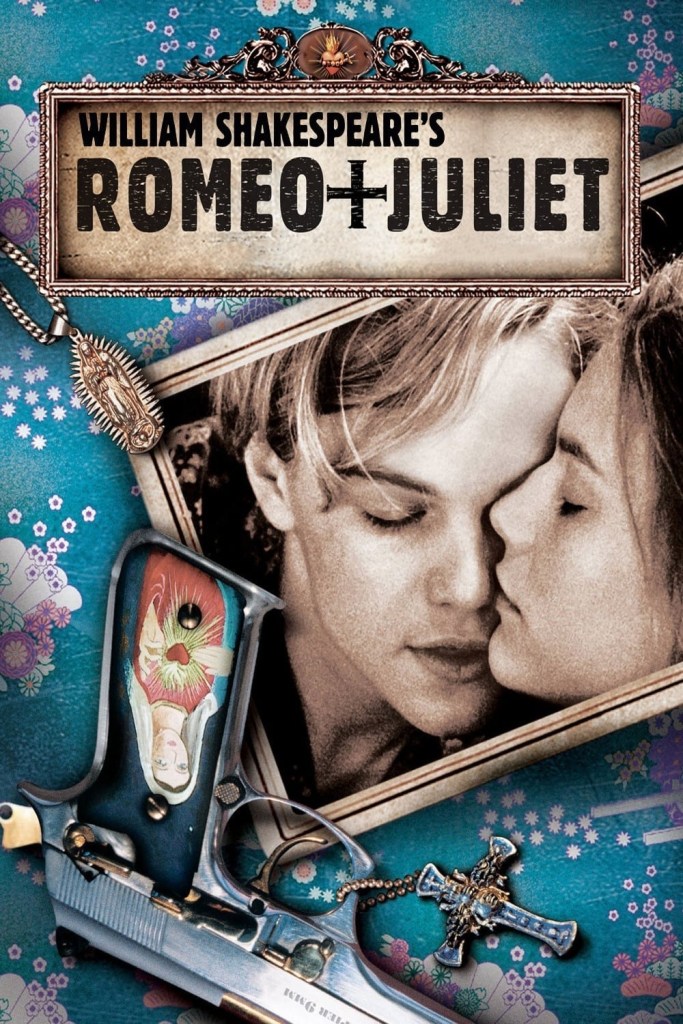
I used to hate this film. Hate, hate, hate it. Looking back, I couldn’t really tell you why, other than that I was a snobby purist who believed that adaptations had to be as close to 100% accurate to the source material as possible. Look at that, seems like I can tell you exactly why. Anyway, I’ve grown up and reevaluated my elitist attitude, so here we are with an incredibly fun adaptation of a Shakespeare classic.
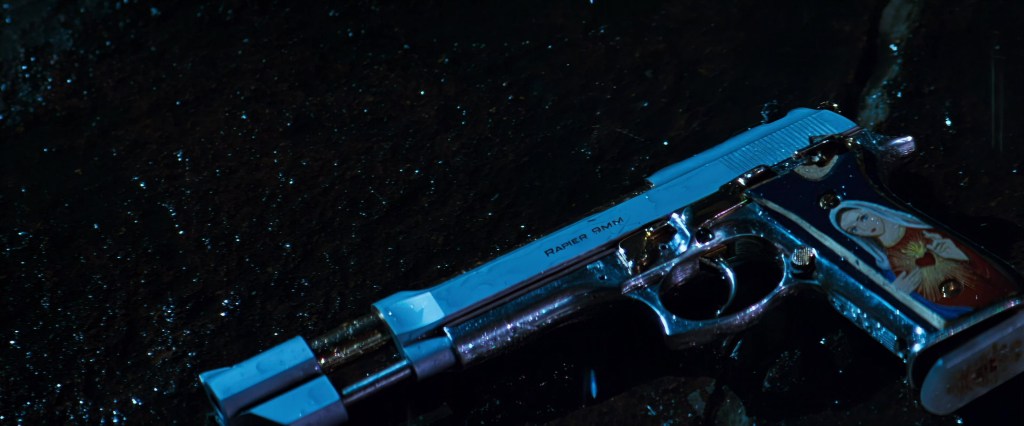
Almost all of the dialogue is lifted directly out of Shakespeare’s play which yields to certain logistical difficulties, all of which the film gets around simply by being earnestly and completely committed to itself. Instead of swords, the characters all carry guns which are branded with things like ‘Rapier’ and ‘Longsword’ (which is basically just a long gun, brilliant).
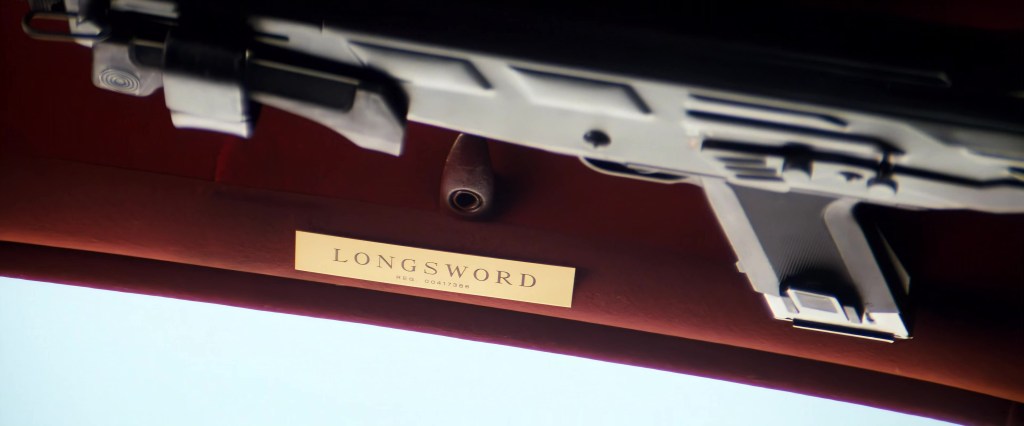
As silly as I used to think this was, it all works within the context of the film because once again, it is fully and sincerely committed to itself. There’s even a courier service called ‘Post Haste’. I feel like taking a very literal interpretation of how to adapt certain terms helps endear the film to the viewer. Some words and names are changed from the original – Friar Laurence becomes Father Laurence, Prince Escalus becomes Captain Prince for example, but these just help contextualise elements of the film for the modern viewer. If they had wielded guns and called them such, and if they had send the letter ‘quickly’ or ‘via UPS’, that takes us out of the hybrid world that Baz Luhrmann has created.
It also helps that it both looks and sounds gorgeous. The original play is full of moody and dramatic characters, and this film bathes them in a beachside sunset, neon filled tombs, a ruined stage. The opening shot of Romeo, smoking a cigarette on the beach whilst Radiohead’s ‘Talk Show Host’ plays is glorious.
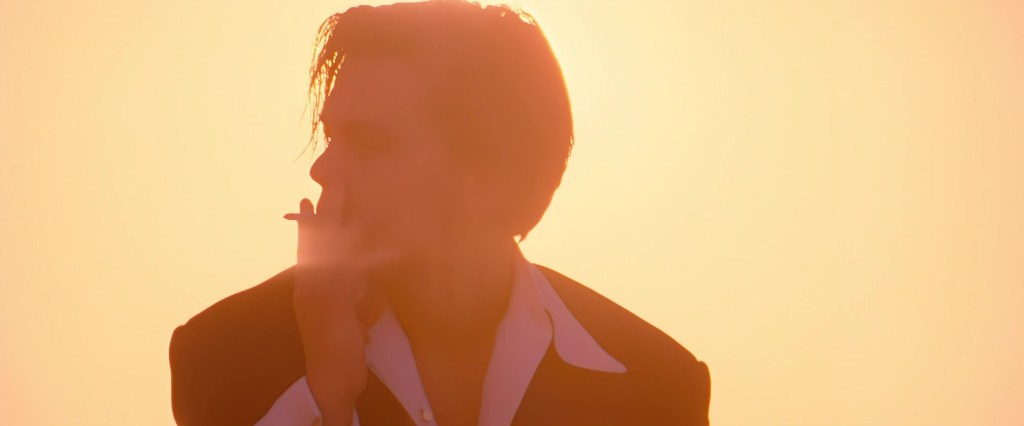
Greeting us with this image of Romeo tells us just about everything you need to know about this character. Handsome, cool, rebellious, moody, youthful, whilst still being uncertain about his place in the world. At this point, he’s in love with Rosaline, in the helpless way that young people are. In this short scene, we are given so much of the introductory context in quite a subtle way, certainly in contrast to the rest of the film’s more in your face method of storytelling.
The repeated use of the piano from Des’ree’s ‘I’m Kissing You’ plays almost as Romeo and Juliet’s theme throughout the film. The song is used diegetically as a performance at the Capulet party, which is where the lead characters first meet and first fall in love. I get goosebumps every time I listen to that song and it fits perfectly within the film. I couldn’t go this whole review without at least mentioning it.
There’s a lovely recurring motif of looking through water, either the characters or we the viewer seeing things through the water.

In a stark contrast to Romeo being bathed in the evening sun, we first see Juliet through the water. She is clear an angelic, hair floating about her face. Unlike Romeo who is looking off to the side when we first see him, Juliet is instead looking directly at the camera. She is far less conflicted than Romeo, she has not known the woeful state of unrequited love (although Romeo is being entirely far too dramatic about that, which is kind of the point). She also cannot hear her mother’s calls through the water, being immune to her family and the baggage that it brings. However, it is her nurse’s calls that eventually get through to her. In this, we get an early sense of the importance of her and her nurse’s relationship as well as her defiance of her family. Both of the titular character introductions are perfect and beautiful and tells us so much without beating us around the head with exposition.
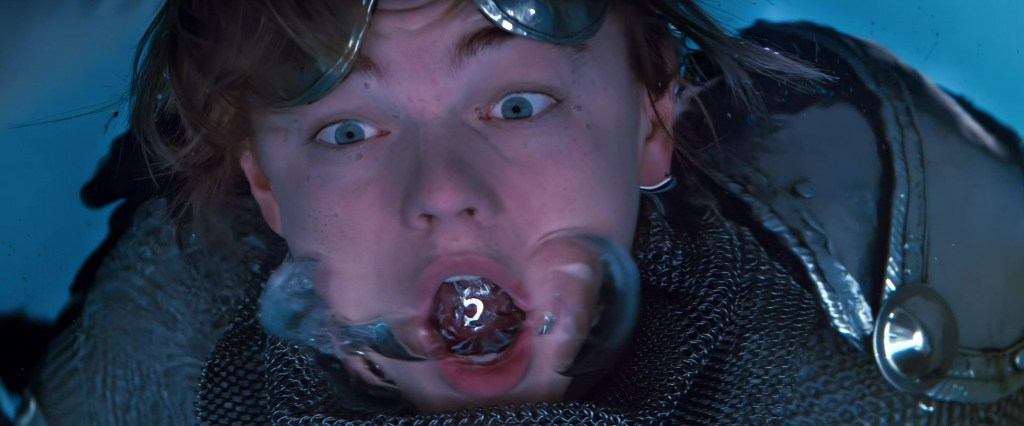
We also see Romeo in a similar position, although here he is distressed rather than at peace, trying to clear his head from the drugs that Mercutio has given him. He doesn’t know this, because he hasn’t watched the film, but he’s trying to gain the peace that Juliet feels at the beginning of the story. In the way that he is anguished and she is innocent, it is as if he is trying to rid himself of his unrequited love for Rosaline, as shown by him meeting Juliet very shortly after.
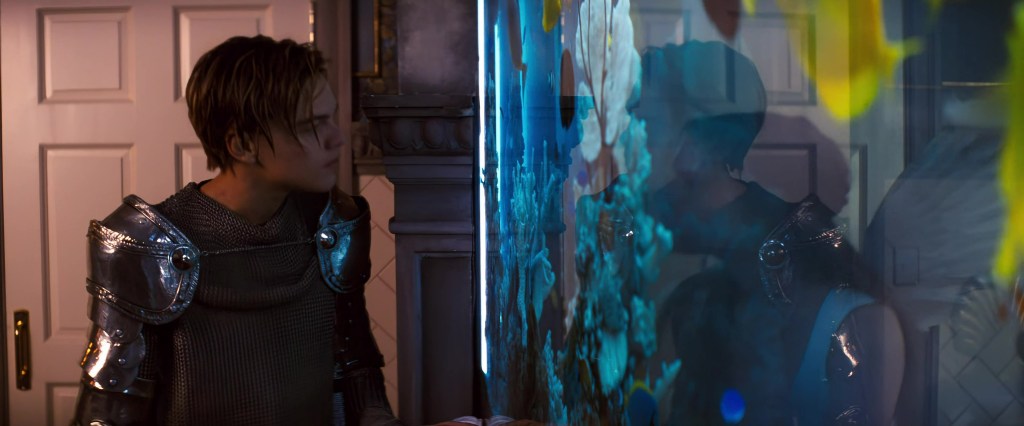
Once again, subtlety is not this film’s strong point, though it’s hardly trying to be. Their costumes are reflections of themselves, a medieval knight and an angel, and I think in this way they are reflected in each other through the fish tank. They are both innocent and they are both noble (and true and just and the rest of the things a knight is supposed to be). Of course, the glass and the water represent an invisible yet unbreachable barrier, owing to their family history, one that they don’t struggle to get around. Despite this barrier, they can see each other perfectly through it, and they do of course breach it and meet one another properly.
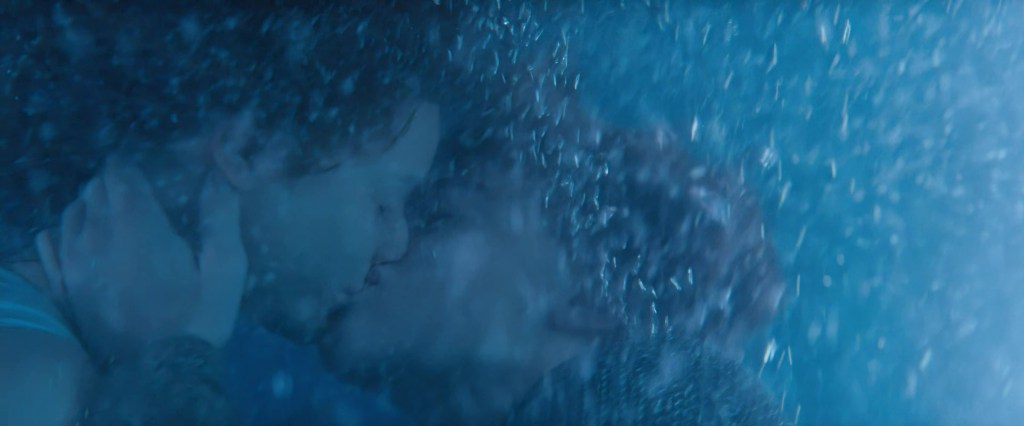
Water is so often a place of tranquillity in this film, a space free from the anxiety and stress of the outside world. It is through water that they both see each other for the first time, and a place that they share a final kiss before parting for the night, a night that will change their lives forever. Now I’m being dramatic, but it’s true. By inviting us into this peaceful place, the director is encouraging us to feel this calm, to share it with Romeo and Juliet. For all of its pomp and its grandeur, as Luhrmann pictures so typically are, this is contracted by the intimacy and tenderness of their relationship.
I’ve said before about the earnestness of the film, and that is represented and embodied by the performances of the two leads, Leonardo DiCaprio and Claire Danes. While they both struggle at times with the Shakespearean dialogue, that is not for their lack of trying. Their portrayals of these two well known characters are pure and sweet, and ultimately are thoroughly convincing. They have wonderful chemistry as well in their time together on screen, especially during their wedding (you’d hope so, wouldn’t you?).
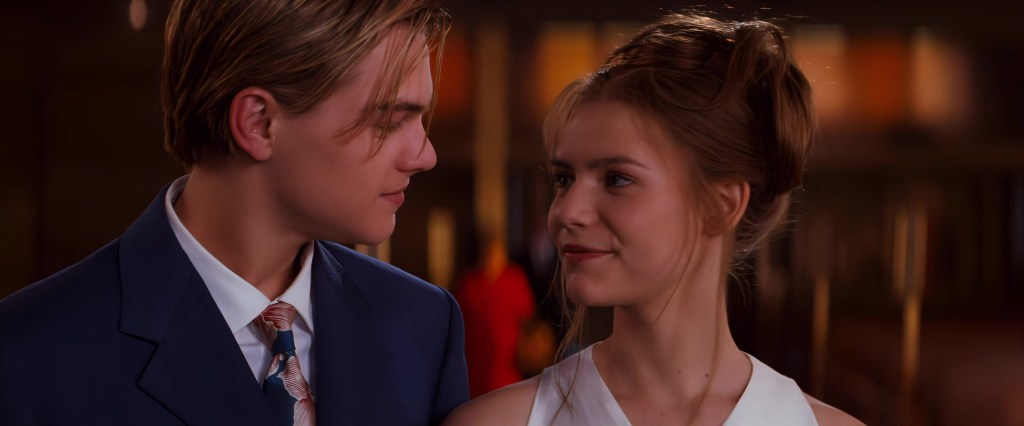
There are three absolute standout performers however: Miriam Margolyes and Pete Postlethwaite who are obviously completely at ease with the classical dialogue, and Harold Perrineau as Mercutio for his truly captivating take on the character. You can tell that the two classically trained actors are the ones most at ease with the dialogue and are able to grow beyond it, delivering memorable performances in small roles. Laurence has the gravitas of an experienced man of religion, and the unnamed nurse grows into her role as Juliet’s surrogate mother. She alone out of Juliet’s family and confidantes supports her fully and is seen with her throughout the film.
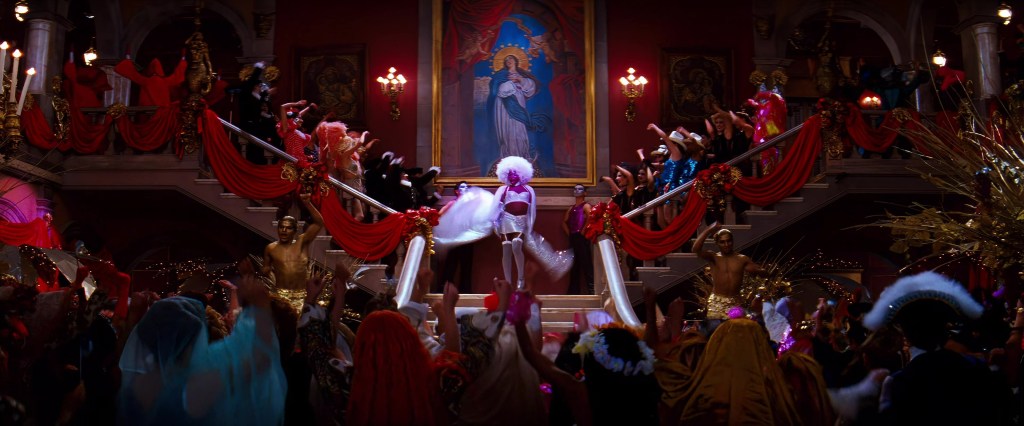
However, it is Perrineau’s Mercutio that steals the show. He has a wonderful physicality that dominates the screen every time that we see him, with the character always being larger than life in their various portrayals. His drag costume at the Capulet party is brilliant and he truly feels like the life and soul of the party, as was always his attention. He chews on the dialogue and Perrineau really enjoys the role, playing it with the sincerity of all the other actors in the film. His death feels theatrical as well as tragic in true Shakespearean fashion as well, literally set on the ruined stage on the beach. He clearly has so much fun playing the character, but his death does not feel like a loss from the story in a way, because this action sets in motion the tragedy of the climax. Indeed, Mercutio moves the plot along in a way that no other character does, whether it is his encouragement of Romeo to gatecrash the party where he meets Juliet, or his cursing of the two families and their feud as he lays dying.
How could I go this long without discussing all of the lovely religious themes and iconography? Almost all of the guns have imagery on them that wouldn’t look out of place in a jazzy Catholic church. Isn’t that ironic, weapons of death with the Immaculate Heart of Mary adorned on them?
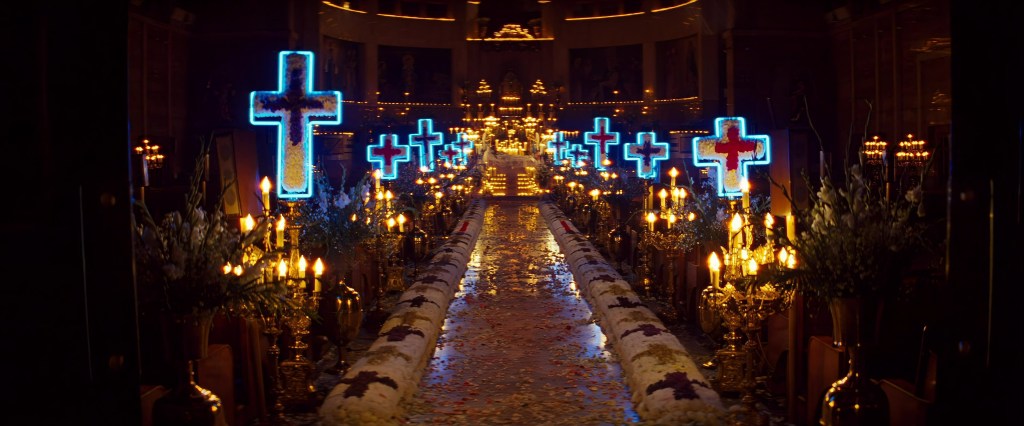
There are crosses absolutely everywhere as well. Tattooed on the back of Father Laurence, covering the tomb, even in the title. It is no coincidence that Luhrmann has opted to forgo an ‘and’ in the title and instead chosen a ‘+’. Star cross’d lovers, indeed.
I love these reflected shots of Father Laurence as he considers the implications that his marriage of Romeo and Juliet could cause, and then his plan to render Juliet in a comatose state in order to allow her to escape her family in order to be with Romeo.
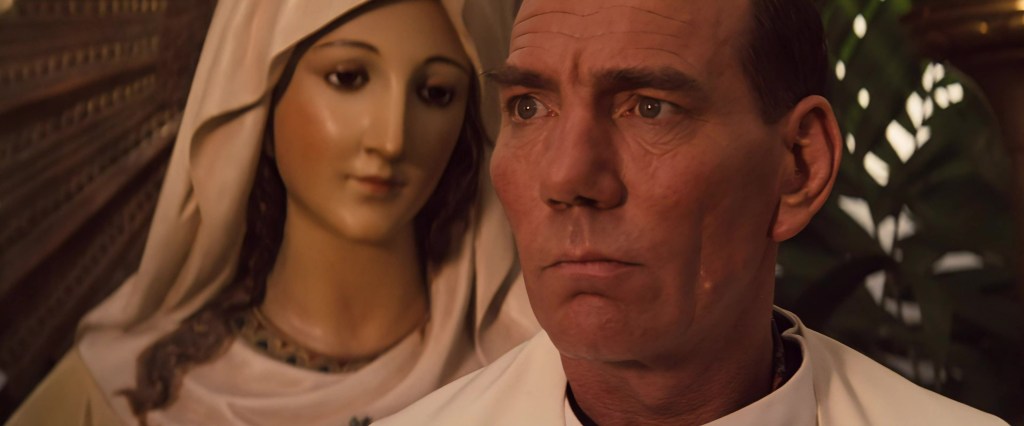
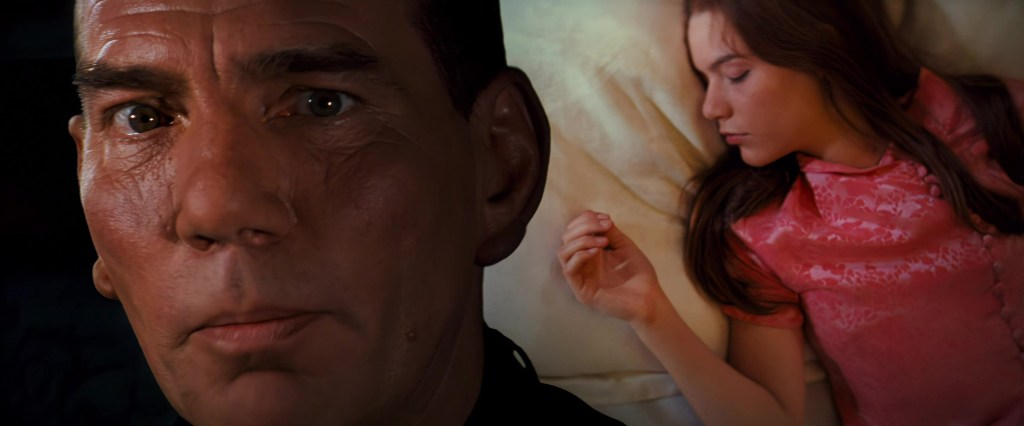
In each of these scenes, he has a vision of what the future could hold. He sees newspaper headlines announcing the conciliation between the Capulets and Montagues, and then of his plan to help Romeo and Juliet run away together. It also brings to mind the imagery of the angel and devil on each shoulder, representing the warring sides of good and evil. I had always thought that traditionally, the angel was always seen on a specific shoulder, but this isn’t the case. As such, the idea of the Virgin Mary whispering in his ear over his shoulder in the first image doesn’t necessarily represent the good, and the actions seen throughout the rest of the film as a result of him marrying the two lovers reflect this. Romeo and Juliet are two characters free from the burdens of good or evil, their love for each other defies this. It is the actions of the those around them that can be seen in this binary (though is there such thing as true good or evil? Certainly not in this film, but I digress). Juliet’s nurse and her love for her is good, Tybalt’s hatred and anger is evil. Things like that.
I really like the decision to have Juliet wake up just as Romeo has taken the poison. In the original play, he dies long before she awakens from her induced slumber and in other adaptations, she awakes to find him dead. Sometimes she kisses him in an attempt to take some poison lingering on his lips, in other she stabs herself. Here however, she awakes as Romeo finds her seemingly lifeless form, watching him take the poison before she can alert him that she is alive or realising what he has done. It is here then, after lamenting his death and the mere seconds that would have changed everything, that she shoots herself, her blood adorning his lifeless face as the true tragedy is allowed to sink in. They were ever the victims of small circumstances – the circumstances of their birth, the family feud, her engagement to Paris, Tybalt’s fury and Romeo’s vengeance. However, the choice to essentially close the film with a montage of Romeo and Juliet’s moments throughout the film as they lay dead in each other’s arms is inspired. These small circumstances also allowed them to find each other and be together, if only briefly. From their chance meeting at the party to their first night as husband and wife, we see how their flame burns brightly.
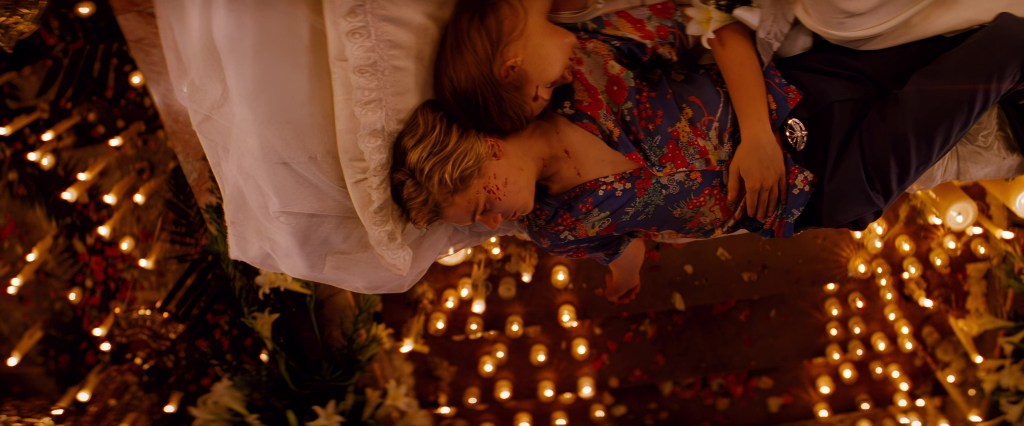
Romeo and Juliet is often called a cautionary tale about young love, but surely it’s a tale about finding moments of light in a life that can be extinguished far too quickly? In Romeo + Juliet, it is a story about the purity and earnestness of young love, of how small chances can lead to wonderful things, but how hatred and power are the barriers to such joy. We are never shown or given detail of what has caused these two families to hate each other so, and the purity and innocence of the titular characters is what should break this cycle, but only leads to their deaths. This is the true tragedy of Juliet and her Romeo.
 The Herbshank Blogdemption