Frozen 2

I think at this point, we all know how Disney struggle with their sequels. Throughout the nineties until the mid-noughties, we got a stream of direct to video sequels that varied in quality from downright terrible to just about watchable. However, in the last two years we’ve got sequels to two films that have really impressed me with the risks that they’ve taken, as surprising as it is for the company that also made at least five interchangeable Marvel origin films. I’ll save Ralph Breaks the Internet for its own post, because I feel like it was really underappreciated, as today I’ll be talking about Frozen 2.

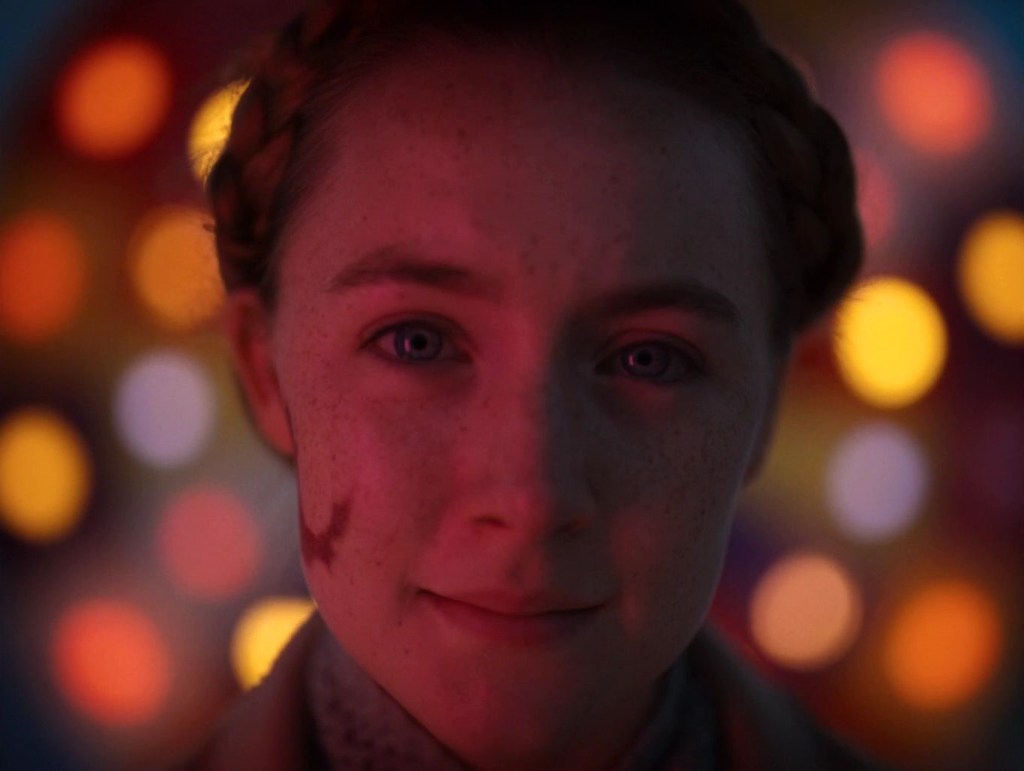
Frozen 2 is one of the most interesting films that Disney have made lately, and that’s saying something considering the quality of their animated features since The Princess and the Frog came out in 2009, kick-starting their second renaissance (I’m not sure if that’s an actual thing but I’m rolling with it). I think it’s easy to be cynical when looking at a film like this. It’s a sequel to what was essentially a cultural phenomenon way back in 2013, something that still sells a huge amount of merchandise even by Disney standards, so it would have been so easy to make an easy cash-grab featuring all their most marketable characters and a couple of new ones, but they did so much more than that. At its core, Frozen 2 is a very introspective look at how the past interacts with the present, with particular focus given to Elsa after the slightly more Anna-centric predecessor.

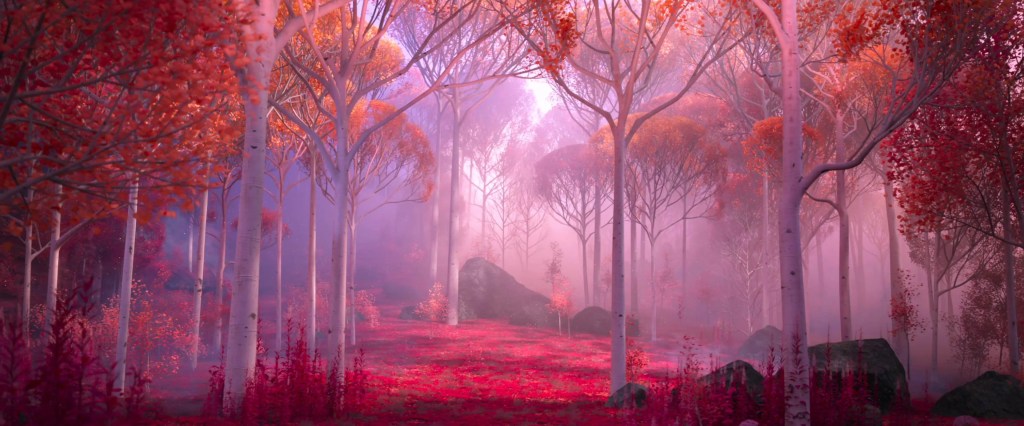
I actually missed the first couple of minutes of the film when I saw it at the cinema, which is really annoying now that I’ve watched those few minutes at home and realised just how essential they are to the story. There’s enough clues and exposition in the film to be able to work out what happened when it becomes relevant, but seeing it unfold is very important even if it’s just to set the tone. Actually, on that note, the whole film is such a joy to watch unfold on a purely visual level. If you start at Toy Story, you can watch 3D animation develop and change over the years and while it feels like every new film in the format is a lovely step-up, Frozen 2 really is on another level. Some of the backgrounds are just so gorgeous to look at that I became really grateful of the mostly static camera, the animators knew that they had created something beautiful and It was nice to linger on the landscapes while the plot unfolded.

Going back to those opening few minutes, they don’t only set up the core conflict of the film, they also set up the emotional conflict of the film with Elsa and her relationship with her mother, whose absence was felt in the first film but feels so much more impactful here. In the first film, the absence of Elsa and Anna’s parents is mostly a plot device to set up the need for Elsa to become queen, but here we really feel the impact that their deaths had. After that opening story from their father, their mother sings the girls a song to help them get to sleep, a song that is reprised later on as well. While Anna falls asleep, Elsa listens to the rest and I think that little moment helps give us just a little more connection between the two characters, which is so important given that Elsa finds her mother at Ahtohallan. ‘Show Yourself’ is undoubtedly the best musical number of the film, and one of the best in any Disney musical. It’s powerful and raw and carries so much emotion, the emotion that Elsa has been carrying ever since the beginning of Frozen really. I love Idina Menzel’s voice and she’s paired so well with Evan Rachel Wood, who apparently was specifically chosen for her voice’s similarity to both Menzel and Kristen Bell, who voices Anna.

Elsa’s journey to find herself is also so important in this film, as I feel like other than ‘Let It Go’, Elsa’s story is mostly told through Anna, which isn’t an issue in the context of the film as Elsa’s need to close herself off requires telling the story in that method. We see so many beautiful moments, with particular standouts being when they find the ship her parents were on when they died and when she tries to travel across the ocean. While the first showcases Elsa’s guilt that her parents were on the ship to try to find out about her power, the second shows off her willpower through the taming of the Nøkk, the water spirit. While her calming of the other spirits is far less dramatic, this one is a powerful sequence which befits the taming of a horse, a symbolic victory for Elsa as she makes her way to find the truth at Ahtohallan, something which she couldn’t do with her powers alone.

The relationship between the past and present is really the crux of the plot, and it’s here where I think the film really shines above the first. Frozen is quite straightforward to say the least, I know it has a couple of twists and turns but I feel like that’s all that the story has to offer really, which for something that was ground-breaking is enough, but it’s still nice to see something different here. The opening story from the father, about the battle between the people of Arendelle and the Northuldra, is something that we take to be true, because why would we doubt it? Seeing how the events actually played out is really interesting and I think quite challenging for a family film, as we learn that it was the king of Arendelle who struck the first blow, the truth being lost in colonial hubris. I think it’s so clever that the event revolves around the building of an artificial dam, given how connected the Northuldra people are with the spirits of the forest, and the eventual destruction of this helps to reconnect all of the people with nature. It’s such a well-considered way of setting up the conflict between the two peoples, where it holds different meaning to them both. I think it’s a bit of a stretch to call it a post-modern film, but the nature of questioning the past and accepting that there is no single fixed interpretation of it fits very much into the core philosophy of the movement.

The comparisons to the treatment of the Native Americans are numerous as well, something that I really didn’t expect in an American-made, family film, certainly not one made by Disney. The king of Arendelle dislikes the Northuldra’s connection to magic and uses the dam to weaken their connection to the spirits, which sounds very much like the historic erasure of native religions and traditions. Likewise, there is that previously mentioned desire to erase the actions of the colonial aggressors and spinning the events around to the negatively portray the native people. Even in the story told by the father, the cause of the conflict is left in the air, and when we learn that it was actually Arendelle who struck the first blow it isn’t too much of a surprise. I was fully expecting the destruction of Arendelle when the dam broke but it was interesting to see Elsa save the castle, with the suggestion that Arendelle can become better than its past a positive message to take home. The actions of the father are not those of the child, and seeing Elsa and Anna be the people to bridge the divide and help free the Northuldra from the event that their grandfather caused is really important.

The only thing that didn’t really click with me was the Anna and Kristoff stuff, but it doesn’t take up too much of the film so I’m not too fussed. The relationship drama was a bit tired and it just felt like there was that need to push that onto the viewer without any real need for it. I had no issue with them being together at all, but the fact that Kristoff’s whole story in the film revolved around him trying to propose is just a bit cliché. His line at the end where he says “my love isn’t fragile,” was nice though, I just felt like that could have come as a result of them not being together in the film much due to bigger problems, without the proposal drama thrown in. Honestly, I’d have loved to see more of Elsa and Honeymaren, one of the Northuldra women, it was nice to see Elsa in brief conversation with someone new and with all the discourse surrounding Elsa’s sexuality, I feel like this could have been the start of something really good. Kristoff’s song was brilliant though, and while I didn’t particularly like their story together, I thought Anna had a great supporting role in this film. Her love for her sister is basically what the whole first film is about, and it’s nice to see that continues here with her undying support for Elsa. You can see how hurt she is when Elsa leaves her behind and ‘The Next Right Thing’ is heart-breaking, and yet another surprise with how frankly it talks about feelings of depression.

Olaf has a great role in this film and is definitely one for the children, though like most family films, everyone will enjoy what he does in the film. Olaf is one of the characters I was most worried about for the sequel due to his marketability, but they keep his sense of wonder and naivety and warm-heartedness that makes his character so sincere and fun to watch. He’s extra important in this film due to the far heavier themes on show, and he’s used to balance those out really well. I think the directors did a really good job in knowing exactly how to use him for absolute maximum effect, and he really shines as a result. All of the characters are really effective individually really, and aside from the Anna and Kristoff stuff that I didn’t really like, all of the combinations work well too. At its core, the film really is based on Elsa and Anna’s relationship and that only grows throughout this film.

This is one of my personal favourite films, re-watching it at home has only solidified just how much I enjoyed it and I think that’s mostly based on how much new ground it covers. I love films that take risks, which I’m sure you’ll see a lot of as you read some more of my posts, and I think the risks in this film work so well. They’ve taken what worked best in Frozen and built on it, and they’ve used interesting new plot developments and ideas to really turn this into something special. I could talk so much more about this film but I really don’t want to go on for too long, maybe I’ll write a follow up to develop existing points and talk about new ones. Hope you enjoyed!
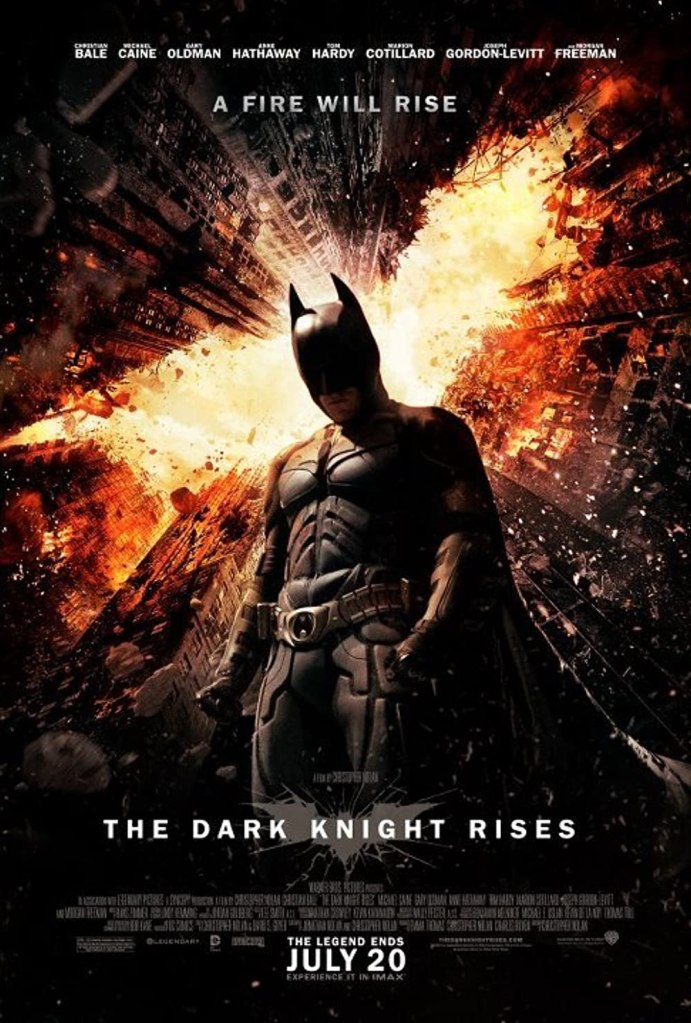
The Dark Knight Rises

I remember watching The Dark Knight Rises at my local cinema for my friend’s birthday, all the way back in 2012 (I have recently been corrected by said friend, Liam, that it wasn’t for his birthday but it was in summer, but I was half right I suppose). I had only seen The Dark Knight prior to watching this, and I thought it was a fantastic sequel that finished the story that I had seen very well, but after I had watched Batman Begins, I realised that it shared far more similarities and themes with the first film in the trilogy, not least due to the constant appearances and references to the League of Shadows. A lot of criticism of the film has arisen after its release, mainly relating to the inconsistencies in logic and character decisions, which I think are a little unfair, though more on that later. It is a very accomplished film in its own right, and it helps with the emotional payoff that Nolan has had three films to help build and establish his characters. The action sequences are bigger than ever before and are just an absolute blast, the opening scene a particular highlight in how it’s crafted.

I think it’s most appropriate to start by discussing the characters, as unlike any other Nolan film, we’ve had three films to watch and understand them, and I think the ones that we have seen throughout the trilogy are fantastic. It is his secondary characters that normally suffer, but I really like the ones that he introduces here – namely, Selina Kyle (Anne Hathaway) and John Blake (Joseph Gordon-Levitt). It helps that they’re both portrayed by very accomplished actors, but they feel very fleshed out as foils to Batman, and Bruce Wayne. Selina Kyle is the antithesis to Batman, she uses her mask to disguise herself and for personal gain rather than to protect loved ones and to help others, and John Blake mirrors Bruce Wayne’s own background as an orphan, taking action in a police uniform rather than a mask and cape. We see two sides of the story of Gotham that Bruce, in his mansion and with his wealth, hasn’t been able to consider. That’s not to say that his character hasn’t suffered, but he’s suffered in a very different way to the two traditional side-kicks.

Talia works moderately well, but the nature of their prior relationship is left very unclear so it doesn’t really make sense when Bruce trusts her with everything to do with his business, a rather crucial plot point as it’s through this control that she engineers the attempted destruction of Gotham. Bane really is such a scene-stealer that it’s almost a shame when it’s revealed that he’s not the mastermind of the plan. I’m really impressed by pretty much every aspect of Bane’s character, as he’s very much the opposite to the Joker in a lot of ways. Bane in hugely strong and imposing, with a legion of followers loyal to the death, whereas the Joker is slaughter and doesn’t use brute force, and operates very much alone, with followers controlled by fear rather than loyalty. Bane also works well as a foil to Batman – stronger and more ferocious, with a mask worn out of necessity rather than choice. They are each students of the League of Shadows, though Bane has a mastery of those skills that Bruce Wayne simply doesn’t. There’s a lot of ideas in this film about the difference of upbringing, with Bruce’s wealth shielding him from a lot of the horrors in life, whereas the likes of Selina, John and Bane don’t have these. There is an arrogance in the nature of Batman, where he places himself above the law and acts like the biggest kid in the playground, but Bane breaks this image of Batman. Bruce is able to rebuild Batman into someone who has learned from both John, when he joins the police in taking down bane’s mob, and Selina, who understands that a moral code is nothing when lives are at risk. Bruce, despite knowing the threat of Bane, is unable to kill him with weapon or blade no matter what happens. Selina does not have such ethics, and does what needs to be done.

The use of the police is interesting throughout the film, after the corruption and failure of the service in the previous two films, we see a police force that is eager to crack down on criminals without having anyone left to arrest. Batman has always operated above the law, and here we have a law which is at a level that needs no further help. As Bruce had hoped, the Dent Act has helped make him redundant, but this is of course built on a lie. This film respects the democratic and bureaucratic process in its rejection of Scarecrow’s witch trials and mirrored denunciation of the Dent Act. Just because everyone knows that the criminals who were eventually arrested, thanks to the emergency powers granted by the Dent Act, should be behind bars, doesn’t mean that they don’t deserve due process like everybody else. Bruce works with the police throughout the climax of the film, unlike dealing solely with Jim Gordon like before. He recognises that an us versus them mentality is no longer needed in Gotham, that what it truly needs is balance between the people and those trusted to enforce the laws of the land. While the shot of the police charging machine gun fire is silly, the payoff of Batman fighting amongst them in broad daylight is brilliant.

I’d never actually seen the first film in the series until well after finishing the last one, which is a shame because so much of the emotional weight and climax of the film relies on having seen Batman Begins. There are so many direct continuations of plot points from that film, namely the League of Shadows, but also smaller moments that add thematic weight to the story. I’ve seen many people ask how Bruce returned to Gotham, and other than ‘he’s Batman’, the most obvious explanation seems to me that he returned across the ice, having learned and fought on the ice with Ra’s al Ghul in the first film. Bruce learned a lot from his time with League, and while his combat techniques didn’t work against Bane, leaving him quite literally broken, that does not mean that his other talents should be wasted. There is also the idea of rising which occurs throughout the film, in stark contrast to the physical falling of Bruce as a young boy down the well. Falling gave Bruce his fear of bats, which shapes his entire journey as a character. It’s this phobia that inspires his costume, inspires the symbol of Batman, and affects his entire being. This is, of course, directly referred to in the scene where Bruce makes his final climb out of the pit, a flock of bats appearing and galvanising his resolve to make the leap.

Similar ideas and images such as this are contrasted between the films – the rise and success of Wayne Enterprises to its apparent fall in this film and the use of Ra’s and then Talia al Ghul to highlight the nature of the League of Shadows being the two most prominent. It’s a shame that Wayne Enterprises never really feels important after the first film, where you can really see its impact on Gotham. It’s a booming success in the second, and by the third film it simply becomes a tool by which the plot moves forward. It’s a very useful tool, as it’s used to represent Bruce’s lack of interest in the outside world, which helps inspire his return when he sees how important both he and Batman can be to the city, but it doesn’t feel as real and important as in the first film. It’s in Batman Begins­ that Ra’s claims that he can live forever, and while this is shown to be how his ideas of chaos and destruction live on after his death, he also meant it literally in how his daughter takes up his mantle in an attempt to complete her father’s work.

Speaking of Talia, goodness me is her death silly. Not so much the nature of it, but the way her head flops down like a cartoon. This isn’t the only odd moment in the film, though it’s hard to recollect many after the fact which is certainly a point in the films favour. The dialogue can be quite stilted, though this is a problem throughout Nolan’s filmography, and is never particularly bad. A lot of people take issue with the speed and method of Batman’s return to Gotham, and how he managed to survive the nuclear blast at the end of the film. I feel like the former issue isn’t a problem, as despite everything that’s happened, he still has the knowledge and skill of Batman, and the favours and power of Bruce Wayne. I can see issues with the latter though, as Bruce is very clearly shown in the Bat-Plane while it is over the water, leading to questions as to how on earth he got out in time even with the autopilot enabled. This, however, is one of the things that I chalk up to an editing issue. Perhaps the intention was to show him for the final time sooner into the flight rather than over the bay, which would suggest that he was able to get out in time without taking away the ambiguity of the penultimate scenes. It’s not really enough to detract from my viewing experience though, it’s just one of those things that happens in film.

Interestingly, both of my parents enjoyed this the most out of the trilogy. Dad thought it was brilliant, having thought the previous entry was too dark and miserable, and mum thought it was good fun without having the scariness of the Joker. This is in contrast to the general view that it’s the worst of the trilogy, not a bad film by any means but not as much of a triumph as the other two films. I think it’s interesting how all three films are so unique in their own way, with each one having very strong arguments for being the best in the trilogy. I really enjoy how fun this film is; Bane is a great villain and is perfect for the story, in the same way that Scarecrow and the Joker fit perfectly within their own narratives. While I think it is the least polished of the three, that doesn’t mean that it’s a bad film at all, and at some points stands the highest of the entire Dark Knight trilogy.

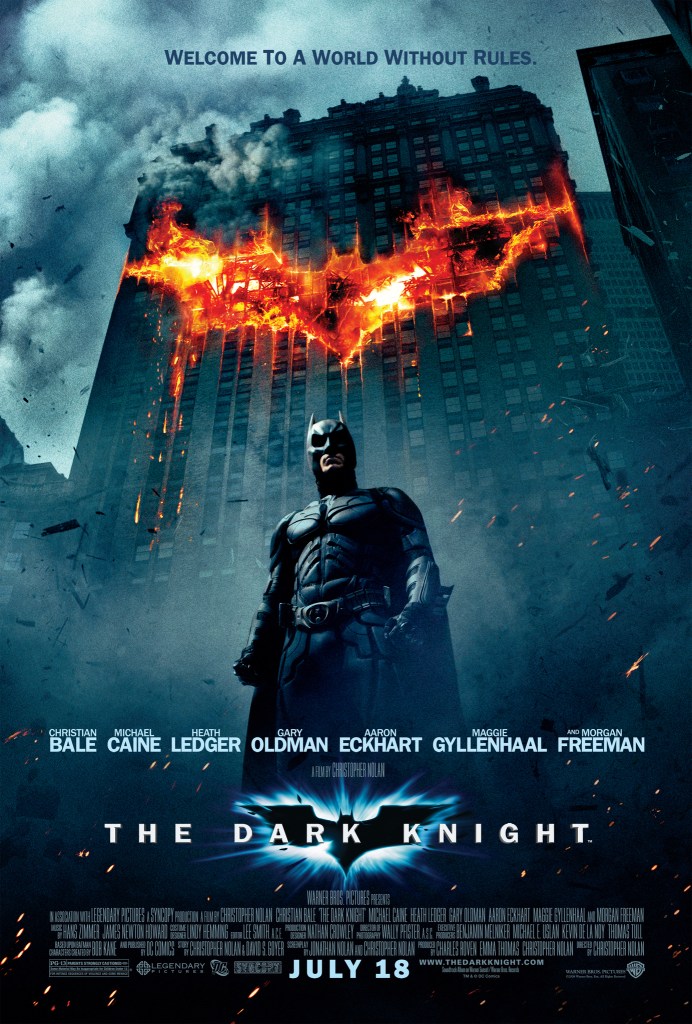
The Dark Knight

The Original Poster

The Dark Knight is like The Beatles, or fish and chips. You may not watch it in a while, you go through phases and trends but when you come back to it, you’re reminded why it’s one of the best films ever made (yeah, no controversial opinions here yet). I’m rarely quite so gripped by a film, especially one that I’ve seen several times before, but this one has me on the edge of my seat pretty much the whole way through. Of course, this is a recurring trend with Christopher Nolan films. They all have at least one set piece or scene which, when it finishes, makes you realise that you can’t remember the least time you breathed. He really is a master of that, of that feeling of suspense and tension to the point where you can get utterly lost. However, unlike his other films, this feeling happens far more often. And that’s due to one key element; Heath Ledger’s performance as the Joker.

What better way to kick off by talking about the one part of the film that to me is absolutely perfect. It’s going to be hard to say something that hasn’t already been said, so what’s the point in trying? People enjoy greatest hits compilations for a reason, and why should you read fifty reviews when you could just read mine? Aside from the obvious superiority in quality that you’ll find in most other publications of course. Ledger absolutely dominates every time that he’s on screen, he’s dynamic and electrifying and is such a huge presence, not physically of course but his character drives the entire plot, and arguably the sequel too. When I watched this film again with my family, my mum was really unsettled by the character, in a way that I haven’t really seen before. Hyperbole is no fun to read though, trust me, so let’s get down to the real nitty gritty.

Physicality is a really underrated acting trait I think, something that I rarely see talked about. When it stands out, it really does, and the best comparison I have is when you watch Timothee Chalamet move on screen. He really inhabits the characters that he plays, and I really recommend you pay close attention to him in any one of his films. Back to Heath Ledger though (I just find it hard not to talk about sweet Timmy at the moment) and he absolutely becomes the Joker. Every movement he makes almost feels calculated, like you can see the cogs in his body turning as he works out how to make his next tiny motion, combining them all into something as simple as the way he stands, or holds a knife. You can tell so much about his character without even hearing him speak, from the way he moves his lips to the way he is standing in front of the Batman as he races towards him on the Bat-Bike. It really is something that’s so interesting to watch on-screen. Likewise, the way he uses his voice is similarly impressive. The range of his mannerisms and little voices that he does changes throughout, and the few moments that he bellows his lines are genuinely quite scary. The entirety of the recorded murder of the Batman impersonator is really chilling, and when he screams “look at me,” you can’t help but pay attention, as if he were doing that to someone on television in real life.

So much so is the quality of his performance, that it actually contributes to the biggest issue throughout the film – whenever he isn’t present. I’ve always thought that the moment that Batman strings up the Joker by his ankle is the moment that The Dark Knight loses its way, but I was wrong. Two-Face is an extension of the Joker, a creation of disorder from order and as such, his final act is that of the Joker too, even though Heath Ledger isn’t on screen. Therefore, the issue isn’t so much when he isn’t present physically on screen, but instead when his influence upon the film isn’t felt. These moments are rare, but disrupt the entire flow of the film. Mostly it refers to Bruce and Rachel’s relationship, one of the few carry-overs from the previous instalment and the only one that doesn’t really work. Of course, the Joker tears them apart, and Rachel reminds us what the Batman means to Bruce Wayne, but we already knew that. The entirety of their on-screen relationship in this film is devoted to that point, which means her death is ultimately the removal of a speed bump in the narrative. He cannot continue to be the caped crusader while she lives, so she must die. This doesn’t have the emotional impact that it wants to, which is a shame though. Once again, even though I’ve gone into details and tried to find the specifics, it really does come down to the fact that when the Joker is not there, the film suffers. It’s not as if Heath Ledger could always be on screen, I know that, but sometimes I wish that he was.

However, I can’t spend all day talking about this (well I could, but I won’t), so let’s move on. The context of this film is so important too. While I love the slight hamminess of Batman Begins, which was common in all of those early to mid-noughties superhero films, it’s clear to see how far the genre had come in that time. X2 was a leap above X-Men in a similar way, and was likewise a bigger critical and commercial success, but I feel like Nolan really showed off how dynamic the genre can be. I certainly don’t agree with all this re-labelling of various Marvel films (particularly Phase 2 ones as they were oh so formulaic) as being ‘political thrillers’ or ‘Shakespearean tragedies’, but this proved that they could be a level of seriousness and thoughtfulness beyond any that had been seen before. Indeed, it’s fun that Iron Man came out in the very same year because that was similar in its introspection, looking at the internal politics that the films creates and responding to them. They’re very different films, but they’re certainly two sides of the same coin, and I think they’re a response to the very cheesy and over the top nature of Sam Raimi’s Spider-Man films. It’s a shame that we’ve swung in quite dramatic directions since then, where superhero films either become bogged down in melodrama or become so afraid of being serious that they feel the need to crack a joke every time something sad happens, but what can you do.

When I talked about Batman Begins, I talked about how Batman was a far less interesting character than Bruce Wayne, but here he really comes into his own. If Begins was about Bruce finding himself, then this film is about Batman doing the same. It’s funny referring to them as two different characters but in the context of the film they’re completely different, as Bruce often points out that Batman is a symbol, that anyone could be the Batman, including Harvey Dent. I’m not sure if the man in the mask actually gets more screen time than the previous film but it certainly feels like it. Bruce’s story is far less important here. He’s returned to Gotham, turned his company around and is just living his best life really, at least until the woman he loves dies etc. Batman, however, has become the symbol of justice in the city but has to contend with the fact that if he truly is a symbol, then he does not need to exist. Indeed, by the end this symbol is desecrated and destroyed in order to uphold what he feels is a more important symbol, that of Harvey Dent.

This is completely isolated from all my other points, but I just wanted to talk about that ridiculous trial scene where Harvey punches the criminal in the face and then quips about how he should have bought American. I used to have this scene, but given my thoughts about how much I loved the hamminess of Batman Begins I’ve really come around on it. I also have my suspicions that it’s basically a little mocking of Americans by Nolan, like to me that’s exactly how I imagine American courts could be with the guns and the patriotism and everything rolling into one neat stereotypical package, which does make the scene even funnier to me. Was it meant to be? I don’t know, but I got a kick out of it for sure.

I spoke enough about how Gotham loses its identity compared to the previous film in my post about Batman Begins, but while I would like to reiterate that I find it disappointing, I see why Nolan wanted to create a much more clean and modern city, as we are supposed to be a few years into the streets being cleaned up and prosperity returning.

I know I spent nearly half of this talking about the Joker, but it’s just so hard not to. I think the film lives and dies with him, which is why it’s such an overall success. I know my opinion that it’s not the best in the trilogy is an uncommon one, but that’s not to take away from the movie at all because it’s just so good. Nolan likes his set pieces and this is full of brilliant scenes that just leave you unable to breathe, so much so that I left mentioning this point to the very end so I wouldn’t get carried away and spent three pages talking about each one of them in great depth. The opening is probably the best for me, and just sets the tone of the film. Overall it is an extraordinary success, the quality of which I don’t think we’ve seen since in since within the genre, but what an incredible peak it is.

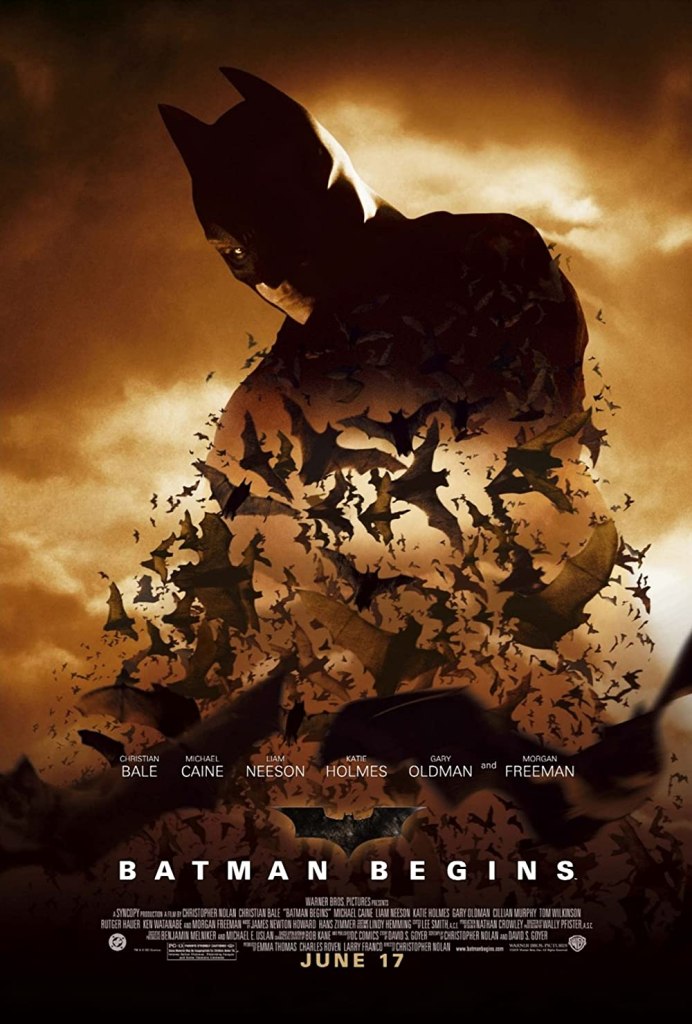
Batman Begins

I’m going to open right off the bat (haha) and say that Batman Begins is my favourite of The Dark Knight Trilogy, and if you read on then you shall surely find out why. To give a little background info, I watched this last out of the trilogy, possibly because I didn’t even realise it was connected until reading about The Dark Knight Rises after watching that at the cinema. Batman Begins very much feels like the odd one out, for a number of reasons, including the fact that Rachel Dawes was later recast and that the feel of Gotham was completely different from the next two, mainly due to the fact that large parts of this film took place in the Narrows; the slums of the city essentially. It does set up pretty much all the thematic conflict for the entire trilogy, and I think being the odd one out really suits the narrative of the film.

I’ll start by talking about my favourite part of the film, and the thing that quite disappointingly didn’t really carry on into the next ones, the use of the city of Gotham. Gotham very much feels like its own character within the film and has a very strong identity. It was mostly shot in Chicago, with lots of exterior shots in other cities including London to give it a more universal feel, supposedly Christopher Nolan wanted Gotham to feel familiar but not too much so. Unlike the sequels, a lot of CGI and sets were used to help diversify the feel of the city, especially in the Narrows, which I mentioned before. Now of course there are reasons that this technique, for lack of a better word, isn’t used in the sequels; the Narrows are described as lost at the end of this film, and as the symbol of Batman works its magic, the city of Gotham becomes cleaner and more modern. It’s not like Batman is a wizard or anything, it’s just a very strong visual motif to symbolise the moving on from the chaos and darkness of the city in this film.

Honestly, more than anything I just love how timeless that Gotham feels. In some places it feels almost Victorian and very industrial, but we also have the modern cityscape too. I think the monorail is brilliant and I love how obvious a metaphor it is for the class divide and issues of Gotham, as we see how run down it becomes over the years and is essentially a symbol for the growing inaction of the wealthy. This strong visual identity is what separates it even more from the other two films in the trilogy. The themes all build on one another, but the Gotham we see in this instalment is very much its own unique take on the city, and one that I wish stayed with us in the sequels even though I understand the thematic reasons as to why it couldn’t.

Another strong visual choice that is not just unique to this film, but occurs throughout Nolan’s filmography, is the use of very quick cuts. I noticed this a lot when I was watching Tenet recently, that scenes and dialogue rarely have a lot of room to breathe as Nolan often cuts away as soon as the last word of dialogue has finished. It adds a lot to the pacing of the films, and this one especially feels like it covers a lot of ground in a very short space of time. Bruce Wayne’s time with the League of Shadows benefits especially from this, as like with the use of Gotham, the quick cuts and chaos tie in well with both the League’s ethos and ninja-like nature. The fight between Bruce and Henri Ducard on the ice is particularly memorable to me, with the dialogue fizzing between them as they fight and we see each of them lose and gain the upper hand. That’s not to say that every single scene is cut as soon as the character finishes speaking, but it happens a lot and is used well when it does.

While we’re on the topic of technique tying in with theme, the use of Ra’s al Ghul is brilliant and there’s a reason that his impact is felt, both literally and metaphorically, throughout the trilogy. Maybe I’m giving the director too much credit, but I feel like he’s playing on the well-worn trope of ‘old oriental man is incredibly wise and worldly’ with the decoy of Ra’s appearing to lead the League while Bruce is training, only for it to be revealed later than Liam Neeson’s character is the real Ra’s. The constant use of deception and theatricality is drilled into us throughout the beginning of the film, and this just serves to drive home the message. The plan to destroy Gotham makes sense and is given extra weight when it is revealed what else the League of Shadows has achieved.

Scarecrow was a fantastic secondary villain too, and one who I’m very pleased appeared in every single film, even if they’re only really cameo appearances. He just reminds us that Gotham is still a mess, that chaos continues to live beneath the surface and, as a result of this, constantly reminds us what Ra’s al Ghul was capable of. Too often in these sorts of films we end up with a very bland and basic introductory antagonist, only to give us one who is actually a threat later, but all three of these films have an appropriate enemy for the Batman. I like the reflection and contrast to the Batman – they are both masked, anonymous, and in a way they both represent fear, but they use this tool in very different ways. Where Batman is holding up a mirror to society, Scarecrow revels in it, wallowing in the filth and chaos that he creates. They aren’t so different, really, but it does show how power can be used in different ways.

Speaking of the Batman, let’s talk about Christian Bale. I think he does a very serviceable job as the caped crusader, but where he really shines is as Bruce Wayne. He really portrays that sort of smarmy, self-obsessed rich man very well but luckily he does less horrible things than in his star turn in American Psycho. I feel bad because his Batman really isn’t anything too memorable in this film, and it’s one of Nolan’s few flaws that he really does struggle with compelling characters outside of the lead, and to me the lead here is Bruce Wayne. Bruce has a lot of depth in this film, we get a very good sense of his character early on and when he eventually becomes Batman to protect the city, it’s not a surprise (I mean obviously we knew that because duh, but it feels very true to character which is what I’m trying to get at). I like Rachel too in this film, though she doesn’t really have much to do which is a shame.

I also LOVE the treatment of Mr. and Mrs. Wayne in the film, they’re revered almost to the point of deification by Bruce and even though we all know the story of Bruce Wayne the orphan, we really feel the impact of their deaths. We see their influence all through the film with the so-symbolic-it-basically-punches-you-in-the-face monorail, which I mentioned earlier. We see Bruce’s father talk about how he built the train for everyone in the city to use, a cheap transport system to unite the public. The fact we see him using it makes him a true man of the people, someone who leaves his ivory castle and really belongs in Gotham. Later in the film we see Rachel riding it. It’s dark and grimy, covered in graffiti, the film is basically slapping you in the face at this point but subtlety is a hard thing to do in superhero films, for seldom found in superhero films, or Nolan films for that matter. The ghosts of his parents, especially his father, are present throughout the story and it’s only by confronting the idea of them, the idea that’s been allowed to die in Gotham, that Bruce can start to truly rebuild their legacy. They were the face, but Batman is the symbol.

Having said all this, I think one of the most fun scenes in the film is also the most superhero-y. This is the fight in the docks, Batman’s first night on the town. It’s dramatic and spooky and fun and over the top and the bit where Batman grabs Falcone by the collar and says, “I’m Batman,” before headbutting him is so comic book it’s brilliant. It’s just ridiculous and really helps balance the tone of the film, where you remember that yes, while this is a serious film, it’s also a superhero film. I also love when Batman first uses the Tumbler in the streets, where it pretty much growls and feels so ferocious. It’s another scene that’s just so much fun that you can’t really dislike it.

There’s a lot more I could say about this film but I don’t want it to feel like a recap, or too long, so I thought it would be nice to highlight mostly the smaller things that I like about the film. There’s a lot to love about it and it’s definitely my favourite of the three, even more so than The Dark Knight. I think that TDK is technically the better film, but I love films that do something a bit different even if it doesn’t always come off, and this film is really ambitious so I can forgive any small flaws a lot more easily than something that plays it safe. The best comparison I have is The Great British Bake Off, where Paul and Mary/Prue always say that if something is basic it has to be absolutely perfect, but if it’s more ambitious then they can forgive a couple of mistakes due to the technical skills required. Bet you never thought you’d see a Batman film discussion end with a comparison to a baking programme, did you?

The Grand Budapest Hotel

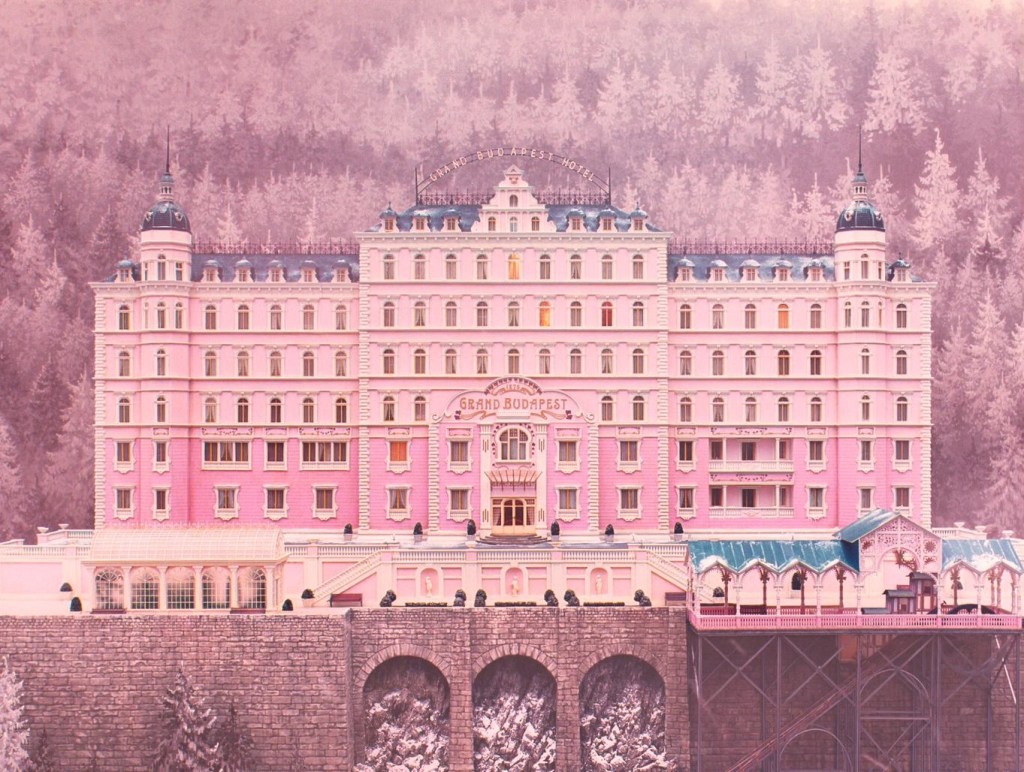
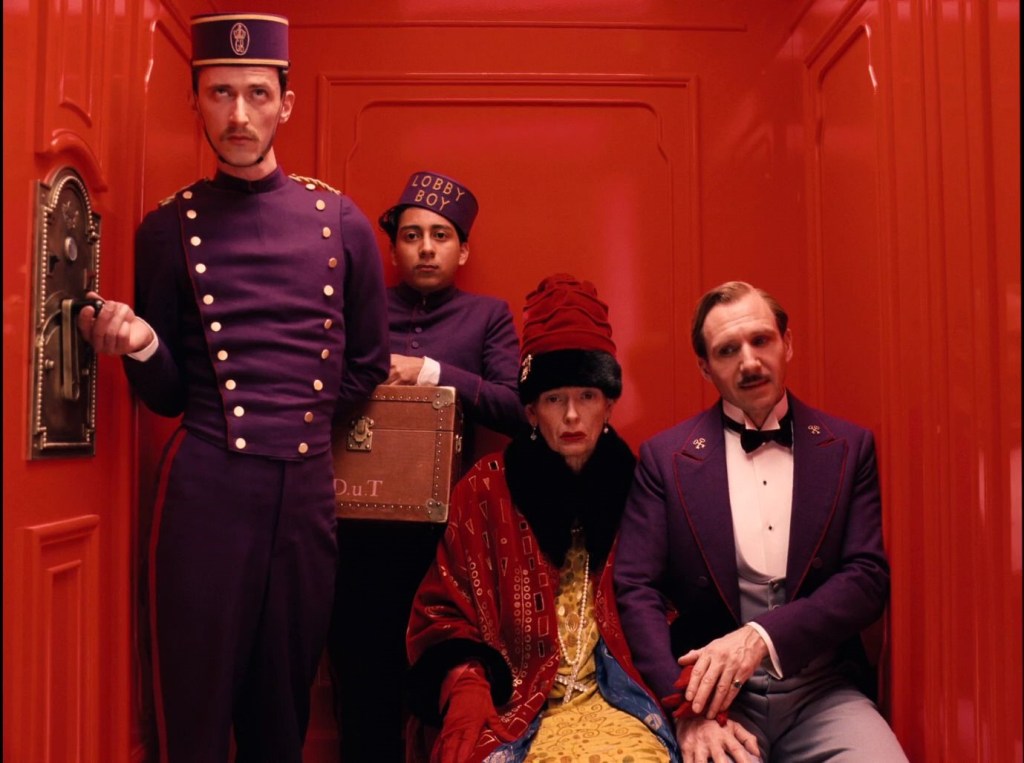
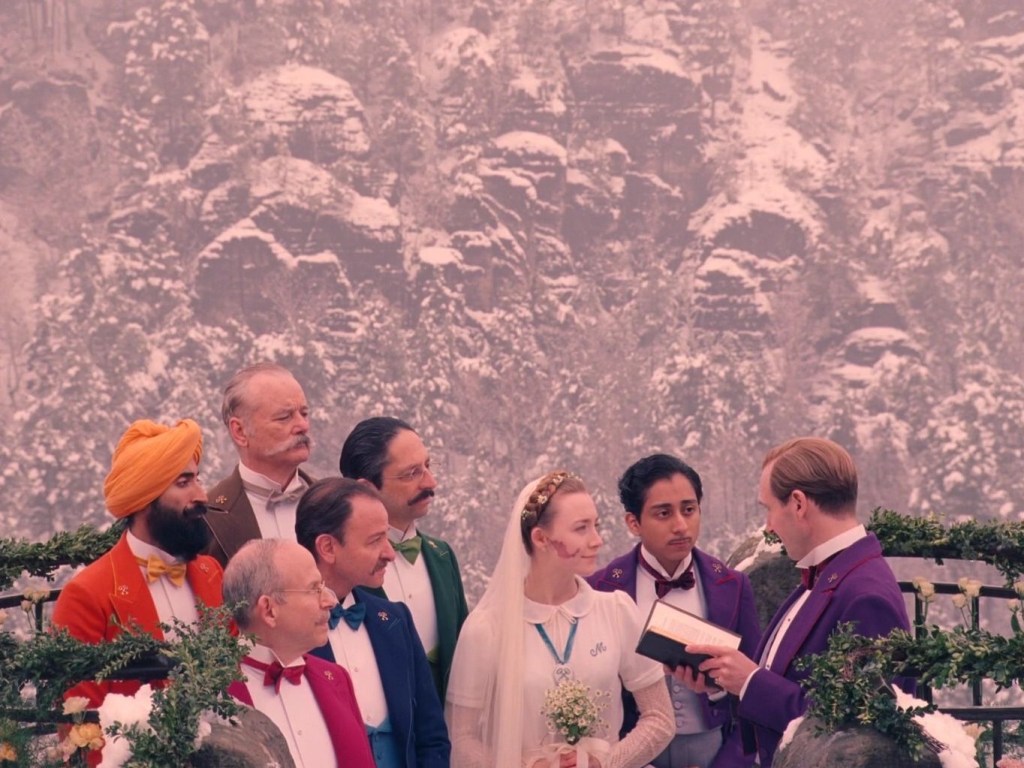
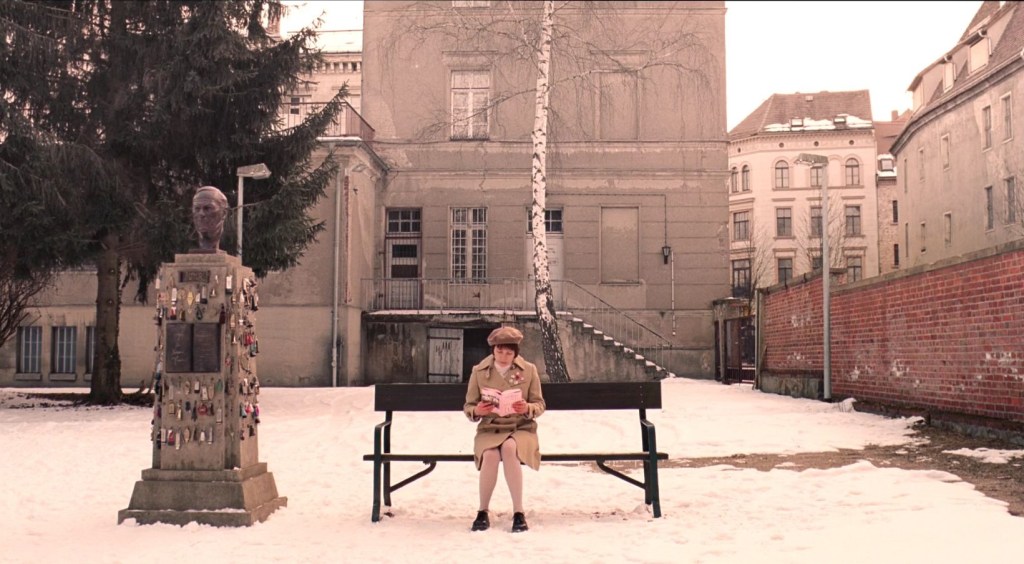
I think that The Grand Budapest Hotel was the first Wes Anderson film that I watched, and what an introduction to his work it is. He’s got such a distinct and unique style and it feels the most distinct in this film, you could pick out almost any frame and instantly know that he directed it. It’s not just the visual and aesthetic style that is so distinct however, it’s also how he moves the plot forward and the characters that he introduces. Each of his films (excluding the couple that I haven’t seen) have a distinct undercurrent of melancholy, a feeling of loneliness and sadness that is hidden just beneath the surface, beneath the meticulously crafted symmetrical shots. Anyone who knows me will know that I love this sort of sad stuff, I struggle to make any music playlist for example that is anywhere more upbeat than ‘sad’. It’s almost like Anderson puts up a barrier between certain characters, keeping them separate from each other. M. Gustave and Zero, the two heroes of the story, are frequently separated throughout the film and even when they’re in the same physical space they are often separated by the camera. It’s not all sadness though, as another thing that we tend to see in Anderson’s film is a feeling of hope and optimism to balance this out. It’s always darkest before the dawn, as they say, and this film is a real reflection of that. Just as a final note to this paragraph, I’m not sure I’ll be using screencaps to illustrate my point so much as decorate my blog, it’s just such a pretty film to look at.

For me, a film lives and dies on the characters that it gives us. That’s not to say that plot is irrelevant to me, far from it, but I would much rather experience a character driven story than a plot driven one. The Grand Budapest Hotel, in spite of all of its lavish set pieces and wacky adventure to sell a priceless piece of artwork and escape law enforcement, the driving force of this film is in its characters. M. Gustave is one of the most remarkable and wonderful characters that I’ve watched come to life on screen, for such a short film he feels so lived in, and this is largely in part to the portrayal by Ralph Fiennes. He brings so much warmth to someone who is an oddity, a man out of time, a man whose position is no more grandiose than a hotel manager, a man who is really rather selfish at times. However, he is ever so charming, and you see his kindness emanate throughout the film. He may be impatient and a little brash to his inferiors, but he is always kind to those who deserve it. Zero is very much a foil to Gustave. He is selfless and patient, out of place rather than out of time, which I think is why both of these characters bond so quickly.

The relationship between Gustave and Zero is just wonderful, from the first moment they first interact on screen until the last, you watch this lovely relationship play out. Two men from very different parts of the world, of different backgrounds, bonding as equals, as brothers. As Zero says to the Author, they shared a vocation, but their bond was so much deeper than that. While Zero looked up to and admired Gustave – a well put together gentleman at the top of his field, someone to aspire to, I believe that Gustave considered Zero to be more than his protégé, almost like a family member. Gustave’s taste in older women is a reflection of his own insecurity, Zero even says that they need to be vain and needy. Zero is Gustave’s hope for the future, acting almost as a father figure in his mentoring though they are more peers than anything else. They mentor each other throughout the film and you see both of them grow – one in confidence and one in humility as the events of the film play their course. It is suitable that Zero inherits the fortune left initially by Madame D. as he becomes the final remnant of Gustave’s legacy. Even though Zero tells the author that he keeps the hotel for Agatha as they were happy there, Gustave is part of the reason they could be happy there. He married them, after all, and a little part of him will always remain in the hotel.

I love the way that this film plays with time too. You’ve got the introduction, set in the present, then you go back to The Author as an older gentleman, before he takes you back to his trip to the Grand Budapest Hotel as a young man, where an older Zero takes us back to the action of the film, in 1932. The use of time shifts as a framing narrative is often overused, but here it feels appropriate and not excessive. The most notable time that we are taken away from the action of 1932 is when Zero’s narration shifts to Agatha, and we’re taken back to see how their relationship was established. This is a lovely little segue, even though from Zero’s tears we know that a happy ending will not be coming, because we can see their youthful love for each other burst free from the screen. I know you weren’t expecting an Interstellar reference here of all places, but love truly does transcend time, as Doctor Brand theorises. Zero and Agatha’s love for each other extends well beyond her untimely passing, as does the hotel in how it exists beyond its own time period. Lots is said in the film about how the hotel (and Gustave) are too old fashioned to exist in their present day, but that doesn’t mean that they can’t live on through the characters that endure on.

This is also seen with the war that afflicts Zubrowka. There are hints of it throughout the first part of the film, including newspaper headlines, and we can sense from here that this war will have an effect on proceedings, though we’re not sure how or when. We don’t really see the effects of it until the first train journey of M. Gustave and Zero. Even here, where the situation appears dire, all is made well rather quickly, off the back of a favour to an old friend. This is one of the remnants of Gustave’s world, the one that Zero feels he was too late for, a world of kindness and favours to be repaid. This is a sharp contrast to the second train journey of the film, where the protagonists are again stopped, but this time there is no smiling Henckels to greet them, instead a much harsher, grubbier, battle-hardened soldier. He does not respond to Gustave’s charm, instead shooting him almost on sight. In a way, this was the only end that would have suited him. We all enjoy a happy ending, but Gustave was never due one, not from the moment that we hear Zero’s summation of him to the Author over dinner. Instead, he died as a beacon of the world that he yearned to be a part of, a time that he kept alive in himself by saving the life of his dear friend. The war is not an issue throughout the film until the final act. It is looming, yes, and it is a clear reference to the real-life wars that affected Europe throughout the twentieth century, but we only see how this war affects everything until the very end. The war kills Gustave, as well as what must be countless unnamed and off-screen individuals, and the effects of it cause Zero to lose the vast fortune that he and Gustave worked throughout the film to earn. However, and most crucially, it did not succeed in taking away Zero’s spirit. We can see the effects that this story has as it ripples through time, courtesy of Zero recounting it to the Author and the Author then to his readers. Their story, and the hotel, will never die.

I fear I haven’t done this film justice, though I’m not sure it’s possible to in a few mere paragraphs. It really is a charming and delightful piece of work, one that I can watch over and over again and never get bored of. Despite the serious backdrop of the events of the film, it really is very funny and remains that way even now, when I know so many of the lines, which is always a good sign in my book. The whimsy of the plot overshadows this foreboding backdrop which I think is a key theme of the film, that happiness is found in the smaller parts of life. Even when everything else is going wrong, it can’t be all bad as long as you hold on to those fleeting moments of humanity and kindness.

Harry Potter and the Philosopher’s Stone

Harry Potter and the Philosopher’s Stone is like a warm hug from an older relative. It’s calming and familiar and it’s always there for you when you need it. Adapting a book as popular and famous as Harry Potter and the Philosopher’s Stone was always going to be an interesting endeavour. It’s a book that demands not only a huge amount of money, but also a lot of time to do right due to the fact that in the very likely probability that it would be a success, there were many more books to adapt within the next few years as each book covered a single school year. The various directors and creative voices that influenced the Harry Potter film series created four very different periods in the series, and while I only think that one was a truly successful film on a creative level, it’s interesting to look at every single one individually. This is the first of at least eight posts, maybe more depending on how much I’ve got to write, about the films in order, though other posts will likely come in-between them as that’s a lot of Harry Potter content all in a row.

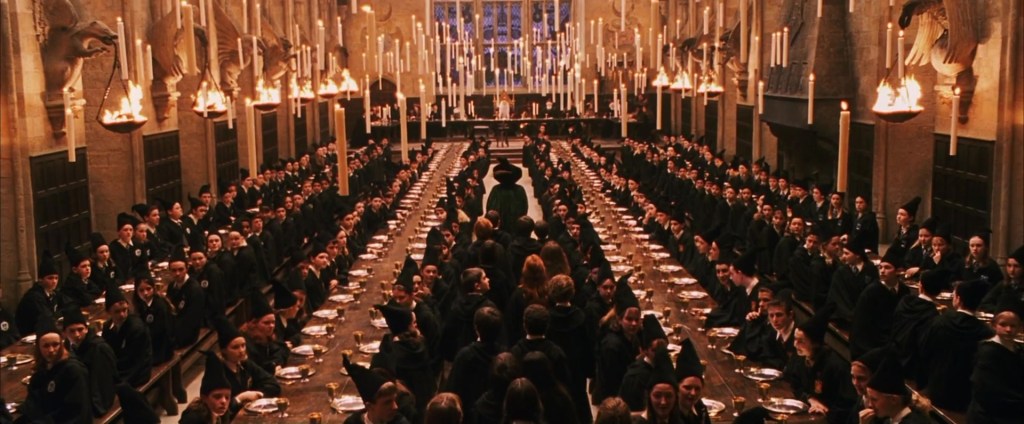
It’s easy to love the first film in the Harry Potter series. It’s sincere, sweet and earnest, hitting all the right notes for a family film with what I imagine were state of the art visuals at the time, not only utilising CGI but also really intricate and elaborate set and costume work. I’ve been on the studio tour a couple of times, and each time I do it becomes more and more clear how much of a labour of love this first film was in particular, with most of the major sets and designs surviving three more directors, each with their own creative vision. A lot of the interior of Hogwarts is beautifully constructed, especially the great hall with its fireplaces and iconic floating candles. However, we’ll start with the negatives before I move on to the positives, as I always find it’s nice to end on a high note.

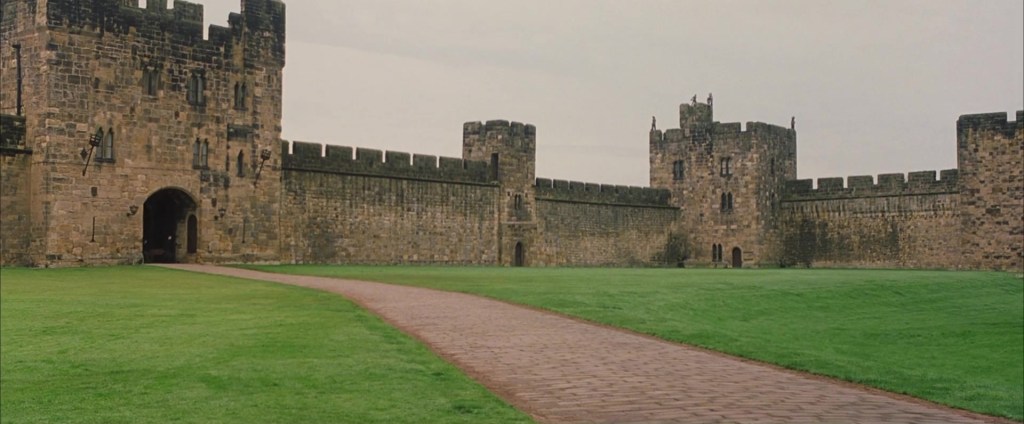
It’s quite a poorly put together film in a lot of ways though, I’m not exactly a film making expert but even I noticed some unusual editing choices. For example, there’s an odd scene about halfway into the film where Harry finds out he’s going to be the new Gryffindor seeker, which then immediately cuts to another scene where the ghosts are talking about how Harry is going to be the new Gryffindor seeker. It’s just unnecessary, we don’t need reminding of this fact, especially as the scene then moves to the gang talking once again about how Harry is the new seeker. It’s repetitive and boring, and I’m not entirely sure how something like this was left in, the ghosts make sporadic appearances throughout the film but surely they’d have been better in the background here than just reiterating known facts? They also use almost identical establishing shots for both Quidditch practice and Harry’s training with Oliver Wood. They occur in the same place, we don’t need to see the same courtyard twice, especially when it looks like this. Not very impressive at all, unlike the exterior shots of the main castle.

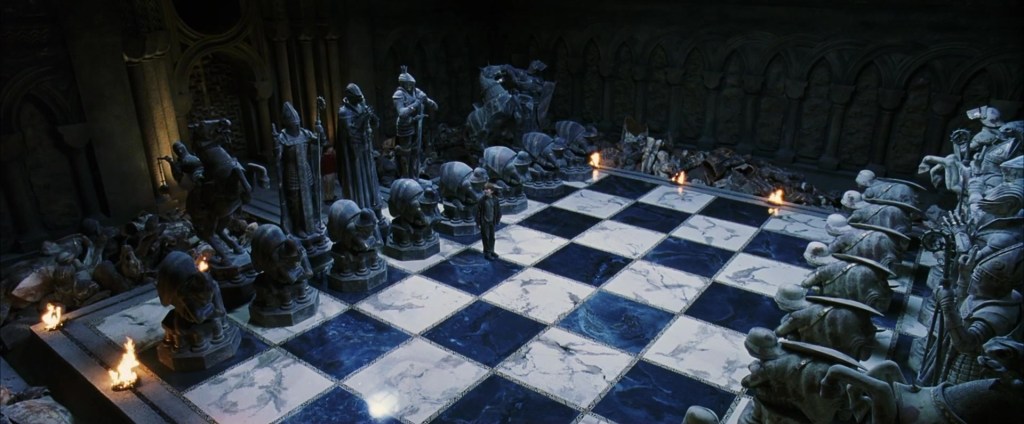
Speaking of Quidditch, there’s also the weird bit that demonstrates that Harry is a Really Great Seeker! When Wood releases the snitch from the chest, Harry keeps up with it moving whereas Wood just looks in completely the wrong direction. It looks like he’s actively looking away from where Harry is looking, which is no way to look for something. He’s supposed to be a goal keeper, knowing where the ball is one of his primary jobs. These moments aren’t necessarily bad but it just feels like amateurish directing. There are some bits from the book that are left in with no context or explanation, which lead to continuity errors within the film. One notable example is during the giant game of wizard’s chess, where three spaces are just inexplicably left open, as unlike books, films don’t have a paragraph to explain things like this. In fairness, this isn’t a huge issue with this film, but it does become a big issue later on which I’m sure I’ll go intro greater detail about when it comes up. I have to include a shot of the chess board though, because what a fantastic piece of set design!

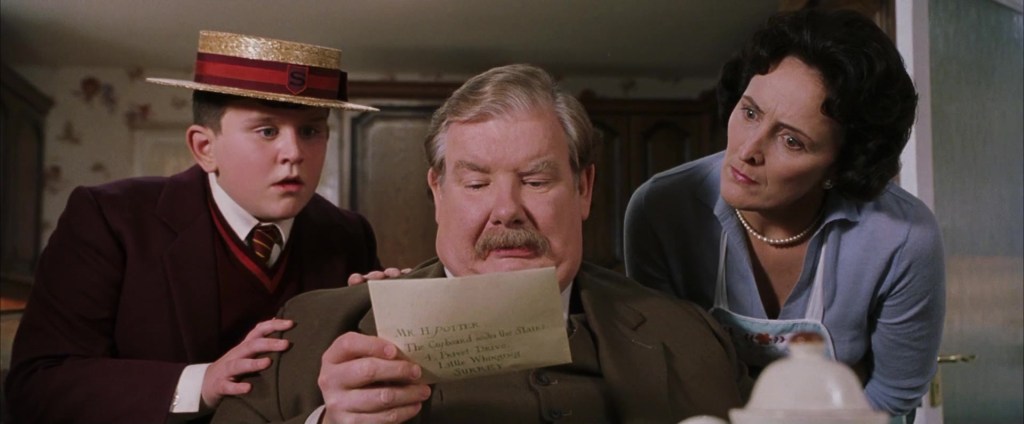
Having said that, I like a lot of the details that are kept in from the book, ones that aren’t necessary in any way to the plot but act like easter eggs for the book readers. These include things like Dudley Dursley’s school uniform for Smeltings school, and Harry wearing shirts that are rolled up at the sleeve as he only wore Dudley’s old shirts.

The attention to detail in this film is its main redeeming feature in my eyes, it certainly has a lot of qualities despite my criticism of it so far, but this is one thing that stands out the most. The thought and care that’s gone into the sets and costumes is incredible, even if I disagree with some of the artistic choices when it comes to the castle itself and the way its presented. I do find issues with the tone as well though, the whimsy from the books is missing and often replaced with a self-seriousness that feels a little out of place in a magic school. With that being said, things like the Forbidden Forest and Argus Filch are taken seriously and are seen as scary by the characters, which is something some of the later films don’t quite get across.

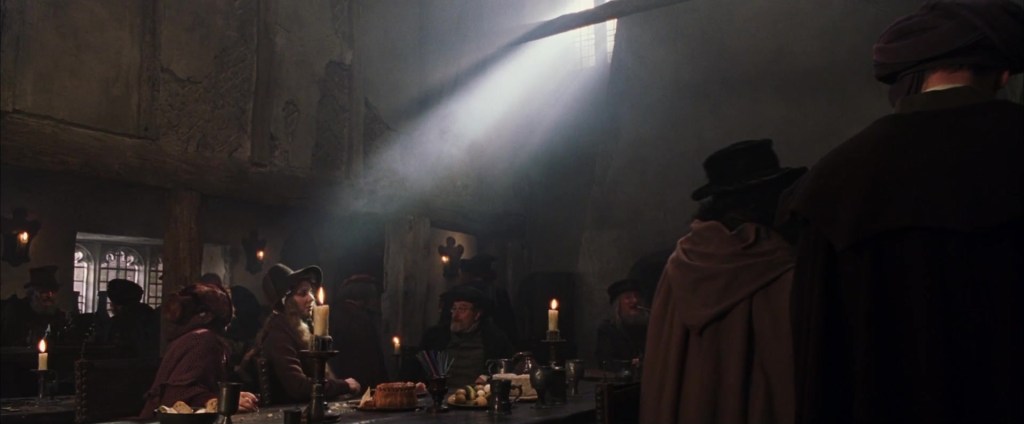
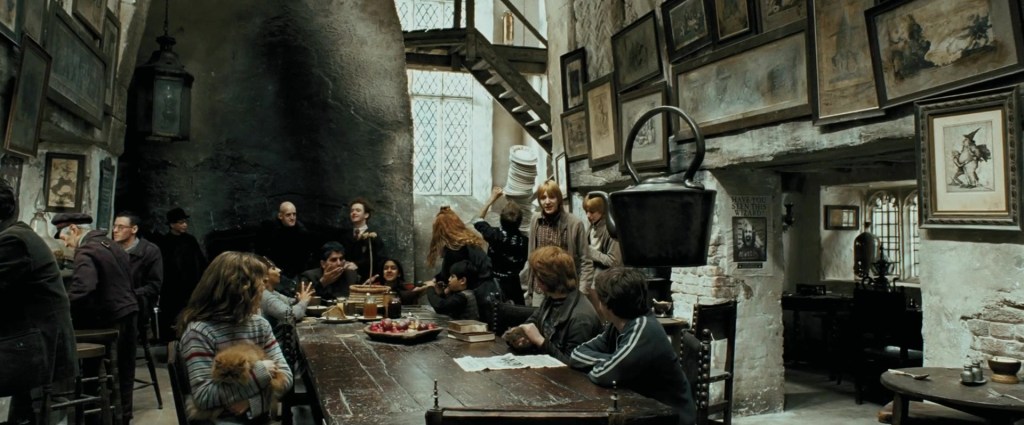
The film also feels so outdated, even taking into account that it came out nearly twenty years ago. It just seems so old and dusty that it feels like an early 90s television serial, and that’s not because it’s set in an old and dusty castle. The colour palette for most of the shots inside the school are a dull, orangey brown that just feels so bland. The way the film is shot is also uninspired. As I was scrolling through a website in order to find screencaps to put into this discussion, it struck me just how much of this film comprises of basic shots of a character’s head and shoulders as they talk or react to something. There’s often nothing very exciting on screen, even with all the magic and wonders that we see it’s just sort of okay. I don’t recall being dazzled by the magic in this nearly as much in other films in the franchise. There’s supposed to be magic and colour and eccentricity everywhere, but other than the glimpses of chocolate frogs and levitation, this feels a little unrealised after the brilliant early scenes at Diagon Alley. Just take a look at these two shots below, one is of The Leaky Cauldron in this film, and the other one is from The Prisoner of Azkaban. While the set is slightly different, the design is still similar and it just shows how murky a lot of this film is, which is a shame really.

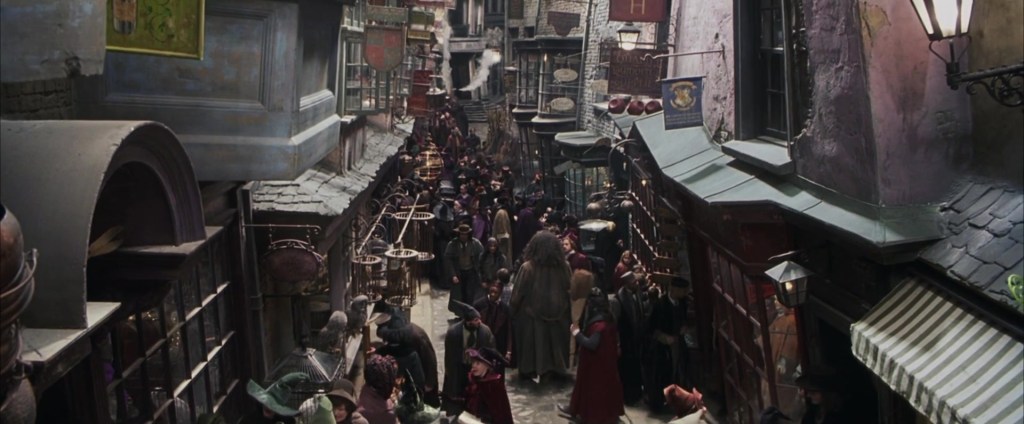
There are some definite outstanding moments though and I think that is what this film is all about. It sets up the world of Harry Potter and despite all of my issues with the presentation, there are hundreds more things that I like about this film. The set design, at least for the locations that remain throughout the series, is second to none and we can see little additions to these made throughout the series. Like I said a little while ago, Diagon Alley is brilliant, as is the design for both the interior and exterior of the Hogwarts Express. They both have that perfect mix of old fashioned with a drizzle of magic, and it’s no wonder that both locations are revisited throughout the series.

Something that is always brought up when talking about the merits of the films is how spot on the casting is, and I can’t help but emphatically agree. Whether you’ve read the books or not, every single character is absolutely spot on. While Professor Snape (and therefore Harry’s parents) are aged up by about ten to twenty years from their book counterparts, Alan Rickman is superb at the menacing evil teacher that Harry perceives him to be. Hagrid and Professor McGonagall are equally fantastically cast, the list goes on really so I won’t bore you too much. I really like Richard Harris as Professor Dumbledore as well, he brings a delicateness to the role that isn’t really present in the first book, where he’s portrayed more as an eccentric old wizard. The conversation between him and Harry in the hospital at the end of the film works exceedingly well because of it, as well as the conversation in front of the Mirror of Erised.

I know a lot has also been said about the quality of the child actors too, but I really do think that’s an issue with the direction more than anything. Their competency is shown in The Prisoner of Azkaban (and yes, this will be a constant comparison throughout my chronicling of the series) when they’re under the instruction of a brilliant director. While they’re obviously inexperienced, I think Daniel Radcliffe expresses the sincerity required for Harry, Emma Watson the snootiness of Hermione and Rupert Grint the loyalty and bluntness of Ron. At the end of the day, they all had a good time and that’s all that matters surely? As is so often the case with actors that grow up with the role, the film versions take on characteristics from the actors that portray them, which does come across here even this early on. The other child actors aren’t really in it enough to make an impact, but they’re okay too really. A nice glowing review from me there.

I almost forgot to say, but the music! What a magnificent, soaring score from John Williams. He doesn’t miss often but this is one of his finest achievements in my opinion. So many pieces of music are so iconic and recognisable that it’s impossible to pick a favourite. Every single piece fits into the film seamlessly, elevating what we see on screen to new heights. I think that might be an issue with looking at stills for this film too in order to decorate this review, each scene is improved by the score so that even when the corridors and turrets of Hogwarts are a bit too murky brown, the score makes it feel like you’re in a supernova, such is the quality of it.

Despite all these little nit-picks and flaws, it’s one of the few films that I will watch whenever it’s on TV. It’s such a fun film, where the casting is all so spot on, that anyone can sit down and enjoy it. It probably sounds like I absolutely hate the film based on what I’ve written here, but that couldn’t be further from the truth. I don’t care about the musty décor of the castle, the weird directorial choices or the middling acting throughout. What I care about is seeing this wondrous location and these brilliant characters brought to life, and brought to life in a way that is just so pleasant. The colour grading doesn’t matter when you’ve got flying candles and staircases with a mind of their own. The questionable child acting doesn’t matter when you’re watching a genuinely entertaining plot unfold in front of you. In short, I don’t care that lots of parts of this film aren’t very good with retrospect, because all together they made something wonderful. The Harry Potter series is such a source of comfort and warmth that you really do just sit down and go along for the ride. There’s so much more that I could say but I’ll limit myself to a mere two thousand words today.

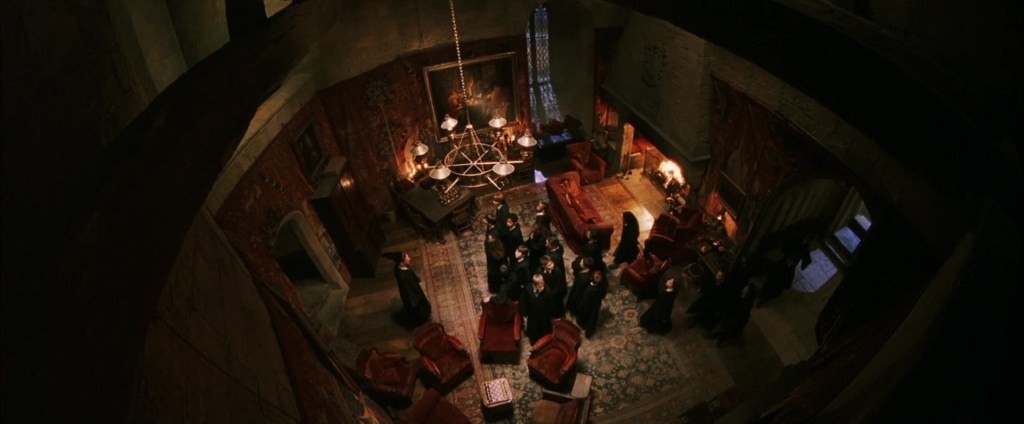
Also, just a little side note/ post script, how many people are actually in Gryffindor house? The books would have us believe that there are five boys and five girls, but I think I counted twenty students following Percy Weasley up to the common room. Look!

There’s also the extra Gryffindor boy who shows up in Prisoner of Azkaban to talk about omens of death and how Sirius Black is impossible to catch, and then Katie Bell is shifted down a year to be Harry’s age in The Half-Blood Prince. Who knows? Does J.K. know? I doubt it.

Moana

*There are spoilers throughout this discussion, so please don’t read unless you’ve already seen the film or aren’t bothered by such things*

I remember going to watch ­Moana at the cinema with a friend when it came out all the way back in 2016 and I was absolutely mesmerised from pretty much the first minute (and even before that really, with the preceding short film ‘Inner Workings’ being a really sweet and charming little appetiser). I find Polynesian culture really interesting, though I’m far from an expert on the subject, so seeing a mainstream film pay tribute to that part of the world was such a nice thing to see.

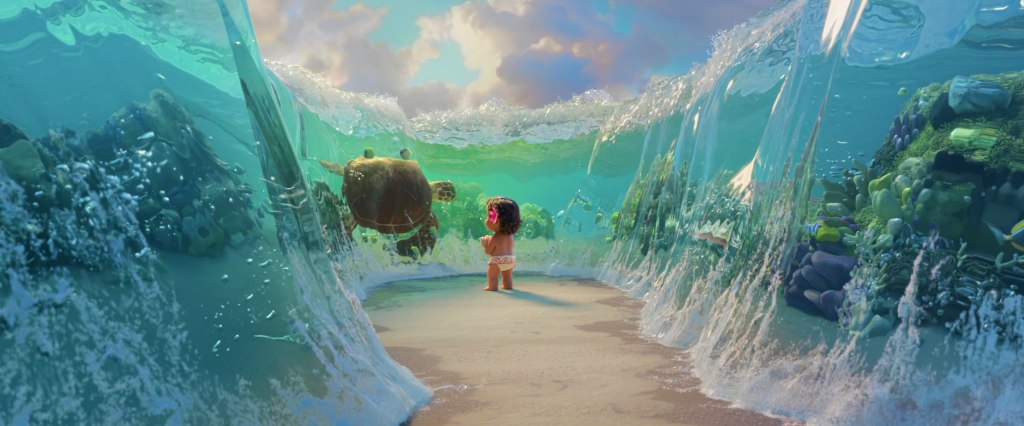
I’ll start us off by saying that this film has two of the most beautiful scenes in them that Disney have ever made in my book, both thematically and aesthetically. The first is one of the first scenes in the film, with the little Moana running off to the shore by herself, which is where she is gifted the heart of Te Fiti by the ocean.

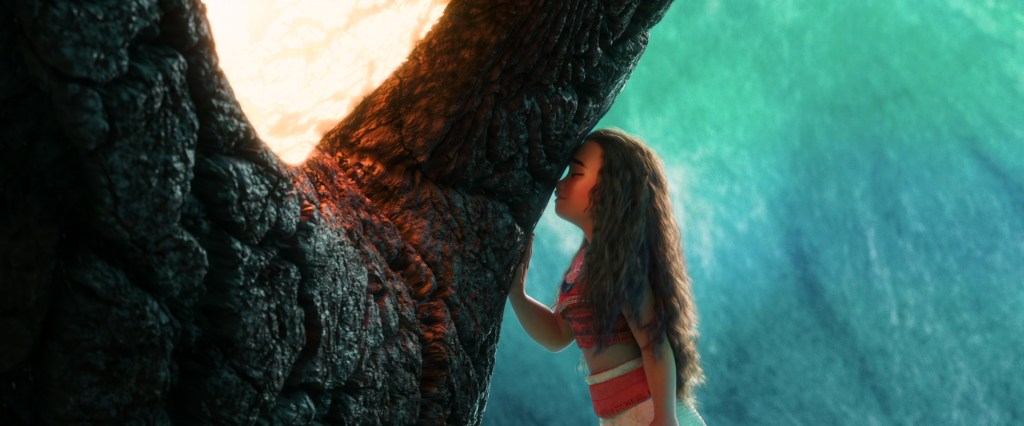
We get a good sense of her character here as well – defying her parents in order to go to the beach, while saving a vulnerable baby turtle in the process. Moana is at once rebellious and kind, though she never puts herself first. Even when she leaves the island of Motonui in secret, she does so to save her people. I think she wants to prove something to herself in the process, but her ultimate goal is to help her island. That part when she’s stepping through the parted sea is so beautiful too, it’s such a gorgeous piece of animation and I like how we see her doing this early on to claim the heart, and at the end of the film she parts the sea again in order to give the heart back to Te Fiti as she recognises that she and Te Kā are the same being. I always get goosebumps when she returns the heart to Te Fiti and shares a moment of kindred understanding with her as she returns to her true form.

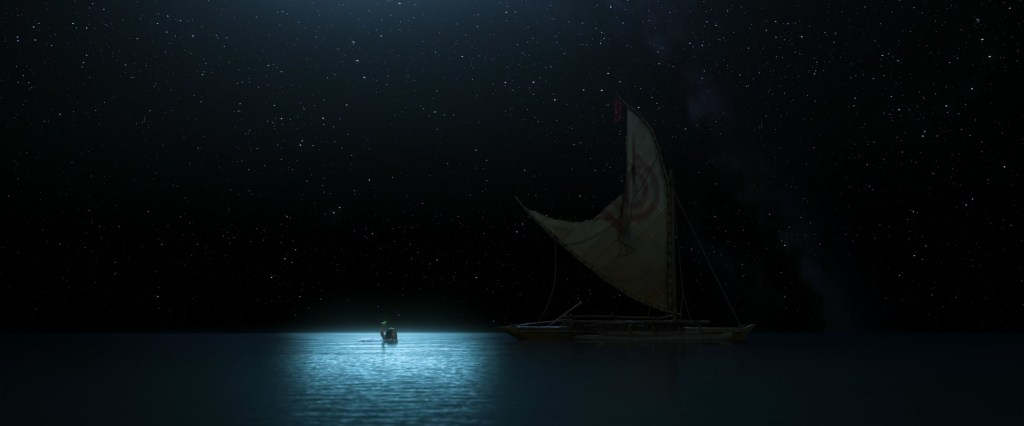
The other scene that stands out to me is when Maui leaves her and she feels that she is not able to do the task that has been given to her, and the beauty and silence of the ocean at night time is stunning, broken only by Moana’s lack of faith in herself. The vision of her voyager ancestors, as well as her grandmother, is up there with the very best of the emotional Disney scenes – and it really is in illustrious company. While ‘How Far I Go’ receives the majority of the plaudits, I really do think that ‘I Am Moana (Song of the Ancestors)’ is a much stronger song in the film from an emotional standpoint, as Moana is at her lowest point in the film and finds her strength again with the help of her grandma and ancestors. The shot where she emerges from the ocean after finding the heart again contrasts nicely with how alone she was after Maui left her, but this time we know that she can achieve her goal.

I’ve really been enjoying the little trend of subversion that’s been going on in Disney films since the return of the ‘classic’ princess stories with The Princess and the Frog in 2009. Since then, there’s been a real shift in the role of the female protagonist, one that is very much continued in Moana. She has so much freedom and self-expression, from the point where we see her as a toddler at the beginning of the film. Here, she stands out from the other children and enjoys her grandma’s stories, rather than being scared by them. Likewise, when she wanders out to the shore by herself and is gifted the heart of Te Fiti by the ocean, you can see why she was chosen. From the first minutes of the film, she is unique, and I think the parallel that she shares with Maui here is also interesting. The beginning of the film sees him steal the heart, whereas she is gifted it. What happen in-between these two events is only revealed later on, but we get a good sense of both characters’, well, character. I also laugh looking back at how the film was setting up that little piglet to be the cute animal companion, only for it to be Heihei the chicken, who is one of the funniest parts of the film.

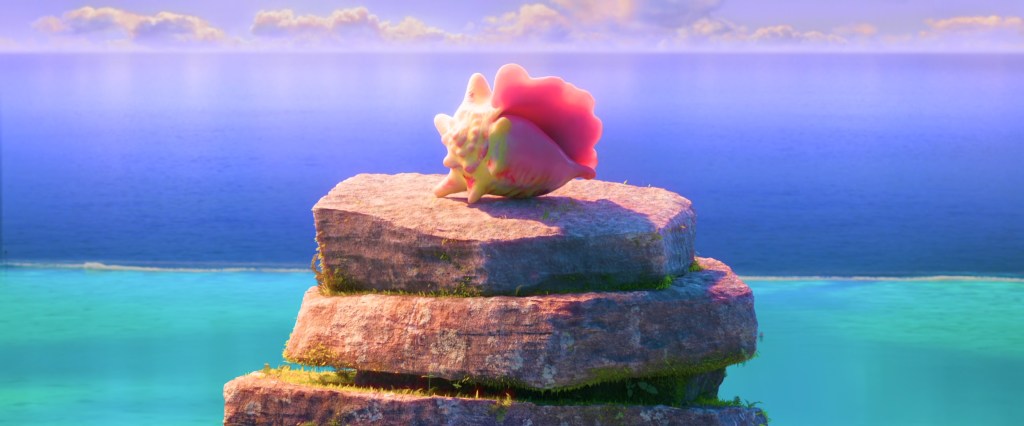
The visual imagery in this film is incredibly strong throughout, featuring so many details and self-references that it’s almost hard to keep up at times. You can see Tamatoa and the Kakamora represented in the art and tapestries in the opening of the film long before they actually appear, and some of the unnamed sea monsters bare a resemblance to the ones we glimpse in Lalotai. The thing I love most about this is in one of the closing shots of the film. From the beginning we see Moana obsessed with the ocean, and when she wanders to the beach as a toddler she is fixated on the large, conch-like shells, trying to pick up all of them. At the end of the film, on the tower of stones that represent each chief of Motonui, Moana leaves one of those shells at the top of the pile. There is no need for such tradition when the islanders are now voyaging again, seeking out new lands. There will never be another chief of the island, because that is not how their people work anymore. They are forming and forging new traditions, and I love how we can infer all of this from the shell at the highest point of the island.

The heart of this film is not that of Te Fiti however, but instead the friendship between Moana and Maui. There individual and shared journey throughout the run time is really beautiful to watch as they start to learn about each other and why they’re both going on this journey together. Maui craves attention and adoration due to his abandonment by his parents, whereas Moana is accepted and loved by her parents but has to cover up her true love for the sea. You can see a mutual respect develop throughout the film as they go through their various trials to take the heart back to Te Fiti, but Moana’s need to prove herself almost costs them their chance at doing so. Maui is more concerned with keeping his fish hook and his powers and leaves, showing that both characters have not yet completed their journey, physically and spiritually. It is only when they reunite, and Maui renounces his fish hook and thereby his selfishness, that they succeed in their mission. These two characters work so well together and the voice acting by Auliʻi Cravalho and Dwayne Johnson really cements that too, they bounce off each other excellently and I’m impressed by the range shown by both of them.

My only real criticism, and it’s not even necessarily a criticism but more of a personal preference, is the inconsistency of the score and music. All of the songs they’ve created are fantastic, to the point where I can’t really pick favourite as they all have their place within the film. Even ‘Shiny’, which sort of comes out of nowhere, feels very appropriate for the character of Tamatoa, and I believe Jermaine Clement (who voices the crab) had a big role in the writing of the song. For the songs like this, the writing duties were split between Lin Manuel Miranda and Opetaia Foa’I, and this combo of a more traditional theatre musician and Oceanic musician is a really nice blend throughout the film, as we end up with songs like ‘Shiny’ and ‘You’re Welcome’, as well as ‘Logo Te Pate’ and ‘I Am Moana’. However, what I don’t like is the orchestral flourishes that appear throughout the score. These are very much a feature of the Disney animated films, usually featuring little samples and reprises of the songs performed in the film, but given the setting and style of the film, a lot of it doesn’t really fit in. That’s not to say it’s not a nice score, Mark Mancina does a good job with the composition, it’s just not quite right for the film, and it’s a shame that Foa’I only has music credits on five of the twenty-six songs on the score after her role in the writing of the songs.

I won’t go into too much detail about the accuracy and authenticity of the film, partly because I don’t know enough about Polynesian culture to comment and partly because I think artistic liberty is always a factor to take into account – if the film makers were trying to keep things one hundred percent accurate, they would have made a documentary. I do enjoy the way the internal legends and myths are presented however, which to me pay tribute to the oral tradition of storytelling. The beginning of the film, with Grandma Tala going over the theft of the heart of Te Fiti, is an example of that. The way that she presents Te Fiti and Te Kā as two separate beings, only for them to turn out to be the same goddess, with the latter being a corrupted, heartless version of the former, feels very much like a nod to that era, and a technique that would have been common at the time. Likewise, the mere mention of Lalotai strikes fear into Moana, showing that she knows of this place. Even when she’s trying to flatter Tamatoa she makes references to legends that she has heard of the giant crab – it feels like the practise of oral tradition is sprinkled throughout the story, and the twisting and mishearing of such tales is also present. The closing song even has the line ‘we tell the stories of our elders in a never-ending chain’, which is a nice note to end the film on.

I ended up getting a little carried away here and wrote more than I intended to, I think I was just excited for the first proper post on my blog, but I hope you enjoyed it all the same. Moana is probably my favourite Disney film (up there with The Lion King and Frozen 2, which I’ll be posting about in the near future), I think it’s such a beautiful story of empowerment and inner strength. The songs are among the best in the Disney catalogue, a big part of that being how well they all fit within the narrative, nothing feels excessive or shoe-horned in. I absolutely love the story, the humour fits in well and balances with the more serious themes throughout. Ultimately, the film rests on the friendship of Moana and Maui, and that is why it is such a resounding success in my book.

Introduction

Hello, my name is Herbie and I like films. And television and books, but not quite as much. I have a degree in English and American Literatures from Keele University, which has largely gone to waste since I finished my degree over three years ago now, so while I’m trying to figure out what on earth I want to do, I thought it was time to finally settle myself down and start this new project for myself. I’ve been wanting to write a blog for ages, more for myself than anything. I’d like to say there’s an actual reason for not having started a blog before, but it really is a lack of motivation mixed with a deep lack of self-confidence when it comes to putting my voice out there. Ultimately, I realised that I want to do this for myself, but I sure do hope that you enjoy coming along for the ride.

I’ve always struggled with titling my writing, and it wasn’t until fairly recently that I questioned why I needed titles at all? I’ll always outline my main talking points in the introduction to each of my posts anyway, so what’s the point in stressing over the five to ten words at the top of the page? This thought developed into how I ultimately decided that I wanted to structure my writing, which will simply be to write. I’ll probably have an introduction and conclusion, but I’m not looking to make any particular argument about a piece of work, instead my posts will act more as discussions on the things I liked (or didn’t like) and what I thought about them. I’m used to going off topic in most aspects of my life, so why not embrace it?

I struggled a lot with the restrictions and rigid structure required for a lot of my university essays, so I’m hoping that this more loose and conversational approach will allow me to express myself in a way that I always wanted to, as this time I don’t have to worry about grades. I’m not intending to be overly self-critical and micro-manage every sentence as I have done in the past as well, I’d like to be able to write some notes on a film, write the blog post and then just check for grammar and legibility. As such, assume that all of my posts will have spoilers in them, unless otherwise stated (likely if I talk about new releases, or if not knowing certain plot points is crucial to the enjoyment of the piece of work).

I do hope that this isn’t the last thing of mine that you read, I want to upload at least semi-regularly and I feel like being less strict with my structure will allow me to write big, sweeping pieces about some things I really love and shorter, snappier pieces about things that I find interesting too. University really changes your perspective on writing, I think writing for anyone other than yourself does, so I’m looking forward to doing this with a bit more freedom than I’ve ever allowed myself before.

*All images and screencaps used throughout the discussions come under UK fair dealing copyright laws, whereby I can use a limited amount of material as long as it is relevant to the discussion*