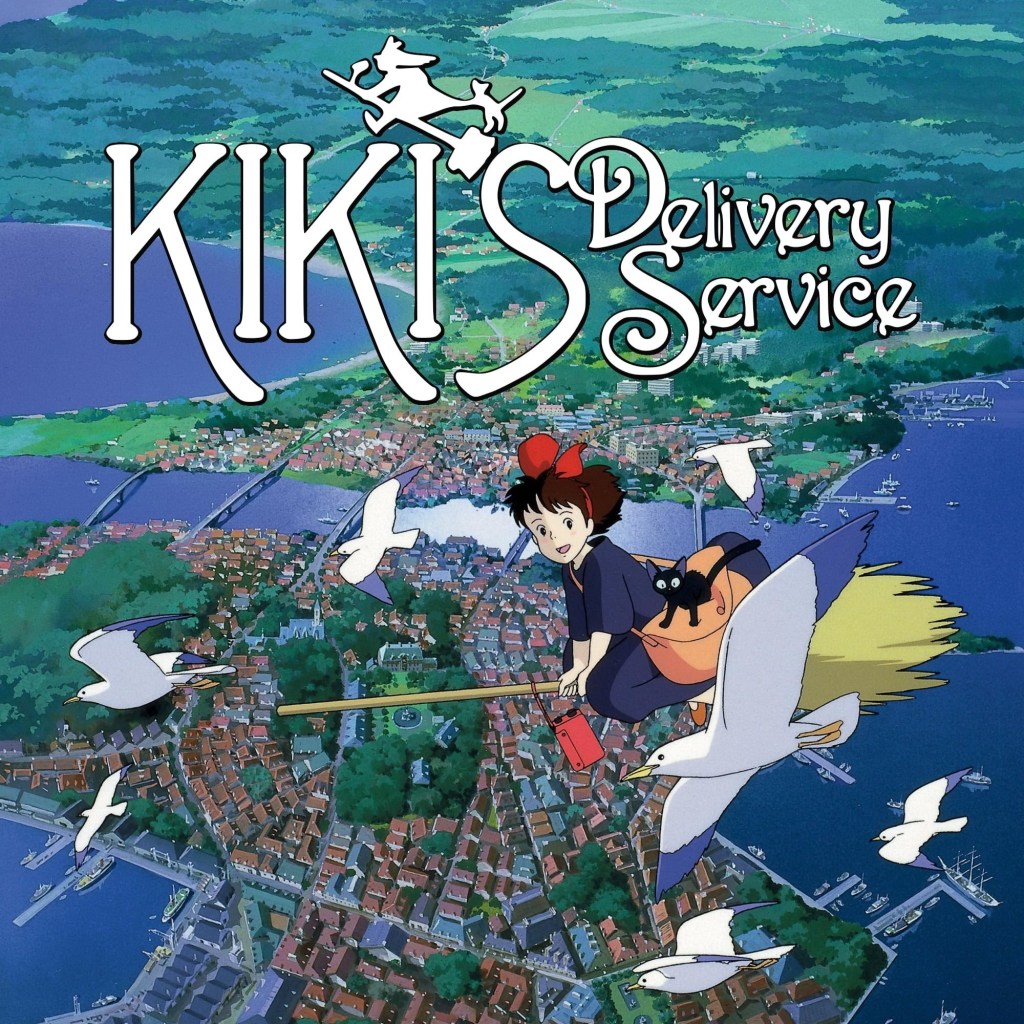
Studio Ghibli films are a very special kind of magical, and Kiki’s Delivery Service is no exception. One of Hayao Miyazaki’s early films, it is very much the embodiment of the magical realism genre that so many of his films incorporate. In the world of this film, magic and witches exist. They are rare enough to remark on but are still commonplace enough that everyone recognises one when they see one. Much like a good plumber, I suppose. The film follows the titular character’s journey as she leaves home for the first time.
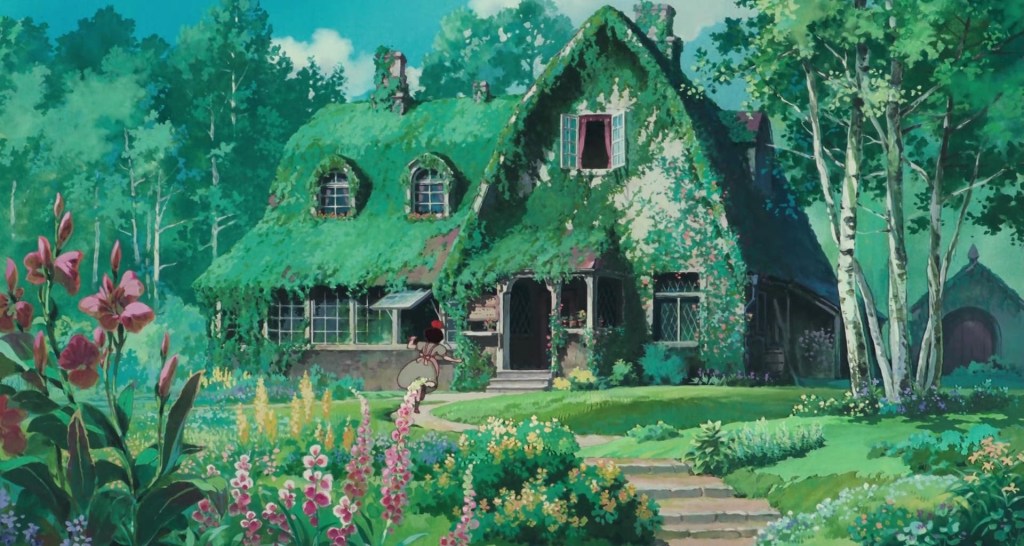
As with every single hand drawn Studio Ghibli film (no, I’m not exaggerating), the animation and the score are things of beauty. Many of Miyazaki’s films are based on real locations. For example, the town in Castle in the Sky, the first official Ghibli film, was largely inspired by the Welsh mining towns that Miyazaki visited in the eighties, during the miner’s strikes. He was inspired by towns in Sweden in this case, and the style of the town in the film is gorgeous. It is busy and bustling, very different from the quiet woodland house that Kiki comes from. Joe Hisaishi has scored just about every Ghibli film in existence and he’s at his very best here, with playful little numbers mixed in with the sweeping, soaring music that he’s most famous for.
These kinds of films are very much defined by the smaller moments within and the friends we meet along the way. This film is about discovering one’s own independence, and the struggles that come with that. Kiki is a young witch excited to find a new town and make her mark on the world, along with her talking cat, Jiji. Jiji also goes on his own little adventure independent from Kiki, getting to know and wooing a sweet little cat that lives near the bakery. Jiji acts as Kiki’s conscience at times during the film, and seeing him grow up is another reflection of Kiki’s own journey. While he is the active pursuer in his relationship, Kiki is very much the pursued by a boy from town seeking to be her friend, Tombo. She doesn’t want anything to do with him despite his efforts to befriend her and to take an interest in her, which is perhaps motivated by her desire to be independent. While she earns her keep at the bakery in return for a room, there is no transactional benefit to a friendship with Tombo.
Another key theme within the film is that of kindness. Like pretty much all of the films created by Studio Ghibli, there is a pervasive and constant theme of kindness, sincerity and support. Kiki is surrounded by kind people who want to help her, not for any personal gain, not to use her powers for themselves, but simply out of the goodness of their hearts. From the bakers, Osono and Fukuo, who take in Kiki like their own child; to Ursula, a student who struggles with artist’s block at times and treats Kiki like a younger sister, Kiki is surrounded by kindness. It’s important, then, that we see Kiki struggle with independence, with finding her place in the world. This is a journey that she was so keen to undertake, she’s found friends and people who love and she loves back, but despite that support system she still struggles. It’s a natural part of life, something that Kiki is able to overcome with her own strength as well as the support of others.
Speaking of kindness, I’m not sure there’s a character that boils my blood more than that ungrateful child who gets annoyed at her grandma baking her a pie. Kiki goes to so much effort to help cooking it, as she does with all her ventures so far in the story. She flies down to return the pacifier to the baby of a bakery customer, she spends hours ensuring that her delivery of the small toy cat goes well, and yet here she’s rewarded with a door slammed in her face. It’s her journey in the rain that gives her a cold too, causing her to miss the party that Tombo had invited her to. This is her first true taste of adversity, and she really struggles with it, as any child would.
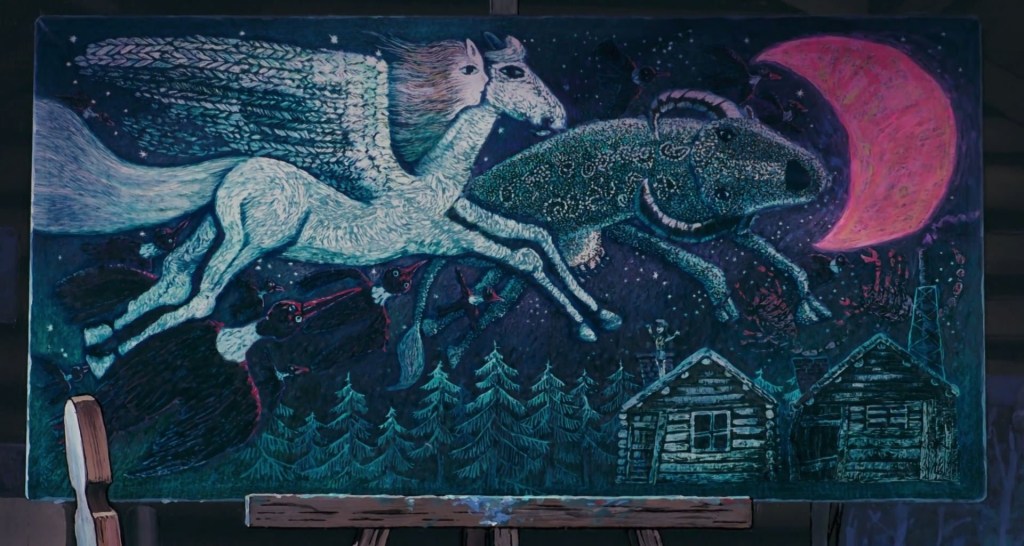
I adore Ursula’s painting almost as much as Kiki is transfixed by it. I’d quite like a replica on my wall, if such an item exists. Anyway, Ursula says that she’s thought of painting over it many times, until she saw Kiki again and wanted her to model for the girl’s face. She’s the one who first thinks that Kiki is suffering from a form of artist’s block. Of course, the crux of the film is about that. She says to Ursula “without even thinking about it, I used to be able to fly. Now, I can’t even begin to remember how I ever used to do it.” Sound familiar? Not the flying part, obviously, but the difficulty in doing something that used to come so naturally. There is nothing in particular that triggers it, it just happens one day. She can’t fly, she can’t understand Jiji, she can’t motivate herself. Ursula says one of the things that helps her overcome it is just to stop forcing herself and take a break. She doesn’t give up, as shown by the fact that she doesn’t paint over her painting, but she takes breaks from it. She gives herself the time she needs, or waits for an opportunity – such as when Kiki came along. It is a similar type of opportunity that inspires Kiki to fly again.
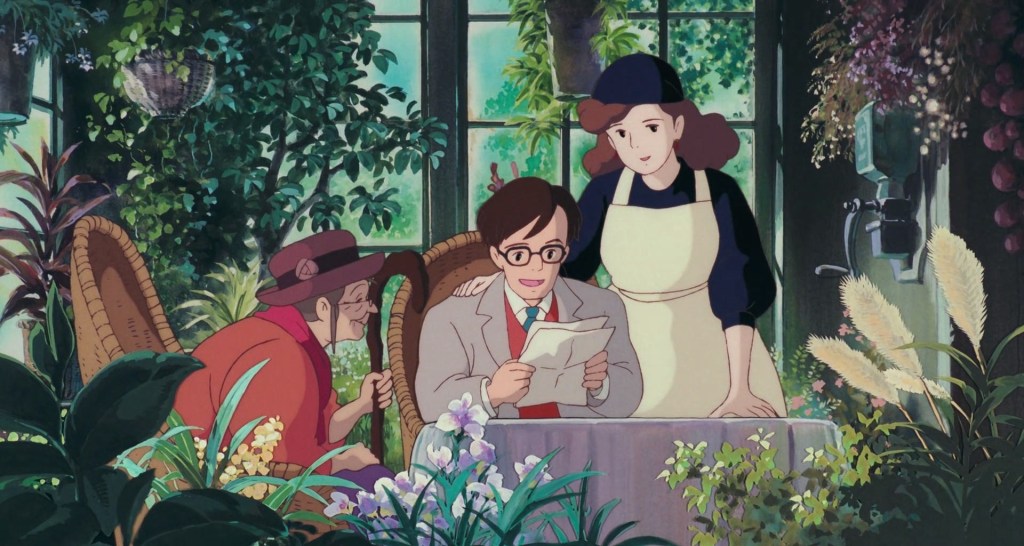
I love the way the film ends. I won’t go into detail for those that haven’t seen it, but over the closing credits (as Ghibli films so often end) we see Kiki’s family receive a letter from her, talking about her adventure and her life since leaving home. It’s a reflection on her roots and her beginnings. Despite seeing how far Kiki has come since leaving home, it also invokes a cyclical feeling. Kiki was so confident and eager to leave home in the beginning of the film, I think the fact that she’s found a new home is not lost on her either and she’s able to reflect on her journey so far. I’ve always loved that ability to quietly reflect on a film during the credits, I will usually stay until the end while at the cinema, but Studio Ghibli providing us with a kind of epilogue to watch during the credits works just as well.
It seems like I’ve got in the habit of writing slightly related ramblings at the end of my discussions. I wrote a little about the lack of cynicism in this film, so here’s some more thoughts on that topic. I feel like we’re in a very cynical age of media at the moment. America’s Obama-era optimism that was so prevalent in their productions throughout the 2010s has completely died now. So many of the most popular films cheap, artless cash grabs or struggle with the concept of hope and optimism. Even if you look at the cultural phenomenon that was Barbie, I think overall it highlights the struggles of simply living in this world. And no matter how many jokes you make about the capitalist hellscape in which we live, we’re not going to forget how much money the companies that made that film are worth.
Also, an extra, extra side note: I was looking through the top ten highest grossing films worldwide post-Obama – in 2018 and 2019, only one film out of the twenty total was not a sequel or part of an existing franchise – Bohemian Rhapsody. I don’t particularly want to think about that film more than I have to (it’s one of the worst I’ve seen in the cinema) but even that is based off someone’s life, you could make an argument for that not being original too. Following that, there are only two more films that are completely original – Tenet and Oppenheimer. Like him or not, Christopher Nolan has a way of capturing people.

 The Herbshank Blogdemption