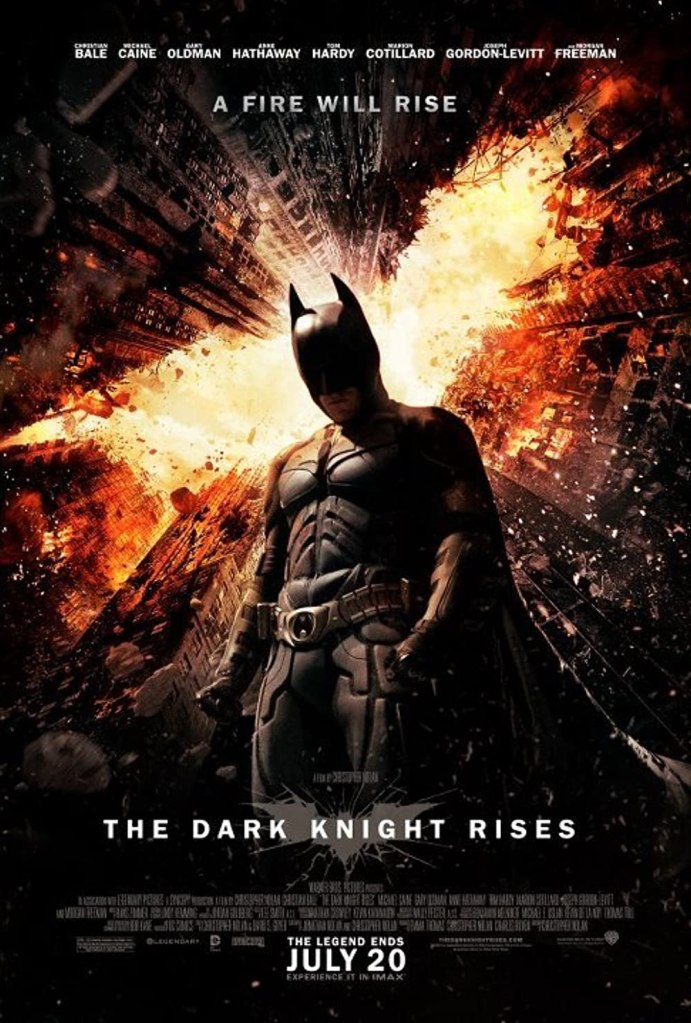
I remember watching The Dark Knight Rises at my local cinema for my friend’s birthday, all the way back in 2012 (I have recently been corrected by said friend, Liam, that it wasn’t for his birthday but it was in summer, but I was half right I suppose). I had only seen The Dark Knight prior to watching this, and I thought it was a fantastic sequel that finished the story that I had seen very well, but after I had watched Batman Begins, I realised that it shared far more similarities and themes with the first film in the trilogy, not least due to the constant appearances and references to the League of Shadows. A lot of criticism of the film has arisen after its release, mainly relating to the inconsistencies in logic and character decisions, which I think are a little unfair, though more on that later. It is a very accomplished film in its own right, and it helps with the emotional payoff that Nolan has had three films to help build and establish his characters. The action sequences are bigger than ever before and are just an absolute blast, the opening scene a particular highlight in how it’s crafted.
I think it’s most appropriate to start by discussing the characters, as unlike any other Nolan film, we’ve had three films to watch and understand them, and I think the ones that we have seen throughout the trilogy are fantastic. It is his secondary characters that normally suffer, but I really like the ones that he introduces here – namely, Selina Kyle (Anne Hathaway) and John Blake (Joseph Gordon-Levitt). It helps that they’re both portrayed by very accomplished actors, but they feel very fleshed out as foils to Batman, and Bruce Wayne. Selina Kyle is the antithesis to Batman, she uses her mask to disguise herself and for personal gain rather than to protect loved ones and to help others, and John Blake mirrors Bruce Wayne’s own background as an orphan, taking action in a police uniform rather than a mask and cape. We see two sides of the story of Gotham that Bruce, in his mansion and with his wealth, hasn’t been able to consider. That’s not to say that his character hasn’t suffered, but he’s suffered in a very different way to the two traditional side-kicks.
Talia works moderately well, but the nature of their prior relationship is left very unclear so it doesn’t really make sense when Bruce trusts her with everything to do with his business, a rather crucial plot point as it’s through this control that she engineers the attempted destruction of Gotham. Bane really is such a scene-stealer that it’s almost a shame when it’s revealed that he’s not the mastermind of the plan. I’m really impressed by pretty much every aspect of Bane’s character, as he’s very much the opposite to the Joker in a lot of ways. Bane in hugely strong and imposing, with a legion of followers loyal to the death, whereas the Joker is slaughter and doesn’t use brute force, and operates very much alone, with followers controlled by fear rather than loyalty. Bane also works well as a foil to Batman – stronger and more ferocious, with a mask worn out of necessity rather than choice. They are each students of the League of Shadows, though Bane has a mastery of those skills that Bruce Wayne simply doesn’t. There’s a lot of ideas in this film about the difference of upbringing, with Bruce’s wealth shielding him from a lot of the horrors in life, whereas the likes of Selina, John and Bane don’t have these. There is an arrogance in the nature of Batman, where he places himself above the law and acts like the biggest kid in the playground, but Bane breaks this image of Batman. Bruce is able to rebuild Batman into someone who has learned from both John, when he joins the police in taking down bane’s mob, and Selina, who understands that a moral code is nothing when lives are at risk. Bruce, despite knowing the threat of Bane, is unable to kill him with weapon or blade no matter what happens. Selina does not have such ethics, and does what needs to be done.
The use of the police is interesting throughout the film, after the corruption and failure of the service in the previous two films, we see a police force that is eager to crack down on criminals without having anyone left to arrest. Batman has always operated above the law, and here we have a law which is at a level that needs no further help. As Bruce had hoped, the Dent Act has helped make him redundant, but this is of course built on a lie. This film respects the democratic and bureaucratic process in its rejection of Scarecrow’s witch trials and mirrored denunciation of the Dent Act. Just because everyone knows that the criminals who were eventually arrested, thanks to the emergency powers granted by the Dent Act, should be behind bars, doesn’t mean that they don’t deserve due process like everybody else. Bruce works with the police throughout the climax of the film, unlike dealing solely with Jim Gordon like before. He recognises that an us versus them mentality is no longer needed in Gotham, that what it truly needs is balance between the people and those trusted to enforce the laws of the land. While the shot of the police charging machine gun fire is silly, the payoff of Batman fighting amongst them in broad daylight is brilliant.
I’d never actually seen the first film in the series until well after finishing the last one, which is a shame because so much of the emotional weight and climax of the film relies on having seen Batman Begins. There are so many direct continuations of plot points from that film, namely the League of Shadows, but also smaller moments that add thematic weight to the story. I’ve seen many people ask how Bruce returned to Gotham, and other than ‘he’s Batman’, the most obvious explanation seems to me that he returned across the ice, having learned and fought on the ice with Ra’s al Ghul in the first film. Bruce learned a lot from his time with League, and while his combat techniques didn’t work against Bane, leaving him quite literally broken, that does not mean that his other talents should be wasted. There is also the idea of rising which occurs throughout the film, in stark contrast to the physical falling of Bruce as a young boy down the well. Falling gave Bruce his fear of bats, which shapes his entire journey as a character. It’s this phobia that inspires his costume, inspires the symbol of Batman, and affects his entire being. This is, of course, directly referred to in the scene where Bruce makes his final climb out of the pit, a flock of bats appearing and galvanising his resolve to make the leap.
Similar ideas and images such as this are contrasted between the films – the rise and success of Wayne Enterprises to its apparent fall in this film and the use of Ra’s and then Talia al Ghul to highlight the nature of the League of Shadows being the two most prominent. It’s a shame that Wayne Enterprises never really feels important after the first film, where you can really see its impact on Gotham. It’s a booming success in the second, and by the third film it simply becomes a tool by which the plot moves forward. It’s a very useful tool, as it’s used to represent Bruce’s lack of interest in the outside world, which helps inspire his return when he sees how important both he and Batman can be to the city, but it doesn’t feel as real and important as in the first film. It’s in Batman Begins that Ra’s claims that he can live forever, and while this is shown to be how his ideas of chaos and destruction live on after his death, he also meant it literally in how his daughter takes up his mantle in an attempt to complete her father’s work.
Speaking of Talia, goodness me is her death silly. Not so much the nature of it, but the way her head flops down like a cartoon. This isn’t the only odd moment in the film, though it’s hard to recollect many after the fact which is certainly a point in the films favour. The dialogue can be quite stilted, though this is a problem throughout Nolan’s filmography, and is never particularly bad. A lot of people take issue with the speed and method of Batman’s return to Gotham, and how he managed to survive the nuclear blast at the end of the film. I feel like the former issue isn’t a problem, as despite everything that’s happened, he still has the knowledge and skill of Batman, and the favours and power of Bruce Wayne. I can see issues with the latter though, as Bruce is very clearly shown in the Bat-Plane while it is over the water, leading to questions as to how on earth he got out in time even with the autopilot enabled. This, however, is one of the things that I chalk up to an editing issue. Perhaps the intention was to show him for the final time sooner into the flight rather than over the bay, which would suggest that he was able to get out in time without taking away the ambiguity of the penultimate scenes. It’s not really enough to detract from my viewing experience though, it’s just one of those things that happens in film.
Interestingly, both of my parents enjoyed this the most out of the trilogy. Dad thought it was brilliant, having thought the previous entry was too dark and miserable, and mum thought it was good fun without having the scariness of the Joker. This is in contrast to the general view that it’s the worst of the trilogy, not a bad film by any means but not as much of a triumph as the other two films. I think it’s interesting how all three films are so unique in their own way, with each one having very strong arguments for being the best in the trilogy. I really enjoy how fun this film is; Bane is a great villain and is perfect for the story, in the same way that Scarecrow and the Joker fit perfectly within their own narratives. While I think it is the least polished of the three, that doesn’t mean that it’s a bad film at all, and at some points stands the highest of the entire Dark Knight trilogy.

 The Herbshank Blogdemption