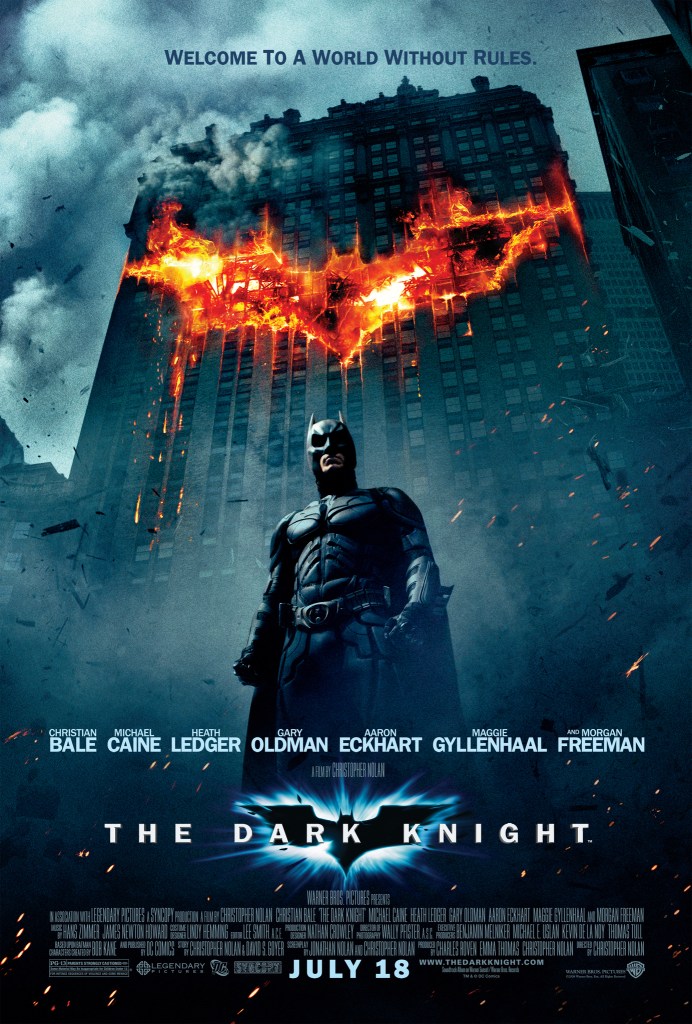
The Dark Knight is like The Beatles, or fish and chips. You may not watch it in a while, you go through phases and trends but when you come back to it, you’re reminded why it’s one of the best films ever made (yeah, no controversial opinions here yet). I’m rarely quite so gripped by a film, especially one that I’ve seen several times before, but this one has me on the edge of my seat pretty much the whole way through. Of course, this is a recurring trend with Christopher Nolan films. They all have at least one set piece or scene which, when it finishes, makes you realise that you can’t remember the least time you breathed. He really is a master of that, of that feeling of suspense and tension to the point where you can get utterly lost. However, unlike his other films, this feeling happens far more often. And that’s due to one key element; Heath Ledger’s performance as the Joker.
What better way to kick off by talking about the one part of the film that to me is absolutely perfect. It’s going to be hard to say something that hasn’t already been said, so what’s the point in trying? People enjoy greatest hits compilations for a reason, and why should you read fifty reviews when you could just read mine? Aside from the obvious superiority in quality that you’ll find in most other publications of course. Ledger absolutely dominates every time that he’s on screen, he’s dynamic and electrifying and is such a huge presence, not physically of course but his character drives the entire plot, and arguably the sequel too. When I watched this film again with my family, my mum was really unsettled by the character, in a way that I haven’t really seen before. Hyperbole is no fun to read though, trust me, so let’s get down to the real nitty gritty.
Physicality is a really underrated acting trait I think, something that I rarely see talked about. When it stands out, it really does, and the best comparison I have is when you watch Timothee Chalamet move on screen. He really inhabits the characters that he plays, and I really recommend you pay close attention to him in any one of his films. Back to Heath Ledger though (I just find it hard not to talk about sweet Timmy at the moment) and he absolutely becomes the Joker. Every movement he makes almost feels calculated, like you can see the cogs in his body turning as he works out how to make his next tiny motion, combining them all into something as simple as the way he stands, or holds a knife. You can tell so much about his character without even hearing him speak, from the way he moves his lips to the way he is standing in front of the Batman as he races towards him on the Bat-Bike. It really is something that’s so interesting to watch on-screen. Likewise, the way he uses his voice is similarly impressive. The range of his mannerisms and little voices that he does changes throughout, and the few moments that he bellows his lines are genuinely quite scary. The entirety of the recorded murder of the Batman impersonator is really chilling, and when he screams “look at me,” you can’t help but pay attention, as if he were doing that to someone on television in real life.
So much so is the quality of his performance, that it actually contributes to the biggest issue throughout the film – whenever he isn’t present. I’ve always thought that the moment that Batman strings up the Joker by his ankle is the moment that The Dark Knight loses its way, but I was wrong. Two-Face is an extension of the Joker, a creation of disorder from order and as such, his final act is that of the Joker too, even though Heath Ledger isn’t on screen. Therefore, the issue isn’t so much when he isn’t present physically on screen, but instead when his influence upon the film isn’t felt. These moments are rare, but disrupt the entire flow of the film. Mostly it refers to Bruce and Rachel’s relationship, one of the few carry-overs from the previous instalment and the only one that doesn’t really work. Of course, the Joker tears them apart, and Rachel reminds us what the Batman means to Bruce Wayne, but we already knew that. The entirety of their on-screen relationship in this film is devoted to that point, which means her death is ultimately the removal of a speed bump in the narrative. He cannot continue to be the caped crusader while she lives, so she must die. This doesn’t have the emotional impact that it wants to, which is a shame though. Once again, even though I’ve gone into details and tried to find the specifics, it really does come down to the fact that when the Joker is not there, the film suffers. It’s not as if Heath Ledger could always be on screen, I know that, but sometimes I wish that he was.
However, I can’t spend all day talking about this (well I could, but I won’t), so let’s move on. The context of this film is so important too. While I love the slight hamminess of Batman Begins, which was common in all of those early to mid-noughties superhero films, it’s clear to see how far the genre had come in that time. X2 was a leap above X-Men in a similar way, and was likewise a bigger critical and commercial success, but I feel like Nolan really showed off how dynamic the genre can be. I certainly don’t agree with all this re-labelling of various Marvel films (particularly Phase 2 ones as they were oh so formulaic) as being ‘political thrillers’ or ‘Shakespearean tragedies’, but this proved that they could be a level of seriousness and thoughtfulness beyond any that had been seen before. Indeed, it’s fun that Iron Man came out in the very same year because that was similar in its introspection, looking at the internal politics that the films creates and responding to them. They’re very different films, but they’re certainly two sides of the same coin, and I think they’re a response to the very cheesy and over the top nature of Sam Raimi’s Spider-Man films. It’s a shame that we’ve swung in quite dramatic directions since then, where superhero films either become bogged down in melodrama or become so afraid of being serious that they feel the need to crack a joke every time something sad happens, but what can you do.
When I talked about Batman Begins, I talked about how Batman was a far less interesting character than Bruce Wayne, but here he really comes into his own. If Begins was about Bruce finding himself, then this film is about Batman doing the same. It’s funny referring to them as two different characters but in the context of the film they’re completely different, as Bruce often points out that Batman is a symbol, that anyone could be the Batman, including Harvey Dent. I’m not sure if the man in the mask actually gets more screen time than the previous film but it certainly feels like it. Bruce’s story is far less important here. He’s returned to Gotham, turned his company around and is just living his best life really, at least until the woman he loves dies etc. Batman, however, has become the symbol of justice in the city but has to contend with the fact that if he truly is a symbol, then he does not need to exist. Indeed, by the end this symbol is desecrated and destroyed in order to uphold what he feels is a more important symbol, that of Harvey Dent.
This is completely isolated from all my other points, but I just wanted to talk about that ridiculous trial scene where Harvey punches the criminal in the face and then quips about how he should have bought American. I used to have this scene, but given my thoughts about how much I loved the hamminess of Batman Begins I’ve really come around on it. I also have my suspicions that it’s basically a little mocking of Americans by Nolan, like to me that’s exactly how I imagine American courts could be with the guns and the patriotism and everything rolling into one neat stereotypical package, which does make the scene even funnier to me. Was it meant to be? I don’t know, but I got a kick out of it for sure.
I spoke enough about how Gotham loses its identity compared to the previous film in my post about Batman Begins, but while I would like to reiterate that I find it disappointing, I see why Nolan wanted to create a much more clean and modern city, as we are supposed to be a few years into the streets being cleaned up and prosperity returning.
I know I spent nearly half of this talking about the Joker, but it’s just so hard not to. I think the film lives and dies with him, which is why it’s such an overall success. I know my opinion that it’s not the best in the trilogy is an uncommon one, but that’s not to take away from the movie at all because it’s just so good. Nolan likes his set pieces and this is full of brilliant scenes that just leave you unable to breathe, so much so that I left mentioning this point to the very end so I wouldn’t get carried away and spent three pages talking about each one of them in great depth. The opening is probably the best for me, and just sets the tone of the film. Overall it is an extraordinary success, the quality of which I don’t think we’ve seen since in since within the genre, but what an incredible peak it is.

 The Herbshank Blogdemption