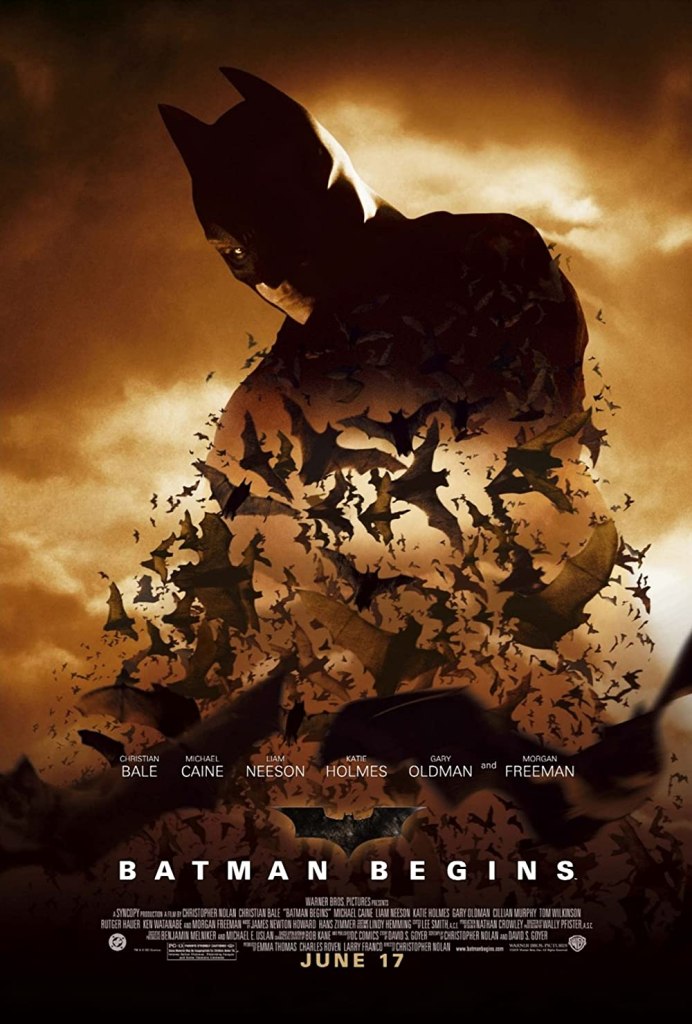
I’m going to open right off the bat (haha) and say that Batman Begins is my favourite of The Dark Knight Trilogy, and if you read on then you shall surely find out why. To give a little background info, I watched this last out of the trilogy, possibly because I didn’t even realise it was connected until reading about The Dark Knight Rises after watching that at the cinema. Batman Begins very much feels like the odd one out, for a number of reasons, including the fact that Rachel Dawes was later recast and that the feel of Gotham was completely different from the next two, mainly due to the fact that large parts of this film took place in the Narrows; the slums of the city essentially. It does set up pretty much all the thematic conflict for the entire trilogy, and I think being the odd one out really suits the narrative of the film.
I’ll start by talking about my favourite part of the film, and the thing that quite disappointingly didn’t really carry on into the next ones, the use of the city of Gotham. Gotham very much feels like its own character within the film and has a very strong identity. It was mostly shot in Chicago, with lots of exterior shots in other cities including London to give it a more universal feel, supposedly Christopher Nolan wanted Gotham to feel familiar but not too much so. Unlike the sequels, a lot of CGI and sets were used to help diversify the feel of the city, especially in the Narrows, which I mentioned before. Now of course there are reasons that this technique, for lack of a better word, isn’t used in the sequels; the Narrows are described as lost at the end of this film, and as the symbol of Batman works its magic, the city of Gotham becomes cleaner and more modern. It’s not like Batman is a wizard or anything, it’s just a very strong visual motif to symbolise the moving on from the chaos and darkness of the city in this film.
Honestly, more than anything I just love how timeless that Gotham feels. In some places it feels almost Victorian and very industrial, but we also have the modern cityscape too. I think the monorail is brilliant and I love how obvious a metaphor it is for the class divide and issues of Gotham, as we see how run down it becomes over the years and is essentially a symbol for the growing inaction of the wealthy. This strong visual identity is what separates it even more from the other two films in the trilogy. The themes all build on one another, but the Gotham we see in this instalment is very much its own unique take on the city, and one that I wish stayed with us in the sequels even though I understand the thematic reasons as to why it couldn’t.
Another strong visual choice that is not just unique to this film, but occurs throughout Nolan’s filmography, is the use of very quick cuts. I noticed this a lot when I was watching Tenet recently, that scenes and dialogue rarely have a lot of room to breathe as Nolan often cuts away as soon as the last word of dialogue has finished. It adds a lot to the pacing of the films, and this one especially feels like it covers a lot of ground in a very short space of time. Bruce Wayne’s time with the League of Shadows benefits especially from this, as like with the use of Gotham, the quick cuts and chaos tie in well with both the League’s ethos and ninja-like nature. The fight between Bruce and Henri Ducard on the ice is particularly memorable to me, with the dialogue fizzing between them as they fight and we see each of them lose and gain the upper hand. That’s not to say that every single scene is cut as soon as the character finishes speaking, but it happens a lot and is used well when it does.
While we’re on the topic of technique tying in with theme, the use of Ra’s al Ghul is brilliant and there’s a reason that his impact is felt, both literally and metaphorically, throughout the trilogy. Maybe I’m giving the director too much credit, but I feel like he’s playing on the well-worn trope of ‘old oriental man is incredibly wise and worldly’ with the decoy of Ra’s appearing to lead the League while Bruce is training, only for it to be revealed later than Liam Neeson’s character is the real Ra’s. The constant use of deception and theatricality is drilled into us throughout the beginning of the film, and this just serves to drive home the message. The plan to destroy Gotham makes sense and is given extra weight when it is revealed what else the League of Shadows has achieved.
Scarecrow was a fantastic secondary villain too, and one who I’m very pleased appeared in every single film, even if they’re only really cameo appearances. He just reminds us that Gotham is still a mess, that chaos continues to live beneath the surface and, as a result of this, constantly reminds us what Ra’s al Ghul was capable of. Too often in these sorts of films we end up with a very bland and basic introductory antagonist, only to give us one who is actually a threat later, but all three of these films have an appropriate enemy for the Batman. I like the reflection and contrast to the Batman – they are both masked, anonymous, and in a way they both represent fear, but they use this tool in very different ways. Where Batman is holding up a mirror to society, Scarecrow revels in it, wallowing in the filth and chaos that he creates. They aren’t so different, really, but it does show how power can be used in different ways.
Speaking of the Batman, let’s talk about Christian Bale. I think he does a very serviceable job as the caped crusader, but where he really shines is as Bruce Wayne. He really portrays that sort of smarmy, self-obsessed rich man very well but luckily he does less horrible things than in his star turn in American Psycho. I feel bad because his Batman really isn’t anything too memorable in this film, and it’s one of Nolan’s few flaws that he really does struggle with compelling characters outside of the lead, and to me the lead here is Bruce Wayne. Bruce has a lot of depth in this film, we get a very good sense of his character early on and when he eventually becomes Batman to protect the city, it’s not a surprise (I mean obviously we knew that because duh, but it feels very true to character which is what I’m trying to get at). I like Rachel too in this film, though she doesn’t really have much to do which is a shame.
I also LOVE the treatment of Mr. and Mrs. Wayne in the film, they’re revered almost to the point of deification by Bruce and even though we all know the story of Bruce Wayne the orphan, we really feel the impact of their deaths. We see their influence all through the film with the so-symbolic-it-basically-punches-you-in-the-face monorail, which I mentioned earlier. We see Bruce’s father talk about how he built the train for everyone in the city to use, a cheap transport system to unite the public. The fact we see him using it makes him a true man of the people, someone who leaves his ivory castle and really belongs in Gotham. Later in the film we see Rachel riding it. It’s dark and grimy, covered in graffiti, the film is basically slapping you in the face at this point but subtlety is a hard thing to do in superhero films, for seldom found in superhero films, or Nolan films for that matter. The ghosts of his parents, especially his father, are present throughout the story and it’s only by confronting the idea of them, the idea that’s been allowed to die in Gotham, that Bruce can start to truly rebuild their legacy. They were the face, but Batman is the symbol.
Having said all this, I think one of the most fun scenes in the film is also the most superhero-y. This is the fight in the docks, Batman’s first night on the town. It’s dramatic and spooky and fun and over the top and the bit where Batman grabs Falcone by the collar and says, “I’m Batman,” before headbutting him is so comic book it’s brilliant. It’s just ridiculous and really helps balance the tone of the film, where you remember that yes, while this is a serious film, it’s also a superhero film. I also love when Batman first uses the Tumbler in the streets, where it pretty much growls and feels so ferocious. It’s another scene that’s just so much fun that you can’t really dislike it.
There’s a lot more I could say about this film but I don’t want it to feel like a recap, or too long, so I thought it would be nice to highlight mostly the smaller things that I like about the film. There’s a lot to love about it and it’s definitely my favourite of the three, even more so than The Dark Knight. I think that TDK is technically the better film, but I love films that do something a bit different even if it doesn’t always come off, and this film is really ambitious so I can forgive any small flaws a lot more easily than something that plays it safe. The best comparison I have is The Great British Bake Off, where Paul and Mary/Prue always say that if something is basic it has to be absolutely perfect, but if it’s more ambitious then they can forgive a couple of mistakes due to the technical skills required. Bet you never thought you’d see a Batman film discussion end with a comparison to a baking programme, did you?

 The Herbshank Blogdemption