*There are spoilers throughout this discussion, so please don’t read unless you’ve already seen the film or aren’t bothered by such things*
I remember going to watch Moana at the cinema with a friend when it came out all the way back in 2016 and I was absolutely mesmerised from pretty much the first minute (and even before that really, with the preceding short film ‘Inner Workings’ being a really sweet and charming little appetiser). I find Polynesian culture really interesting, though I’m far from an expert on the subject, so seeing a mainstream film pay tribute to that part of the world was such a nice thing to see.
I’ll start us off by saying that this film has two of the most beautiful scenes in them that Disney have ever made in my book, both thematically and aesthetically. The first is one of the first scenes in the film, with the little Moana running off to the shore by herself, which is where she is gifted the heart of Te Fiti by the ocean.
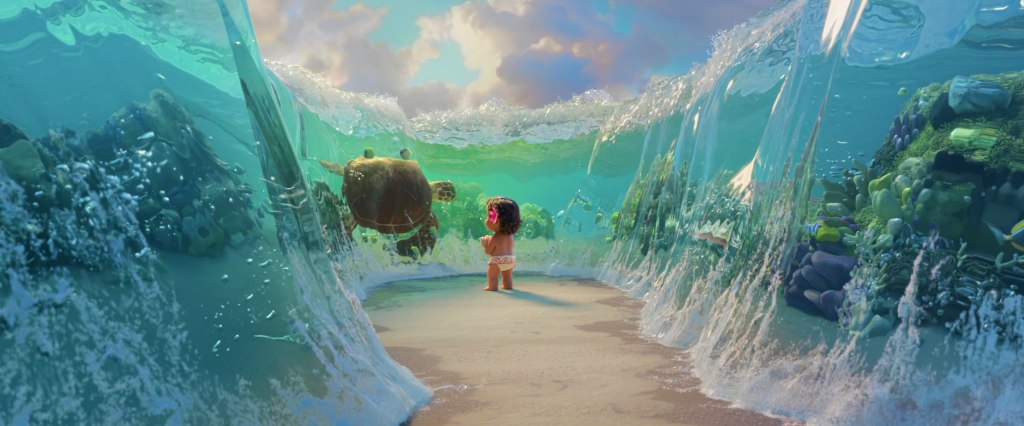
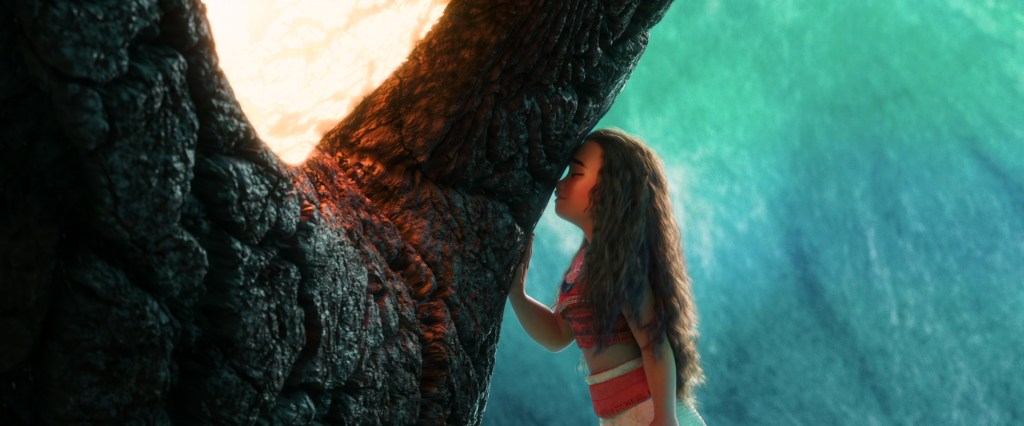
We get a good sense of her character here as well – defying her parents in order to go to the beach, while saving a vulnerable baby turtle in the process. Moana is at once rebellious and kind, though she never puts herself first. Even when she leaves the island of Motonui in secret, she does so to save her people. I think she wants to prove something to herself in the process, but her ultimate goal is to help her island. That part when she’s stepping through the parted sea is so beautiful too, it’s such a gorgeous piece of animation and I like how we see her doing this early on to claim the heart, and at the end of the film she parts the sea again in order to give the heart back to Te Fiti as she recognises that she and Te Kā are the same being. I always get goosebumps when she returns the heart to Te Fiti and shares a moment of kindred understanding with her as she returns to her true form.
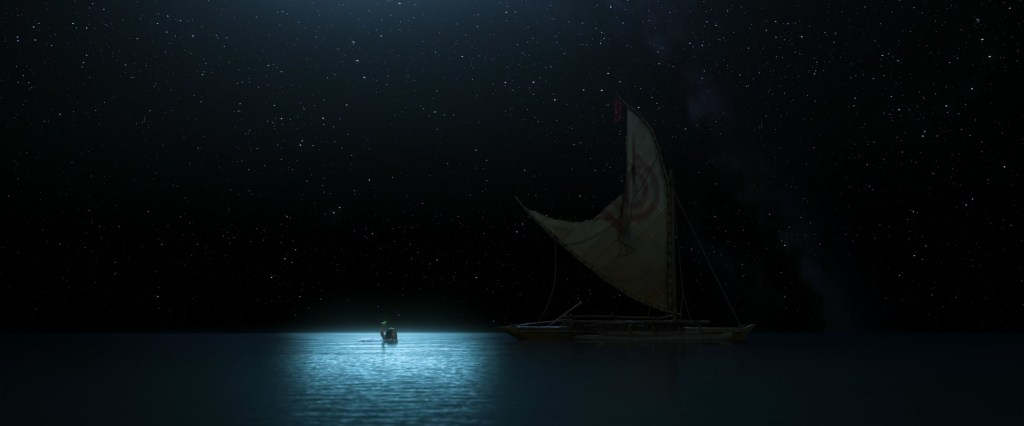
The other scene that stands out to me is when Maui leaves her and she feels that she is not able to do the task that has been given to her, and the beauty and silence of the ocean at night time is stunning, broken only by Moana’s lack of faith in herself. The vision of her voyager ancestors, as well as her grandmother, is up there with the very best of the emotional Disney scenes – and it really is in illustrious company. While ‘How Far I Go’ receives the majority of the plaudits, I really do think that ‘I Am Moana (Song of the Ancestors)’ is a much stronger song in the film from an emotional standpoint, as Moana is at her lowest point in the film and finds her strength again with the help of her grandma and ancestors. The shot where she emerges from the ocean after finding the heart again contrasts nicely with how alone she was after Maui left her, but this time we know that she can achieve her goal.
I’ve really been enjoying the little trend of subversion that’s been going on in Disney films since the return of the ‘classic’ princess stories with The Princess and the Frog in 2009. Since then, there’s been a real shift in the role of the female protagonist, one that is very much continued in Moana. She has so much freedom and self-expression, from the point where we see her as a toddler at the beginning of the film. Here, she stands out from the other children and enjoys her grandma’s stories, rather than being scared by them. Likewise, when she wanders out to the shore by herself and is gifted the heart of Te Fiti by the ocean, you can see why she was chosen. From the first minutes of the film, she is unique, and I think the parallel that she shares with Maui here is also interesting. The beginning of the film sees him steal the heart, whereas she is gifted it. What happen in-between these two events is only revealed later on, but we get a good sense of both characters’, well, character. I also laugh looking back at how the film was setting up that little piglet to be the cute animal companion, only for it to be Heihei the chicken, who is one of the funniest parts of the film.
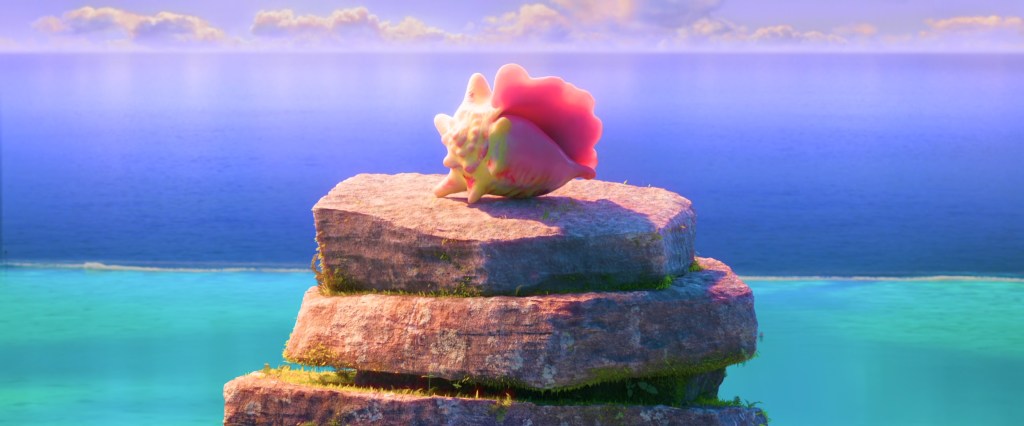
The visual imagery in this film is incredibly strong throughout, featuring so many details and self-references that it’s almost hard to keep up at times. You can see Tamatoa and the Kakamora represented in the art and tapestries in the opening of the film long before they actually appear, and some of the unnamed sea monsters bare a resemblance to the ones we glimpse in Lalotai. The thing I love most about this is in one of the closing shots of the film. From the beginning we see Moana obsessed with the ocean, and when she wanders to the beach as a toddler she is fixated on the large, conch-like shells, trying to pick up all of them. At the end of the film, on the tower of stones that represent each chief of Motonui, Moana leaves one of those shells at the top of the pile. There is no need for such tradition when the islanders are now voyaging again, seeking out new lands. There will never be another chief of the island, because that is not how their people work anymore. They are forming and forging new traditions, and I love how we can infer all of this from the shell at the highest point of the island.
The heart of this film is not that of Te Fiti however, but instead the friendship between Moana and Maui. There individual and shared journey throughout the run time is really beautiful to watch as they start to learn about each other and why they’re both going on this journey together. Maui craves attention and adoration due to his abandonment by his parents, whereas Moana is accepted and loved by her parents but has to cover up her true love for the sea. You can see a mutual respect develop throughout the film as they go through their various trials to take the heart back to Te Fiti, but Moana’s need to prove herself almost costs them their chance at doing so. Maui is more concerned with keeping his fish hook and his powers and leaves, showing that both characters have not yet completed their journey, physically and spiritually. It is only when they reunite, and Maui renounces his fish hook and thereby his selfishness, that they succeed in their mission. These two characters work so well together and the voice acting by Auliʻi Cravalho and Dwayne Johnson really cements that too, they bounce off each other excellently and I’m impressed by the range shown by both of them.
My only real criticism, and it’s not even necessarily a criticism but more of a personal preference, is the inconsistency of the score and music. All of the songs they’ve created are fantastic, to the point where I can’t really pick favourite as they all have their place within the film. Even ‘Shiny’, which sort of comes out of nowhere, feels very appropriate for the character of Tamatoa, and I believe Jermaine Clement (who voices the crab) had a big role in the writing of the song. For the songs like this, the writing duties were split between Lin Manuel Miranda and Opetaia Foa’I, and this combo of a more traditional theatre musician and Oceanic musician is a really nice blend throughout the film, as we end up with songs like ‘Shiny’ and ‘You’re Welcome’, as well as ‘Logo Te Pate’ and ‘I Am Moana’. However, what I don’t like is the orchestral flourishes that appear throughout the score. These are very much a feature of the Disney animated films, usually featuring little samples and reprises of the songs performed in the film, but given the setting and style of the film, a lot of it doesn’t really fit in. That’s not to say it’s not a nice score, Mark Mancina does a good job with the composition, it’s just not quite right for the film, and it’s a shame that Foa’I only has music credits on five of the twenty-six songs on the score after her role in the writing of the songs.
I won’t go into too much detail about the accuracy and authenticity of the film, partly because I don’t know enough about Polynesian culture to comment and partly because I think artistic liberty is always a factor to take into account – if the film makers were trying to keep things one hundred percent accurate, they would have made a documentary. I do enjoy the way the internal legends and myths are presented however, which to me pay tribute to the oral tradition of storytelling. The beginning of the film, with Grandma Tala going over the theft of the heart of Te Fiti, is an example of that. The way that she presents Te Fiti and Te Kā as two separate beings, only for them to turn out to be the same goddess, with the latter being a corrupted, heartless version of the former, feels very much like a nod to that era, and a technique that would have been common at the time. Likewise, the mere mention of Lalotai strikes fear into Moana, showing that she knows of this place. Even when she’s trying to flatter Tamatoa she makes references to legends that she has heard of the giant crab – it feels like the practise of oral tradition is sprinkled throughout the story, and the twisting and mishearing of such tales is also present. The closing song even has the line ‘we tell the stories of our elders in a never-ending chain’, which is a nice note to end the film on.
I ended up getting a little carried away here and wrote more than I intended to, I think I was just excited for the first proper post on my blog, but I hope you enjoyed it all the same. Moana is probably my favourite Disney film (up there with The Lion King and Frozen 2, which I’ll be posting about in the near future), I think it’s such a beautiful story of empowerment and inner strength. The songs are among the best in the Disney catalogue, a big part of that being how well they all fit within the narrative, nothing feels excessive or shoe-horned in. I absolutely love the story, the humour fits in well and balances with the more serious themes throughout. Ultimately, the film rests on the friendship of Moana and Maui, and that is why it is such a resounding success in my book.

 The Herbshank Blogdemption